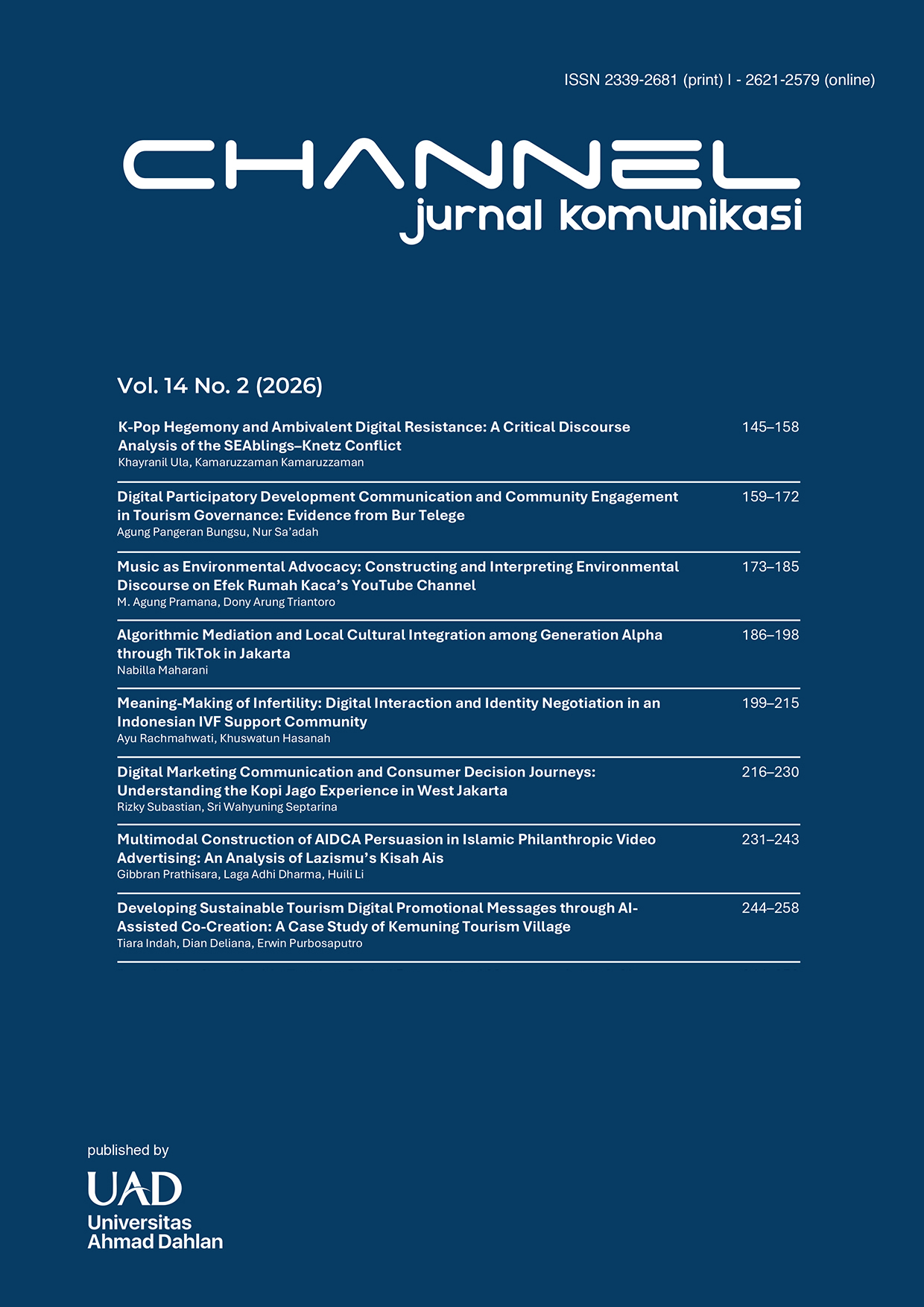
Multimodal Construction of AIDCA Persuasion in Islamic Philanthropic Video Advertising: An Analysis of Lazismu’s Kisah Ais
DOI:
https://doi.org/10.12928/channel.v14i2.2353Keywords:
AIDCA, Advertising, Islamic philanthropy, Dakwah communications, Multimodal analysisAbstract
Islamic philanthropic institutions increasingly rely on audiovisual persuasion to mobilize charitable giving, yet the semiotic architecture of their video advertising remains underexplored. This study examines how the AIDCA persuasion model, which comprises Attention, Interest, Desire, Conviction, and Action, is operationalized through multimodal resources in Lazismu’s philanthropic video advertisement Kisah Ais. Using a qualitative descriptive-interpretive design grounded in multimodal discourse analysis, the study subjected a single purposively selected video to systematic scene-by-scene analysis with a deductively constructed AIDCA codebook that mapped visual, auditory, narrative, and cinematic resources onto the five persuasion stages. The findings show that all five stages are fully and sequentially realized across nine analytically distinct scenes. Attention is achieved through a non-chronological narrative hook, Interest through purely visual contextualization of hardship, and Desire through accumulated domestic vignettes and a prosocial child action. Conviction is built through two distinctive mechanisms: direct verbal testimony at the Desire-to-Conviction boundary and a television-within-film validation device. Action is delivered through an integrated institutional call to action. The study offers a preliminary, case-based elaboration of AIDCA for analyzing digital dakwah advertising, with tentative design implications for Islamic philanthropic communication that require further testing across a broader corpus.
References
Bak, S., Yeu, M., Min, D., Lee, J., & Jeong, J. (2024). Charitable crowdfunding donation-intention estimation depending on emotional project images using fNIRS-based functional connectivity. PLOS ONE, 19(5), e0303144. https://doi.org/10.1371/journal.pone.0303144
Barry, T. E. (1987). The Development of the Hierarchy of Effects: An Historical Perspective. Current Issues and Research in Advertising, 10(1–2), 251–295. https://doi.org/10.1080/01633392.1987.10504921
Bateman, J. A., & Tseng, C. I. (2023). Multimodal discourse analysis as a method for revealing narrative strategies in news videos. Multimodal Communication, 12(3), 261–285. https://doi.org/10.1515/mc-2023-0029
Bin-Nashwan, S. A., Shah, M. H., Abdul-Jabbar, H., & Al-Ttaffi, L. H. A. (2023). Social-related factors in integrated UTAUT model for ZakaTech acceptance during the COVID-19 crisis. Journal of Islamic Accounting and Business Research, 14(8), 1383–1403. https://doi.org/10.1108/JIABR-02-2022-0038
Campbell, S., Greenwood, M., Prior, S., Shearer, T., Walkem, K., Young, S., … Walker, K. (2020). Purposive sampling: complex or simple? Research case examples. Journal of Research in Nursing, 25(8), 652–661. https://doi.org/10.1177/1744987120927206
Du, Y., Yang, Y., Li, Z., & Xue, J. (2025). Beyond Affordances: Understanding the Holistic Influence of Multimodal Medical Crowdfunding Affordances on Charitable Crowdfunding Outcome (Preprint). JMIR Medical Informatics. https://doi.org/10.2196/75563
Fadhli, A., Fahzaria, N. A., Indrawati, I. N., Dewi, I. N. I., & Ridzki, M. Z. (2025). Dialogic Engagement and Institutional Trust: A Netnographic Study of @halal.indonesia on Instagram as a Government Communication Platform. CHANNEL: Jurnal Komunikasi, 13(1), 1–16. https://doi.org/10.12928/channel.v13i1.956
Goenka, S., & van Osselaer, S. M. J. (2019). Charities Can Increase the Effectiveness of Donation Appeals by Using a Morally Congruent Positive Emotion. Journal of Consumer Research, 46(4), 774–790. https://doi.org/10.1093/jcr/ucz012
Hamdani, L., Sunarsih, S., Yusfiarto, R., Rizal, A., & Khoirunnisa, A. N. (2024). Social media, trust and intention to pay zakat through institution: lessons from Indonesian experience. Journal of Islamic Marketing, 15(9), 2399–2418. https://doi.org/10.1108/JIMA-01-2023-0016
Haq, R. A., & Yahdini, A. T. (2024). Objectification and the Male Gaze: A Semiotic Analysis of Women’s Representation in Tyla’s Music Video Water. CHANNEL: Jurnal Komunikasi, 12(2), 207–216. https://doi.org/10.12928/channel.v12i2.1032
Hudaefi, F. A., & Beik, I. S. (2021). Digital zakāh campaign in time of Covid-19 pandemic in Indonesia: a netnographic study. Journal of Islamic Marketing, 12(3), 498–517. https://doi.org/10.1108/JIMA-09-2020-0299
Iwamoto, A. (2023). The origin of AIDA: Who invented and formulated the AIDA model?. Proceedings of the Biennial Conference on Historical Analysis and Research in Marketing (CHARM). Vol. 21. https://ojs.library.carleton.ca/index.php/pcharm/article/view/4340
Kaczorowska, K., Conduit, J., & Goodman, S. (2025). Evoking Altruistic Behaviours: The Effects of Storytelling in Different Narrative Modes. Australasian Marketing Journal. https://doi.org/10.1177/14413582251389231
Kang, I., Leliveld, M. C., & Ferraro, R. (2022). The impact of facial emotional expression on the effectiveness of charitable advertisements: the role of sympathy and manipulative intent. Journal of Behavioral Decision Making, 35(5). https://doi.org/10.1002/bdm.2281
Kress, G., & van Leeuwen, T. (2020). Reading Images: The Grammar of Visual Design (3rd ed.). Routledge.
Lee, Y.-I., & Trim, P. R. J. (2022). Enhancing Marketing Provision through Increased Online Safety That Imbues Consumer Confidence: Coupling AI and ML with the AIDA Model. Big Data and Cognitive Computing, 6(3), 78. https://doi.org/10.3390/bdcc6030078
Liu, H., Liu, L., & Li, H. (2024). Multimodal Discourse Studies in the International Academic Community (1997–2023): A Bibliometric Analysis. Sage Open, 14(4). https://doi.org/10.1177/21582440241305454
O’Connor, C., & Joffe, H. (2020). Intercoder Reliability in Qualitative Research: Debates and Practical Guidelines. International Journal of Qualitative Methods, 19. https://doi.org/10.1177/1609406919899220
Roberts, K., Dowell, A., & Nie, J.-B. (2019). Attempting rigour and replicability in thematic analysis of qualitative research data; a case study of codebook development. BMC Medical Research Methodology, 19(1), 66. https://doi.org/10.1186/s12874-019-0707-y
Rochman, F., Waris, S. A., Santoso, E. B., & Ulya, I. (2024). Analysis on the AIDCA Method in Website UX Design Copywriting. International Journal of Social Science and Community Service, 2(4), 298–311. https://doi.org/10.70865/ijsscs.v2i4.52
Saldaña, J. (2021). Coding Manual For Qualitative Researchers (4th ed.). Sage Publication.
Sandoval, P. S., & García‐Madariaga, J. (2024). Impact of emotional appeal on non‐profit advertising: A neurophysiological analysis. Journal of Consumer Behaviour, 23(1), 203–217. https://doi.org/10.1002/cb.2168
Sikumbang, A. T., Dalimunthe, M. A., Kholil, S., & Nasution, N. F. (2023). Digital Da’wah Indonesia Ulema in the Discourse of Theology. Pharos Journal of Theology, 105(1). https://doi.org/10.46222/pharosjot.1051
Sommer, V. (2021). Multimodal Analysis in Qualitative Research: Extending Grounded Theory Through the Lens of Social Semiotics. Qualitative Inquiry, 27(8–9), 1102–1113. https://doi.org/10.1177/1077800420978746
Song, H., Ruan, W. J., & Jeon, Y. J. J. (2021). An integrated approach to the purchase decision making process of food-delivery apps: Focusing on the TAM and AIDA models. International Journal of Hospitality Management, 95, 102943. https://doi.org/10.1016/j.ijhm.2021.102943
Strong, E. K. (1925). The psychology of selling and advertising (1st ed.). New York: McGraw-Hill.
Tan, S. Z., Yang, L., Loo, W. H., & Chalke, A. (2026). Stories that matter: the effects of narrative transportation and influencer-message congruity on prosocial behavior. Journal of Business Research, 208, 116051. https://doi.org/10.1016/j.jbusres.2026.116051
Thomas, V. L., & Grigsby, J. L. (2024). Narrative transportation: A systematic literature review and future research agenda. Psychology & Marketing, 41(8), 1805–1819. https://doi.org/10.1002/mar.22011
Traichok, S., Kubota, S., Morioka, M., & Sembokuya, Y. (2024). Applying the AIDA and AIDCA models to destination cities in Hokkaido to improve their images and strategies. Japanese Journal of Agricultural Economics, 26, 66–71. https://doi.org/10.18480/jjae.26.0_66
van Laer, T., de Ruyter, K., Visconti, L. M., & Wetzels, M. (2014). The Extended Transportation-Imagery Model: A Meta-Analysis of the Antecedents and Consequences of Consumers’ Narrative Transportation. Journal of Consumer Research, 40(5), 797–817. https://doi.org/10.1086/673383
Winkler, J. R., Appel, M., Schmidt, M.-L. C. R., & Richter, T. (2023). The Experience of Emotional Shifts in Narrative Persuasion. Media Psychology, 26(2), 141–171. https://doi.org/10.1080/15213269.2022.2103711
Xing, C., & Feng, D. (William). (2023). Multimodal intertextuality and persuasion in advertising discourse. Discourse & Communication, 17(5), 613–629. https://doi.org/10.1177/17504813231170579
Yousef, M., Dietrich, T., Rundle‐Thiele, S., & Alhabash, S. (2022). Emotional appeals effectiveness in enhancing charity digital advertisements. Journal of Philanthropy and Marketing, 27(4). https://doi.org/10.1002/nvsm.1763
Downloads
Published
Issue
Section
License
Copyright (c) 2026 CHANNEL: Jurnal Komunikasi

This work is licensed under a Creative Commons Attribution-ShareAlike 4.0 International License.