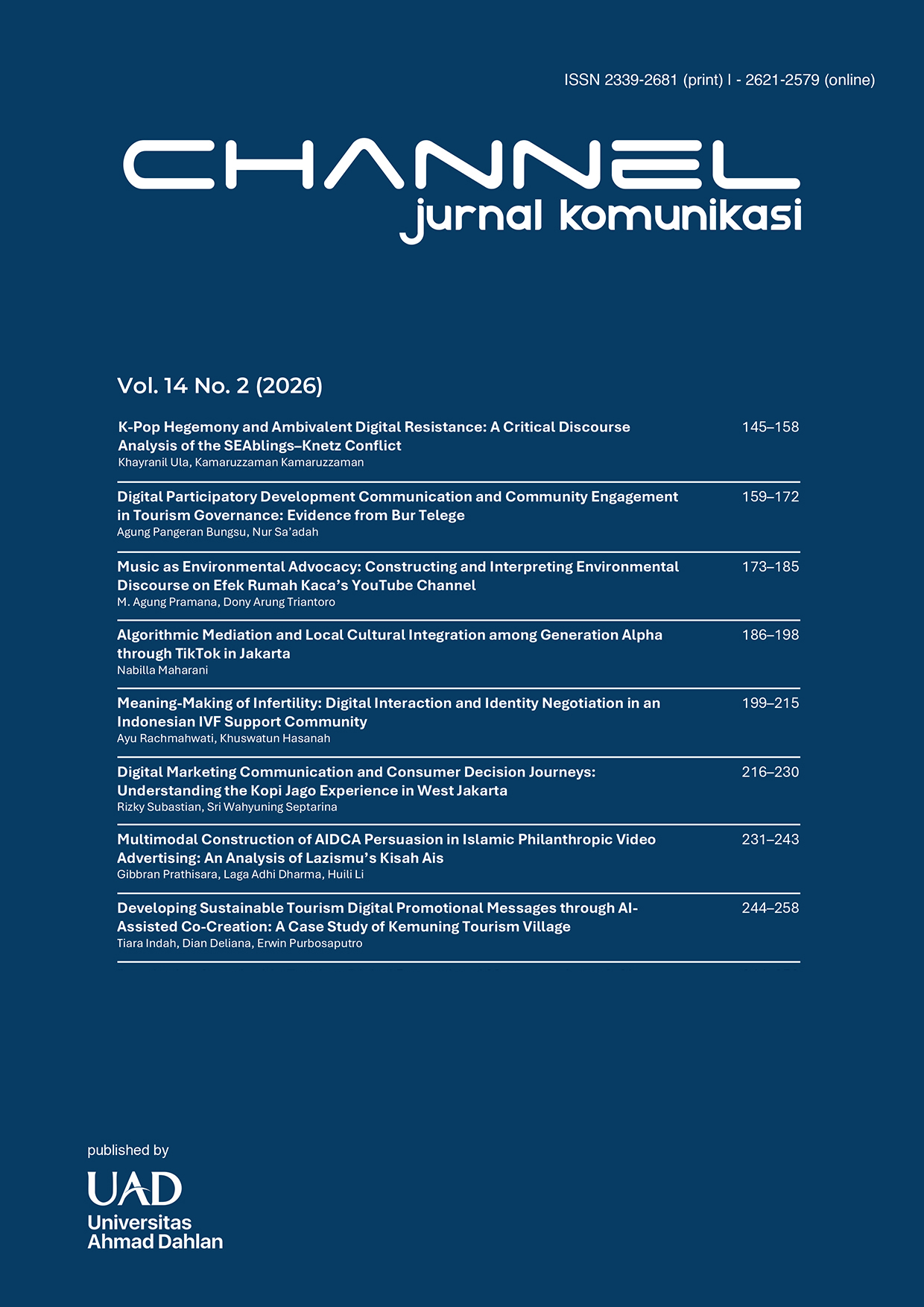
K-Pop Hegemony and Ambivalent Digital Resistance: A Critical Discourse Analysis of the SEAblings–Knetz Conflict
DOI:
https://doi.org/10.12928/channel.v14i2.2205Keywords:
K-Pop hegemony, Digital resistance, Critical Discourse Analysis, Digital racism, SEAblingsAbstract
Cultural hegemony and digital resistance intersect in the 2026 SEAblings–Knetz conflict, a transnational online dispute between Southeast Asian and South Korean netizens concerning racism, cultural superiority, and K-Pop fandom. Drawing on Gramsci’s theory of hegemony, Bourdieu’s concept of symbolic violence, and Fairclough’s Critical Discourse Analysis (CDA), this study examines how K-Pop operates as both global popular culture and a mechanism of symbolic domination in digital communication. Using a qualitative approach, the study analyzes comments, hashtags, viral posts, and memes circulated on X, TikTok, and Instagram between January and March 2026. The findings reveal that social media platforms function as contested discursive arenas where engagement-driven circulation amplifies racial stereotypes, conflict narratives, and nationalist sentiment. Racist discourse targeting Southeast Asian netizens reflects asymmetrical power relations associated with the global dominance of Korean popular culture. In response, SEAblings mobilized digital solidarity, counter-discourses, boycott campaigns, and platform-based activism. However, this resistance remains ambivalent, as some counter-discourses reproduce the stereotyping and symbolic violence they challenge. Theoretically, this study extends CDA-based research on cultural hegemony by demonstrating how domination and resistance coexist within digital discourse, challenging binary understandings of online activism. Practically, the findings highlight the importance of platform moderation, media literacy, and ethically reflexive fandom practices in addressing symbolic violence within transnational fan communities.
References
Agustin, S. M., & Sepang, N. R. (2026). Gramsci dan Komunikasi: Hegemoni Budaya dan Peran Intelektual dalam Kajian Media. In Komunikasi dan Kebudayaan di Era Akal Imitasi: Identitas, Kreativitas, dan Keberlanjutan. Gramedia Pustaka Utama.
Akter, S., & Shorna, S. A. (2025). K-Pop as Cultural Hybrid: Mimicry, Identity, and Global Power in Gangnam Style and APT. Waiguo Yuyan Yu Wenhua, 9(4), 769–781. https://www.waiguoyuyanyuwenhua.com/article/k-pop-as-cultural-hybrid-mimicry-identity-and-global-power-in-gangnam-style-and-apt
Alves de Oliveira, C. V. (2025). The Hallyu Wave as a Strategic Soft Power Tool: South Korea’s Cultural Diplomacy in the 21st Century. Em SciELO Preprints. https://doi.org/10.1590/SciELOPreprints.12388
Amali, M. T., & Putri, L. C. (2024). McDxNewJeans collaborative campaign: How Co-Branding impacts fandom purchase behavior. COMMICAST, 5(3), 51–70. https://doi.org/10.12928/commicast.v5i3.11719
Balraj, B. M., & Abd Manan, M. H. bt. (2022). The Conception of Soft Power in Korean’s Popular Culture. International Journal of Academic Research in Business and Social Sciences, 12(9), 1–6. https://doi.org/10.6007/IJARBSS/v12-i9/14387
Binokular. (2026). SEAblings: A Unique Show of Southeast Asian Netizen Solidarity. Binokular. https://binokular.net/en/2026/02/20/seablings-a-unique-show-of-southeast-asian-netizen-solidarity/
Bourdieu, P. (2018). Distinction: A Social Critique of the Judgement of Taste*. In Food and Culture (pp. 141–150). Routledge. https://doi.org/10.4324/9781315680347-10
Chua, P. (2017). Cultural Racism. In The Wiley‐Blackwell Encyclopedia of Social Theory (pp. 1–3). Wiley. https://doi.org/10.1002/9781118430873.est0079
Dasom, L. (2023). No. of K-pop On-Demand Streams Grows 42% Led by Japan. Korea.Net. http://www.korea.net/NewsFocus/Culture/view?articleId=240892
Davies, J. S. (2025). Gramscian considerations on the contentious politics of austere neoliberalism: critical junctures after the global economic crisis. Social Movement Studies, 24(4), 436–453. https://doi.org/10.1080/14742837.2023.2268016
Dezhboro, A., Ramirez-Marquez, J. E., & Krstikj, A. (2026). Community Shaping in the Digital Age: A Risk-Focused Temporal Fusion Framework for Analyzing Information Diffusion and Fragmentation in Online Social Networks. Risk Analysis, 46(4). https://doi.org/10.1111/risa.70214
Dirgantari, T. S., Intyaswati, D., & Amartiwi, U. (2025). Public Voices and Cyber Controversy: A Critical Discourse Analysis of the #Bjorka Trending Topic on Twitter (X). CHANNEL: Jurnal Komunikasi, 13(2), 188–198. https://doi.org/10.12928/channel.v13i2.1317
Fairclough, N. (2001). Language and Power. Routledge. https://doi.org/10.4324/9781315838250
Fatikh, M. A. (2025). Dinamika Komunikasi Lintas Budaya: Menogosiasikan Identitas di Ruang Digital. Al-Mada: Jurnal Agama, Sosial, Dan Budaya, 8(1), 142–157. https://doi.org/10.31538/almada.v8i1.9892
Fatmawati, N. I., & Sholikin, A. (2020). Pierre Bourdieu dan Konsep Dasar Kekerasan Simbolik. Madani: Jurnal Politik Dan Sosial Kemasyarakatan, 12(1), 41–60. https://doi.org/10.52166/madani.v12i1.3280
Femia, J. V. (1987). Gramsci’s Political Thought. Oxford University Press. https://doi.org/10.1093/acprof:oso/9780198275435.001.0001
Gongane, V. U., Munot, M. V., & Anuse, A. D. (2022). Detection and moderation of detrimental content on social media platforms: current status and future directions. Social Network Analysis and Mining, 12(1), 129. https://doi.org/10.1007/s13278-022-00951-3
Guo, W. (2025). Conflict resolution in intercultural communication: strategies for managing cultural conflicts. Humanities and Social Sciences Communications, 12(1), 73. https://doi.org/10.1057/s41599-025-04391-0
Jin, D. Y. (2024). The rise of digital platforms as a soft power apparatus in the New Korean Wave era. Communication and the Public, 9(2), 161–177. https://doi.org/10.1177/20570473241234204
Lee Jung-youn. (2025). Overseas, image most associated with Korea is still K-pop: survey. Koreaherald. https://www.koreaherald.com/article/10459701
Maqsood, A., Sumera, B., & Zaffer, N. (2022). Consumption Patterns of South Korean Content: Cross-Cultural Acceptance of Romance and Beauty among Pakistani Youth. Journal of Policy Research, 8(3), 329–338. https://doi.org/10.5281/zenodo.7297132
Matamoros-Fernández, A., & Farkas, J. (2021). Racism, Hate Speech, and Social Media: A Systematic Review and Critique. Television and New Media, 22(2), 205–224. https://doi.org/10.1177/1527476420982230
Mayani, F., Wulan, N., & Puryanti, L. (2025). Idols, Ideals, and Identity: K-Pop and Indonesian Girls’ Self-Perception. IKAT: The Indonesian Journal of Southeast Asian Studies, 7(2), 98. https://doi.org/10.22146/ikat.v7i2.109923
Metzler, H., & Garcia, D. (2024). Social Drivers and Algorithmic Mechanisms on Digital Media. Perspectives on Psychological Science, 19(5), 735–748. https://doi.org/10.1177/17456916231185057
Oh, D. C. (2024). Theorizing Cultural Appropriation: Complications of Globalization and Power in Hybrid K-Pop. Situations, 17(1), 25–50. https://doi.org/10.22958/situcs.2024.17.1.002
Pane, D. E. S. (2025). Hegemoni Budaya K-Pop dan Dinamika Cultural Hybridization. Jurnal Hubungan Internasional, 18(2), 555–570. https://doi.org/10.20473/jhi.v18i2.81856
Perera, S., Meedin, N., Caldera, M., Perera, I., & Ahangama, S. (2023). A comparative study of the characteristics of hate speech propagators and their behaviours over Twitter social media platform. Heliyon, 9(8), e19097. https://doi.org/10.1016/j.heliyon.2023.e19097
Putra, B. A. (2024). Digital activism in Southeast Asia: the #MilkTeaAlliance and prospects for social resistance. Frontiers in Sociology, 9, 1478630. https://doi.org/10.3389/fsoc.2024.1478630
Putri, P. Y., & Purwadi. (2025). Representations of Korean Dramas in Indonesian Audience Discourse: A Topic Modeling Analysis of YouTube Comments. INJECT (Interdisciplinary Journal of Communication), 10(1), 989–1010. https://doi.org/10.18326/inject.v10i1.4525
Raihani, V., & Kurnia, N. (2025). Fan Labour in Closed Online Spaces: Admin Practices and Dynamics in the Enhypen WhatsApp Fandom. CHANNEL: Jurnal Komunikasi, 13(2), 152–166. https://doi.org/10.12928/channel.v13i2.1440
Rizal, M. S. (2025). Komunikasi Lintas Budaya di Era Digital sebagai Strategi Mengurangi Stereotip terhadap Masyarakat Madura. TUTURAN: Jurnal Ilmu Komunikasi, Sosial Dan Humaniora, 3(2), 136–149. https://doi.org/10.47861/tuturan.v3i2.1808
Sau, A. (2025). Hegemony and crisis: An analysis of habit and ideology as mechanisms for achieving ‘consent.’ Capital & Class, 49(1), 101–121. https://doi.org/10.1177/03098168241268031
Shafie, T. (2025). K-pop Idols as Diplomats: South Korean Celebrities and Soft Power. Athens Journal of Politics & International Affairs, 1(3), 179–202. https://doi.org/10.30958/ajpia.1-3-1
Shahin, S., & Hou, M. (2025). #StopAsianHate as Hashtag Activism: Provocateurs, Celebrities, and Fan Practices of Collective Action Against Racism. Social Media + Society, 11(1), 20563051241309700. https://doi.org/10.1177/20563051241309701
Shimauchi, S. (2024). Fans speak for whom? Imagined ‘official’, internalised hegemony and self-censorship. Media, Culture & Society, 46(7), 1454–1468. https://doi.org/10.1177/01634437241249175
Sunyogita, S. (2024). Harnessing Cultural Soft Power: A Study of South Korea’s Global Influence through the Korean Wave. Asian Journal of Language, Literature and Culture Studies, 7(2), 261–268. https://journalajl2c.com/index.php/AJL2C/article/view/183
Suryani, N. P. E. (2015). Korean Wave sebagai Instrumen Soft Power untuk Memperoleh Keuntungan Ekonomi Korea Selatan. Global: Jurnal Politik Internasional, 16(1), 69–83. https://doi.org/10.7454/global.v16i1.8
Ul Mustafa, R., & Japkowicz, N. (2024). Monitoring The Evolution Of Antisemitic Hate Speech On Extremist Social Media. 2024 IEEE Digital Platforms and Societal Harms (DPSH), 1–8. https://doi.org/10.1109/DPSH60098.2024.10774848
Wondal, J. F., & Angelin, Y. A. (2026). Perbandingan Soft Power Digital antara Negara-Negara Global Selatan: Media Sosial, Budaya Pop, dan Diplomasi Publik. Al-Zayn: Jurnal Ilmu Sosial & Hukum, 4(1), 5213–5222. https://doi.org/10.61104/alz.v4i1.4002
Yoon, K. (2023). De/Constructing the soft power discourse in Hallyu. Communication Research and Practice, 9(3), 341–357. https://doi.org/10.1080/22041451.2023.2237811
Downloads
Published
Issue
Section
License
Copyright (c) 2026 CHANNEL: Jurnal Komunikasi

This work is licensed under a Creative Commons Attribution-ShareAlike 4.0 International License.