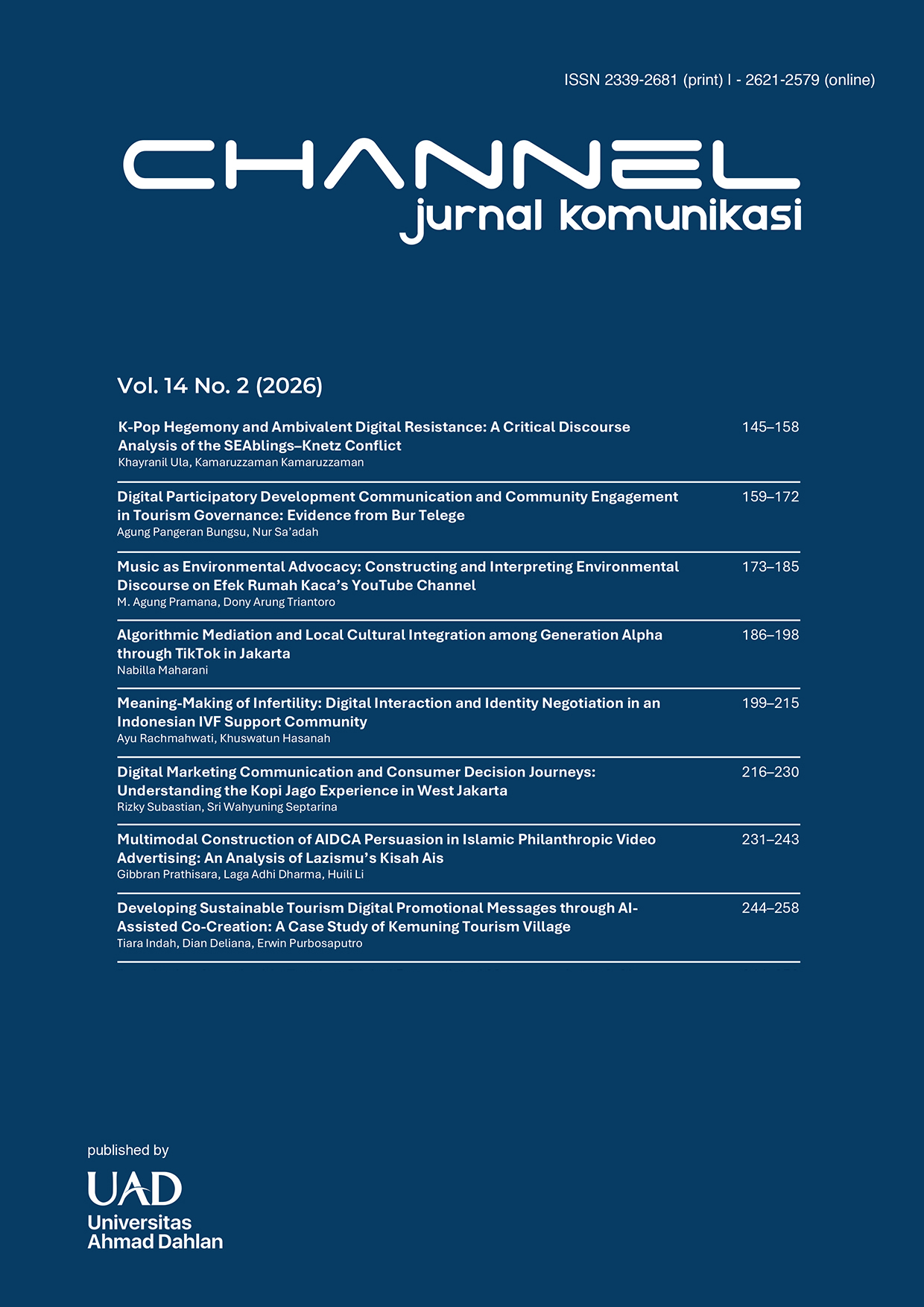
Algorithmic Mediation and Local Cultural Integration among Generation Alpha through TikTok in Jakarta
DOI:
https://doi.org/10.12928/channel.v14i2.2156Keywords:
Algorithmic mediation, Local cultural integration, Generation alpha, Digital cultural exposure, TikTokAbstract
The development of digital communication has increased Generation Alpha's exposure to cultural content through algorithmically recommended media. This study examines how algorithmic mediation supports local cultural visibility and integration among Generation Alpha through TikTok in Jakarta, Indonesia. This study used a descriptive qualitative approach and Algorithmic Mediation Theory as its analytical framework. Data were collected through semi-structured, in-depth interviews with eight informants comprising four Generation Alpha children aged 11–15 years, two parents, one educator, and one information technology practitioner. The study used source triangulation to compare perspectives across informant groups. The findings show that algorithmic recommendations introduce children to regional songs, sounds, and linguistic elements based on their interests and subsequent activity. Repeated exposure can build familiarity and support cultural recognition, while comments, hashtags, original versions, and related content provide information about cultural origins. Some children reused sounds, followed trends, imitated content, and shared it with peers, while others remained at the viewing stage. These different responses show that algorithmic mediation shapes cultural visibility and repeated exposure, whereas cultural integration develops through children's recognition, participation, imitation, and interaction with peers. Recognition and reproduction of cultural elements do not necessarily indicate complete cultural understanding. The study highlights how algorithmic visibility and children's digital and social activities contribute to integrating local cultural elements into everyday digital communication.
References
Ahmad, M., & Wilkins, S. (2024). Purposive sampling in qualitative research: a framework for the entire journey. Quality & Quantity, 59(2), 1461–1479. https://doi.org/10.1007/s11135-024-02022-5
Al-Jbouri, E., Volk, A. A., Spadafora, N., & Andrews, N. C. Z. (2024). Friends, followers, peers, and posts: adolescents’ in-person and online friendship networks and social media use influences on friendship closeness via the importance of technology for social connection. Frontiers in Developmental Psychology, 2, 1419756. https://doi.org/10.3389/fdpys.2024.1419756
Alam, M. M., Rahman, M., Arif, M. M. I., & Hossan, M. J. (2025). The power of social media in the digital era in keeping cultural traditions alive. International Journal of Social Science Research and Review, 8(10), 68–88. https://doi.org/10.47814/ijssrr.v8i10.2933
Altınok, N., Over, H., & Carpenter, M. (2023). Young children use imitation communicatively. Journal of Experimental Child Psychology, 231, 105654. https://doi.org/10.1016/j.jecp.2023.105654
Azhar, M. J., & Aesthetika, N. M. (2024). Celebrification process of celebrity children on TikTok: A study on media exposure, personal characteristics, and public engagement. CHANNEL: Jurnal Komunikasi, 12(2), 152–161. https://doi.org/10.12928/channel.v12i2.985
Baumann, F., Arora, N., Rahwan, I., & Czaplicka, A. (2026). Dynamics of algorithmic content amplification on TikTok. EPJ Data Science, 15, 18. https://doi.org/10.1140/epjds/s13688-026-00629-2
Cao, H. (2025). Exploring the promotion of musical intangible cultural heritage under TikTok short videos. Scientific Reports, 15, 21772. https://doi.org/10.1038/s41598-025-09723-3
Chu, H. L., Zhou, Y. X., Ni, K. W., Li, F. W., & Zhao, Y. M. (2021). Consideration of sample size in qualitative interviews based on information power. Chinese General Practice, 24(10), 1274–1276. https://doi.org/10.12114/j.issn.1007-9572.2020.00.415
Dahal, N., Neupane, B. P., Pant, B. P., Dhakal, R. K., Giri, D. R., Ghimire, P. R., & Bhandari, L. P. (2024). Participant selection procedures in qualitative research: experiences and some points for consideration. Frontiers in Research Metrics and Analytics, 9. https://doi.org/10.3389/frma.2024.1512747
Daniel, E., Döring, A. K., & Cieciuch, J. (2023). Development of intraindividual value structures in middle childhood: A multicultural and longitudinal investigation. Journal of Personality, 91(2), 482–496. https://doi.org/10.1111/jopy.12742
Dekker, C. A., Baumgartner, S. E., & Sumter, S. R. (2025). For you vs. for everyone: The effectiveness of algorithmic personalization in driving social media engagement. Telematics and Informatics, 101, 102300. https://doi.org/10.1016/j.tele.2025.102300
Desiana, R. (2024, July 3). Krisis etika penggunaan media sosial Gen Alpha. Balai Diklat Keagamaan Jakarta. https://bdkjakarta.kemenag.go.id/krisis-etika-penggunaan-media-sosial-gen-alpha
Dias, A. F., Dias, P., & Andrade, J. G. (2025). Generation Alpha and music: The influence of TikTok on music consumption. Opus, 31, 1–22. https://doi.org/10.20504/opus2025.31.32
Donkoh, S., & Mensah, J. (2023). Application of triangulation in qualitative research. Journal of Applied Biotechnology & Bioengineering, 10(1), 6–9. https://doi.org/10.15406/jabb.2023.10.00319
Haque, A. B., Islam, N., & Mikalef, P. (2025). To explain or not to explain: An empirical investigation of AI-based recommendations on social media platforms. Electronic Markets, 35, 2. https://doi.org/10.1007/s12525-024-00741-z
Haryono. (2025). Local Wisdom and Social Resilience: Humanities Studies in the Face of Global Crises. International Journal of Social Sciences and Humanities, 3(2), 173–178. https://doi.org/10.55681/ijssh.v3i2.1511
Ionescu, C. G., & Licu, M. (2023). Are TikTok algorithms influencing users’ self-perceived identities and personal values? A mini review. Social Sciences, 12(8), 465. https://doi.org/10.3390/socsci12080465
Kasemsarn, K., & Nickpour, F. (2025). Digital storytelling in cultural and heritage tourism: A review of social media integration and youth engagement frameworks. Heritage, 8(6), 200. https://doi.org/10.3390/heritage8060200
Khatout, R., Barkat, A., & Baali, M. (2025). Digital socialization: Understanding the role of influencers on child behavior. Annals of the “Constantin Brâncuși” University of Târgu Jiu. Letter and Social Science Series, 1(2025), 327–338. https://alss.utgjiu.ro/mdocs-posts/26-ramdhane-khatout-et-al-digital-socialization-understanding-the-role-of-influencers-on-child-behavior/
Li, Q., & Qiu, Y. (2025). Research on Traditional Cultural Communication Based on Digital Humanities. Proceedings of the 2025 6th International Conference on Mental Health, Education and Human Development (MHEHD 2025), 236–242. https://doi.org/10.2991/978-2-38476-460-0_27
Lin, H.-C. K., Lu, L.-W., & Lu, R.-S. (2024). Integrating digital technologies and alternate reality games for sustainable education: Enhancing cultural heritage awareness and learning engagement. Sustainability, 16(21), 9451. https://doi.org/10.3390/su16219451
Liu, R. W., Lapinski, M. K., Kerr, J. M., Zhao, J., Bum, T., & Lu, Z. (2022). Culture and social norms: Development and application of a model for culturally contextualized communication measurement (MC3M). Frontiers in Communication, 6, 770513. https://doi.org/10.3389/fcomm.2021.770513
Lukitowati, S., Hanum, A. N., & Yuliono, A. (2023). Nurturing Healthy Media Consumption Habits in Early Childhood: A Social Campaign Approach. CHANNEL: Jurnal Komunikasi, 11(2), 178–189. https://doi.org/10.12928/channel.v11i2.549
Madsen, D. Ø. (2026). Generation alpha speaks in memes: a conceptual framework for platformed language. Frontiers in Communication, 11, 1695863. https://doi.org/10.3389/fcomm.2026.1695863
McDonnell, T. E. (2023). Cultural Objects, Material Culture, and Materiality. Annual Review of Sociology, 49, 195–220. https://doi.org/10.1146/annurev-soc-031021-041439
Mensonides, D., Van Cauwenberge, A., Swart, J., & Broersma, M. (2025). TikTok as a peer playground: Understanding how children in middle childhood use TikTok to shape their peer relations. New Media & Society, 28(9), 4449–4469. https://doi.org/10.1177/14614448251362690
Pelealu, A. E., Manueke, A. Y., & Dasfordate, A. (2025). Between Local Wisdom and the Flow of Modernization: Legal Protection for the Mapalus Culture of the Tolour Tribe Amidst Social Change. Journal of Cultural Analysis and Social Change, 10(2), 793–798. https://doi.org/10.64753/jcasc.v10i2.1682
Pérez-Rodríguez, A., Jaramillo-Dent, D., & Alencar, A. (2022). Digital social media cultures: New models of creativity, (self)representation and participation. ICONO 14, 20(2). https://doi.org/10.7195/ri14.v20i2.1928
Pramono, S., Azmir, A. F., Aditia, Mahdania, H., & Rahmi. (2025). Arts and culture as a national competitive advantage in Indonesia: a systematic literature review. Discover Sustainability, 6(1), 639. https://doi.org/10.1007/s43621-025-01215-8
Radesky, J., Bridgewater, E., Black, S., O’Neil, A., Sun, Y., Schaller, A., Weeks, H. M., & Campbell, S. W. (2024). Algorithmic content recommendations on a video-sharing platform used by children. JAMA Network Open, 7(5), E2413855. https://doi.org/10.1001/jamanetworkopen.2024.13855
Rasidi, R., Istiningsih, G., Masithoh, R. F., & Rosyidi, M. I. (2025). Education based on local wisdom: An alternative model for the integration of cultural values in the school curriculum in Indonesia. International Journal of Contemporary Studies in Education (IJ-CSE), 4(2), 114–135. https://doi.org/10.56855/ijcse.v4i2.1521
Riyanto, G. P. (2025, August 8). Jumlah pengguna internet di Indonesia tahun 2025 tembus 229,4 juta. Kompas.Com. https://tekno.kompas.com/read/2025/08/08/16110007/jumlah-pengguna-internet-di-indonesia-tahun-2025-tembus-2294-juta
Roberts, S.-J., Saylor, M. A., Ivynian, S., & DiGiacomo, M. (2026). Data saturation and information power: sample size in qualitative research—when is enough and how to assess? European Journal of Cardiovascular Nursing, 25(5), 1069–1074. https://doi.org/10.1093/eurjcn/zvag046
Sakti, S. A., Endraswara, S., & Rohman, A. (2024). Integrating local cultural values into early childhood education to promote character building. International Journal of Learning, Teaching and Educational Research, 23(7), 84–101. https://doi.org/10.26803/ijlter.23.7.5
Scalvini, M. (2023). Making sense of responsibility: A semio-ethic perspective on TikTok’s algorithmic pluralism. Social Media + Society, 9(2), 1–14. https://doi.org/10.1177/20563051231180625
Setiawan, R. F., & Lestari, M. T. (2025). Humor Content and Media Credibility: An Analysis of Audience Engagement on the Instagram Account @simamaungcom. CHANNEL: Jurnal Komunikasi, 13(2), 199–209. https://doi.org/10.12928/channel.v13i2.1375
Shahibah, A. (2025, December 15). 42% Anak Usia Dini Indonesia Sudah Gunakan Handphone. GoodStats Data. https://data.goodstats.id/statistic/42-anak-usia-dini-indonesia-sudah-gunakan-handphone-EHoyX
Sina, E., Buck, C., Ahrens, W., Coumans, J. M. J., Eiben, G., Formisano, A., Lissner, L., Mazur, A., Michels, N., Molnar, D., Moreno, L. A., Pala, V., Pohlabeln, H., Reisch, L., Tornaritis, M., Veidebaum, T., & Hebestreit, A. (2023). Digital media exposure and cognitive functioning in European children and adolescents of the I.Family study. Scientific Reports, 13(1), 18855. https://doi.org/10.1038/s41598-023-45944-0
Šramová, B., & Pavelka, J. (2023). Generation Alpha media consumption during Covid-19 and teachers’ standpoint. Media and Communication, 11(4), 227–238. https://doi.org/10.17645/mac.v11i4.7158
Sukri, A., Shasrini, T., Saputra, H. H., & Hamsal. (2025). Socialization of digital media literacy in shaping positive behavior in adolescents. ARSY: Aplikasi Riset Kepada Masyarakat, 6(2), 270–278. https://doi.org/10.55583/arsy.v6i2.1288
Sun, S., Liu, Z., & Waxman, D. (2025). A dynamical measure of algorithmically infused visibility. Royal Society Open Science, 12(11), 242232. https://doi.org/10.1098/rsos.242232
Wang, S., Yang, Y., & Shi, W. (2025). Configuring factors for effective dissemination of intangible cultural heritage on Douyin: An fsQCA approach. Humanities and Social Sciences Communications, 12, 979. https://doi.org/10.1057/s41599-025-05414-6
Zierock, B., Schulze, J., & Angar, S. (2025). From Gen Z to Generation Alpha: Navigating the evolution of communication in a digital age. SCIREA Journal of Education, 10(2), 69–80. https://doi.org/10.54647/education880581
Downloads
Published
Issue
Section
License
Copyright (c) 2026 CHANNEL: Jurnal Komunikasi

This work is licensed under a Creative Commons Attribution-ShareAlike 4.0 International License.