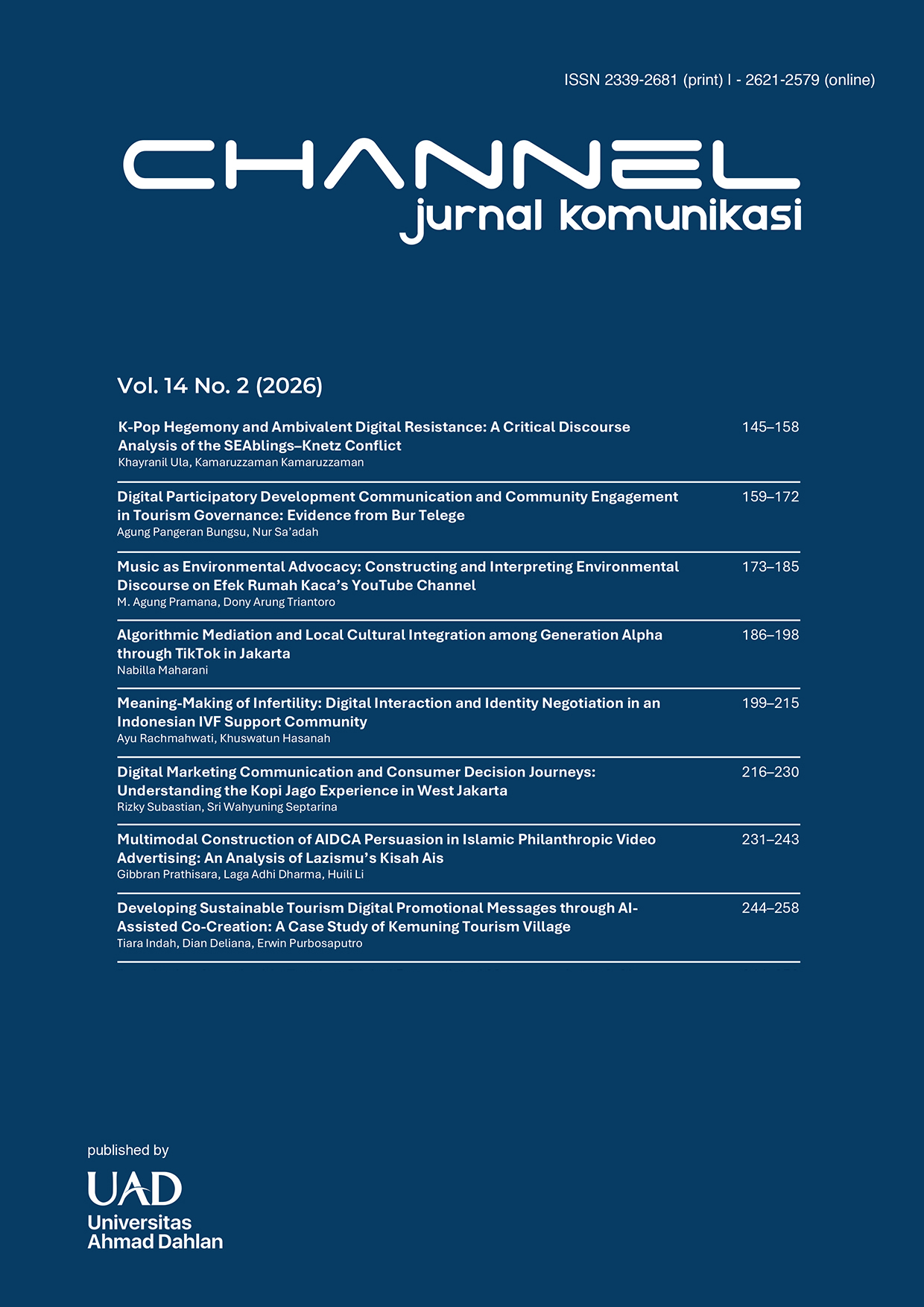
Music as Environmental Advocacy: Constructing and Interpreting Environmental Discourse on Efek Rumah Kaca’s YouTube Channel
DOI:
https://doi.org/10.12928/channel.v14i2.2119Keywords:
Environmental advocacy, Environmental communication, Environmental discourse, Audience interpretation, NetnographyAbstract
Music provides a cultural medium through which environmental concerns can be articulated beyond conventional informational and advocacy-based communication. This study examines how Efek Rumah Kaca (ERK) constructs environmental discourse through music and how audiences interpret these meanings within the digital context of YouTube. Employing a netnographic approach, the study analyzes three music videos published on ERK’s YouTube channel, @efekrumahkacaofficial: “Efek Rumah Kaca,” “Hujan Jangan Marah,” and “Merdeka,” alongside 46 audience comments. The findings reveal that ERK articulates environmental discourse through interconnected ecological, social, and political narratives. “Efek Rumah Kaca” addresses global warming and the greenhouse effect, while “Hujan Jangan Marah” evokes environmental degradation and ecological vulnerability. Meanwhile, “Merdeka” connects environmental concerns with natural resource ownership, community resistance, and social justice. Audience comments further illustrate how these meanings are interpreted and extended through concerns about resource ownership, environmental inequality, and the commodification of nature. By examining musical and audiovisual representations alongside audience interpretations, this study highlights how music functions as a medium of environmental advocacy and how YouTube provides a digital context in which environmental discourse is communicated and interpreted. The study contributes to environmental communication and media studies by examining both the construction of environmental meanings through music and their interpretation by audiences.
References
Anwar, M. K., & Anwar, M. S. (2019). Gaya bahasa kiasan dalam lirik lagu band “Efek Rumah Kaca” album Efek Rumah Kaca, Kamar Gelap, Sinestesia. Jurnal Ilmiah Buana Bastra: Bahasa, Susastra, dan Pengajarannya, 6(1), 47–51. https://doi.org/10.36456/bastra.vol6.no1.a3599
Boykoff, M. T. (2009). We speak for the trees: Media reporting on the environment. Annual Review of Environment and Resources, 34(1), 431–457. https://doi.org/10.1146/annurev.environ.051308.084254
Castrechini, A., Pol, E., & Guàrdia-Olmos, J. (2014). Media representations of environmental issues: From scientific to political discourse. European Review of Applied Psychology, 64(5), 213–220. https://doi.org/10.1016/j.erap.2014.08.003
Collinson, I., & Keogh, B. (2024). Jack Johnson’s quiet activism. Continuum, 38(1), 68–83. https://doi.org/10.1080/10304312.2024.2314195
Costello, L., McDermott, M.-L., & Wallace, R. (2017). Netnography: Range of practices, misperceptions, and missed opportunities. International Journal of Qualitative Methods, 16(1), 1–12. https://doi.org/10.1177/1609406917700647
Creswell, J. (2013). Qualitative inquiry and research design: Choosing among five approaches. Sage Publications.
Cribb, R. (1990). The politics of pollution control in Indonesia. Asian Survey, 30(12), 1123–1135. https://doi.org/10.2307/2644989
Dixon, C. E., Goldman, L. S., Crawford, S., & Lease, P. C. (2024). Music as a vehicle for climate change communication: The ClimateMusic Project. In Storytelling to accelerate climate solutions (pp. 265–293). Springer. https://doi.org/10.1007/978-3-031-54790-4_12
Ekasari, A. H. (2019). Tindak tutur ekspresif dalam lirik lagu karya Efek Rumah Kaca: Analisis sosiopragmatik [Bachelor’s Thesis, Universitas Gadjah Mada]. https://etd.repository.ugm.ac.id/penelitian/detail/177425
Entman, R. M. (1993). Framing: Toward clarification of a fractured paradigm. Journal of Communication, 43(4), 51–58. https://doi.org/10.1111/j.1460-2466.1993.tb01304.x
Fantinelli, M. (2026). Dialogic ecologies: Producer–audience dynamics in Arabic YouTube environmental communication. Language Sciences, 116, 101815. https://doi.org/10.1016/j.langsci.2026.101815
Forsyth, T. (2014). Public concerns about transboundary haze: A comparison of Indonesia, Singapore, and Malaysia. Global Environmental Change, 25, 76–86. https://doi.org/10.1016/j.gloenvcha.2014.01.013
Gordon, J. (1998). NGOs, the environment, and political pluralism in New Order Indonesia. Explorations: A graduate student journal of Southeast Asian Studies, 2(2), 47–68. http://hdl.handle.net/10125/2544
Han, R., & Xu, J. (2020). A Comparative Study of the Role of Interpersonal Communication, Traditional Media and Social Media in Pro-Environmental Behavior: A China-Based Study. International Journal of Environmental Research and Public Health, 17(6), 1883. https://doi.org/10.3390/ijerph17061883
Hastuti, I. P., & Rifa’i, A. (2024). Masalah perkotaan dalam musik (Analisis wacana pada lirik lagu “Banyak Asap di Sana” karya Efek Rumah Kaca). Jurnal Literasiologi, 11(2), 46-79. https://doi.org/10.47783/literasiologi.v11i2.704
Ho, S. S., & Chuah, A. S. F. (2017). Climate change communication in Singapore. In M. C. Nisbet, S. S. Ho, E. Markowitz, S. O’Neill, M. S. Schäfer, & J. Thaker (Eds.), The Oxford encyclopedia of climate change communication (pp. 500–514). Oxford University Press. https://doi.org/10.1093/acrefore/9780190228620.013.473
Hou, M. (2019). Social media celebrity and the institutionalization of YouTube. Convergence: The International Journal of Research into New Media Technologies, 25(3), 534–553. https://doi.org/10.1177/1354856517750368
Idris, I. K., Jalli, N., Khan, M. L., & Sunaryo. (2023). Virality is not enough when the audience misses the point: A content analysis of YouTube comments on environmental documentary “Sexy Killers.” Jurnal Komunikasi: Malaysian Journal of Communication, 39(2), 1–18. https://doi.org/10.17576/JKMJC-2023-3902-01
Ji, Q., Harlow, S., Cui, D., & Wang, Z. (2018). Discussing environmental issues in Chinese social media: An analysis of Greenpeace China’s Weibo posts and audience responses. The Journal of Social Media in Society, 7(1), 37–60. https://thejsms.org/index.php/JSMS/article/view/314/148
Kim, J. (2012). The institutionalization of YouTube: From user-generated content to professionally generated content. Media, Culture & Society, 34(1), 53–67. https://doi.org/10.1177/0163443711427199
Kozinets, R. V. (2019). Netnography: The essential guide to qualitative social media research. Sage Publications.
Kristi, L. S. (2025). Tiada Tuhan selain pemilik kapital: Ketidakadilan hak petani dan eksploitasi alam pada konflik agraria dalam jerat kapitalisme di Indonesia melalui lagu “Tiada Tuhan Selain Pemilik Kapital” karya Efek Rumah Kaca. Aradha: Journal of Divinity, Peace and Conflict Studies, 5(3), 209–229. https://doi.org/10.21460/aradha.2025.53.1583
Mahat, H., Hussein, S. W., Saleh, Y., Hashim, M., Nayan, N., Said, Z. M., & Kurniawan, E. (2023). Social media as a medium for disseminating community awareness of environmental issues in Malaysia. TEM Journal, 12(3), 1658–1667. https://doi.org/10.18421/TEM123-47
Ningsih, S., Setyawan, A., & Ansori, T. (2024). Kritik sosial dalam musik (Analisis semiotika makna lirik lagu “Seperti Rahim Ibu” karya band Efek Rumah Kaca). Journal of Communication Studies, 4(1), 16–30. https://doi.org/10.37680/jcs.v4i1.4870
Oh, Y. K., & Choeh, J. Y. (2022). Social media engagements of music videos on YouTube’s official artist channels. Convergence: The International Journal of Research into New Media Technologies, 28(3), 804–821. https://doi.org/10.1177/13548565211054906
Pieri, Z. P. (2025). Framing the climate emergency: The role of music in Extinction Rebellion. Social Movement Studies, 24(4), 509–524. https://doi.org/10.1080/14742837.2024.2304300
Pramestusi, A. W., Rochwulaningsih, Y., & Sulistiyono, S. T. (2022). Parties and environmental issues: PDIP action programs in the Reformation era, 2002–2014. E3S Web of Conferences, 359, Article 04006. https://doi.org/10.1051/e3sconf/202235904006
Prior, H. M. (2022). How can music help us to address the climate crisis? Journal of Popular Music Studies, 34(1), 3–18. https://doi.org/10.1177/20592043221075725
Resosudarmo, B. P. (2016). Reformasi, environmental security and development in Indonesia. In Development in an insecure and gendered world (pp. 195–212). Routledge. https://doi.org/10.4324/9781315576862-13
Rupley, K. H., Brown, D., & Marshall, R. S. (2012). Governance, media and the quality of environmental disclosure. Journal of Accounting and Public Policy, 31(6), 610–640. https://doi.org/10.1016/j.jaccpubpol.2012.09.002
Saleh, M., & Saifudin, M. (2017). Media and environmental non-governmental organizations (ENGOs) roles in environmental sustainability communication in Malaysia. Discourse and Communication for Sustainable Education, 8(1), 90–101. https://doi.org/10.1515/dcse-2017-0007
Triyanti, A., Indrawan, M., Nurhidayah, L., & Marfai, M. A. (2023). Environmental governance in Indonesia. Springer Nature. https://library.oapen.org/handle/20.500.12657/61283
Wodak, J. (2018). Shifting baselines: Conveying climate change in popular music. Environmental Communication, 12(1), 58–70. https://doi.org/10.1080/17524032.2017.1371051
Woltermann, L. (2026). Comment sections as counterpublics: Negotiating public discourse in Indonesia’s digital media sphere. Wacana, Journal of the Humanities of Indonesia, 27(1), 1–35. https://doi.org/10.17510/wacana.v27i1.2032
Wu, L., Qing, C., & Jin, S. (2022). Environmental protection and sustainable development of enterprises in China: The moderating role of media attention. Frontiers in Environmental Science, 10, 966479. https://doi.org/10.3389/fenvs.2022.966479
Yuan, S., & Lu, H. (2023). Don’t talk climate like this: Exploring the moderating effects of comment stance on aggressive climate change videos. Environmental Communication, 17(2), 146–156. https://doi.org/10.1080/17524032.2023.2165524
Downloads
Published
Issue
Section
License
Copyright (c) 2026 CHANNEL: Jurnal Komunikasi

This work is licensed under a Creative Commons Attribution-ShareAlike 4.0 International License.