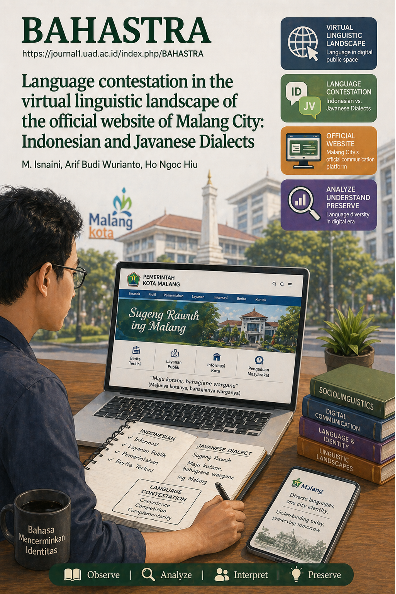
Language contestation in the virtual linguistic landscape of the official website of Malang City: Indonesian and Javanese Dialects
DOI:
https://doi.org/10.26555/bs.v46i1.2099Keywords:
Javanese Dialect , Virtual Linguistic Landscape , WebsiteAbstract
This study examines language contestation in the virtual linguistic landscape (VLL) of the official website of Malang City Government, focusing on the interaction between Indonesian and Javanese dialects. While previous studies emphasize the dominance of national languages in digital governance, this study critically interrogates whether such dynamics represent contestation, coexistence, or symbolic marginalization. Using a concurrent mixed-methods design, data were collected from 55 indexed web pages through systematic content analysis, supported by policy documentation and semi-structured interviews with website administrators (n = 3). The analysis integrates linguistic distribution, language style, and communicative function within a VLL framework. The findings reveal that Indonesian overwhelmingly dominates administrative and informational functions, while Javanese dialects appear in limited symbolic forms, such as service names and cultural expressions. Rather than indicating active contestation, this pattern reflects a hierarchical linguistic order shaped by institutional norms, regulatory constraints, and digital governance practices. This study contributes theoretically by reconceptualizing “language contestation” in digital institutional spaces as structured hierarchy rather than direct competition. Practically, it highlights the need for more functional integration of regional languages in digital governance to support linguistic diversity beyond symbolic representation.
References
Abdullah, C. U., & Wulung, S. R. P. (2023). Lanskap linguistik daya tarik wisata: Aspek multilingualisme di Kawasan Pariwisata Nasional Lembang dan Tangkubanparahu. Khasanah Ilmu-Jurnal Pariwisata dan Budaya, 14(1), 43-49. https://doi.org/10.31294/khi.v14i1.14350
Aini, A. N., Yarno, Y., & Hermoyo, R. P. (2023). Lanskap linguistik di Stasiun Surabaya Pasarturi. Diglosia: Jurnal Kajian Bahasa, Sastra, dan Pengajarannya, 6(3), 795–814. https://doi.org/10.30872/diglosia.v6i3.691
Ambarsari, T. A. B., & Mujianto, G. (2022). Analisis variasi konsultatif pada gilir bicara dalam pembelajaran daring Bahasa Indonesia di SMK PGRI 1 Giri Banyuwangi. Jurnal Pendidikan Bahasa dan Sastra Indonesia Undiksha, 12(1), 21-30. https://doi.org/10.23887/jjpbs.v12i1.43557
Amos, H. W. (2017). Regional language vitality in the linguistic landscape: Hidden hierarchies on street signs in Toulouse. International Journal of Multilingualism, 14(2), 93–108. https://doi.org/10.1080/14790718.2015.1103244
Anam, A. K., Purnama, Y., & Hilaliyah, H. (2024). Lanskap linguistik di Stadion Patriot Candrabhaga Kota Bekasi. Indonesian Language Education and Literature, 10(1), 21-39.
https://doi.org/10.24235/ileal.v10i1.15054
Ardhian, D., Zakiyah, M., & Fauzi, N. B. (2023). Pesan dan simbol identitas di balik kematian: Lanskap linguistik pada area publik tempat pemakaman umum di Kota Malang. LITERA, 22(1), 90–106. https://doi.org/10.21831/ltr.v22i1.54366
Creswell, J. W., & Creswell, J. D. (2018). Research design: Qualitative, quantitative, and mixed methods approaches. Sage.
Dwijayanti, T. A., & Mujianto, G. (2020). Analisis penggunaan variasi register berdasarkan model interaksi speaking dalam media sosial youtube. Deiksis: Jurnal Pendidikan Bahasa dan Sastra Indonesia, 7(2), 70-83. https://doi.org/10.33603/deiksis.v7i2.3505
Elika, N., & Nurhayati, N. (2024). Metafora konseptual aksara Jawa dalam Serat Centhini: Kajian linguistik kognitif. Diglosia: Jurnal Kajian Bahasa, Sastra, dan Pengajarannya, 7(3), 431–444. https://doi.org/10.30872/diglosia.v7i3.1038
Erikha, F. (2018). Konsep lanskap linguistik pada papan nama jalan kerajaan (Râjamârga): Studi kasus di Kota Yogyakarta. Paradigma, Jurnal Kajian Budaya, 8(1), 38. https://doi.org/10.17510/paradigma.v8i1.231
Fitriati, S. W., & Rata, E. (2021). Language, globalisation, and national identity: A study of English-medium policy and practice in Indonesia. Journal of Language, Identity & Education, 20(6), 411–424. https://doi.org/10.1080/15348458.2020.1777865
Goebel, Z. (2014). Blommaert, Jan (2013): Ethnography, superdiversity, and linguistic landscapes: Chronicles of complexity. Sociolinguistica, 28(1). https://doi.org/10.1515/soci-2014-0016
Gomaa, Y. (2020). Language policy in the virtual linguistic landscape: The case of the Kingdom of Bahrain E-Government National Portal. Cadernos de Linguagem e Sociedade, 21(2), 20–37. https://doi.org/10.26512/les.v21i2.29354
Itaristanti, I. (2020). Pengutamaan Bahasa Indonesia di ruang publik pada nama tempat usaha di Jalan Perjuangan Kota Cirebon. Indonesian Language Education and Literature, 5(2), 223. https://doi.org/10.24235/ileal.v5i2.6427
Ivkovic, D., & Lotherington, H. (2009). Multilingualism in cyberspace: Conceptualising the virtual linguistic landscape. International Journal of Multilingualism, 6(1), 17–36. https://doi.org/10.1080/14790710802582436
Keles, U., Yazan, B., & Giles, A. (2020). Turkish-English bilingual content in the virtual linguistic landscape of a university in Turkey: Exclusive de facto language policies. International Multilingual Research Journal, 14(1), 1–19. https://doi.org/10.1080/19313152.2019.1611341
Kusno, A. (2021). Redefinisi kosakata terkait perang bahasa (Kajian linguistik forensik). Diglosia: Jurnal Kajian Bahasa, Sastra, dan Pengajarannya, 4(3), 287–300. https://doi.org/10.30872/diglosia.v4i3.183
Landry, R., & Bourhis, R. Y. (1997). Linguistic landscape and ethnolinguistic vitality: An empirical study. Journal of Language and Social Psychology, 16(1), 23–49. https://doi.org/10.1177/0261927X970161002
Lantaya, L., Bonifacio, R., Jabagat, G., Ilongo, L. J., Lucday, E. C. G., & Maluenda, R. (2021). Beyond extinction: Preservation and maintenance of endangered Indigenous languages in the Philippines. International Journal of Scientific & Technology Research, 10(12), 54–61.
Lu, S., Li, G., & Xu, M. (2020). The linguistic landscape in rural destinations: A case study of Hongcun Village in China. Tourism Management, 77, 104005. https://doi.org/10.1016/j.tourman.2019.104005
Mujianto, G. (2018). Analisis wacana kritis pemberitaan tentang ormas islam pada situs berita online. KEMBARA: Jurnal Keilmuan Bahasa, Sastra, dan Pengajarannya, 4(2), 155-172. https://doi.org/10.22219/kembara.v4i2.7035
Mujianto, G., & Sudjalil, S. (2021). Tipe modifikasi fonem kata serapan asing ke dalam bahasa Indonesia pada surat kabar online berbahasa Indonesia. KEMBARA: Jurnal Keilmuan Bahasa, Sastra, dan Pengajarannya, 7(1), 1-19. https://doi.org/10.22219/kembara.v7i1.16206
Nash, J. (2016). Is the linguistic landscape necessary? Landscape Research, 41(3), 380–384. https://doi.org/10.1080/01426397.2016.1152356
Pangesti, F., & Prihatini, A. (2021). Senyapan terisi pada tuturan mahasiswa Bahasa Indonesia bagi penutur asing (BIPA). Prosiding Konferensi Linguistik Tahunan Atma Jaya (KOLITA), 150-154.
Paramarta, I. M. S., Satyawati, M. S., Purnawati, K. W., Suputra, P. E. D., & Sudana, P. A. P. (2022). Language contestation on the virtual linguistic landscape of the government website of Bali, Indonesia. Rupkatha Journal on Interdisciplinary Studies in Humanities, 14(3). https://doi.org/10.21659/rupkatha.v14n3.19
Peck, A., & Banda, F. (2014). Observatory’s linguistic landscape: Semiotic appropriation and the reinvention of space. Social Semiotics, 24(3), 302–323. https://doi.org/10.1080/10350330.2014.896651
Penalosa, F. (1981). Introduction to the sociology of language. Newbury House Publishers.
Prihatini, A., Pangesti, F., & Zamahsari, G. K. (2024). Using metacognitive strategies in second language learning: A bibliometric analysis. Linguists: Journal of Linguistics and Language Teaching, 10(2), 197-216. https://doi.org/10.29300/ling.v10i2.4602
Putikadyanto, A. P. A., Alatas, M. A., Albaburrahim, A., & Junjunan, M. I. (2024). Multilingualisme dan kesetiaan Berbahasa Indonesia: Studi lanskap linguistik di ruang publik Pamekasan, Madura. Ranah: Jurnal Kajian Bahasa, 13(1), 58-70. https://doi.org/10.26499/rnh.v13i1.4584
Sahril, S., Harahap, S. Z., & Hermanto, A. B. (2019). Lanskap linguistik Kota Medan: Kajian onomastika, semiotika, dan spasial. Medan Makna: Jurnal Ilmu Kebahasaan dan Kesastraan, 17(2), 195-208. https://doi.org/10.26499/mm.v17i2.2141
Sartini, N. W. (2022). Pemetaan lanskap linguistik di Universitas Airlangga Surabaya. Kongres Internasional Masyarakat Linguistik Indonesia, 265–268. https://doi.org/10.51817/kimli.vi.61
Savitri, E. D., Nuswantara, K., & Ratu, A. (2022). Tourism language accommodation in Ubud, Bali: The virtual landscape linguistics (VLL) through Google Street View. Journal of Applied Studies in Language, 6(2), 154–160. https://doi.org/10.31940/jasl.v6i2.610
Symaco, L. P. (2017). Education, language policy, and language use in the Philippines. Language Problems and Language Planning, 41(1), 87–102. https://doi.org/10.1075/lplp.41.1.05sym
Taylor-Leech, K. J. (2012). Language choice as an index of identity: Linguistic landscape in Dili, Timor-Leste. International Journal of Multilingualism, 9(1), 15–34. https://doi.org/10.1080/14790718.2011.583654
Winarti, A., Syafroni, R. N., & Maspuroh, U. (2024). Analisis lanskap linguistik iklan Kota Harapan Indah serta rekomendasinya sebagai brosur teks iklan kelas VIII. JIIP - Jurnal Ilmiah Ilmu Pendidikan, 7(2), 1519–1527. https://doi.org/10.54371/jiip.v7i2.3506
Wulansari, D. W. (2020). Lanskap linguistik di Bali: Tanda multilingual dalam papan nama ruang publik. KREDO: Jurnal Ilmiah Bahasa dan Sastra, 3(2), 420–429. https://doi.org/10.24176/kredo.v3i2.4600
Yan, X. (2019). A study of language choices in the linguistic landscape of Macao’s heritage and gaming tourism. Journal of Multilingual and Multicultural Development, 40(3), 198–217. https://doi.org/10.1080/01434632.2018.1498853
Yoniartini, D. M. (2021). Lanskap linguistik kawasan pusat pendidikan di Kota Mataram. Jurnal Ilmiah Telaah, 6(2), 162-172. https://doi.org/10.31764/telaah.v6i2.6189
Zaman, S., Rahmawati, A., & Kurniawan, K. (2023). Konsep ideal lanskap linguistik di ibu kota negara baru (Ideal concept of linguistic landscape in new state capital). Indonesian Language Education and Literature, 9(1), 222. https://doi.org/10.24235/ileal.v9i1.13049
Zulaekho, S. (2011). Language styles of Muluk in Alangkah Lucunya Negeri Ini movie (Thesis, Univertsitas Diponegoro).
Additional Files
Published
Issue
Section
License
Copyright (c) 2025 M. Isnaini, Arif Budi Wurianto, Ho Ngoc Hiu

This work is licensed under a Creative Commons Attribution-ShareAlike 4.0 International License.
1.jpg)