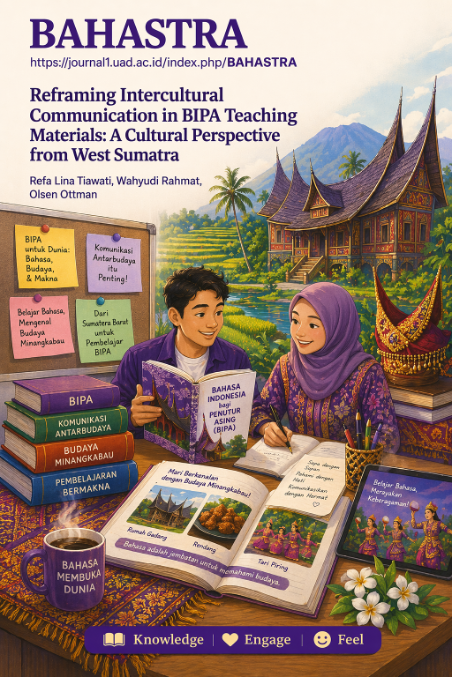
Reframing intercultural communication in BIPA teaching materials: A cultural perspective from West Sumatra
DOI:
https://doi.org/10.26555/bs.v46i1.2066Keywords:
A Cultural Perspective , BIPA, Intercultural Communication , Teaching MaterialsAbstract
This study examines the representation of Minangkabau local wisdom in five nationally standardized BIPA (Indonesian for Foreign Speakers) textbooks and three supplementary materials utilized in Padang. Employing qualitative content analysis alongside critical discourse analysis (CDA), the research investigates how sociocultural knowledge is constructed, prioritized, or silenced in pedagogical materials. The findings reveal three critical gaps: (1) the complete absence of Kato Nan Ampek (the traditional speech-level system); (2) only two out of twelve Sumbang Duo Baleh behavioral norms are implicitly referenced; and (3) the matrilineal kinship system is consistently framed as a static ‘traditional custom’ rather than a dynamic, living social structure. These omissions point to a systematic marginalization of Minangkabau sociopragmatic knowledge, which may hinder learners’ development of authentic intercultural competence. To address these empirical and pedagogical gaps, the study proposes the BITD (Budaya, Identitas, Teks, dan Dialog) region-based thematic model, which integrates localized wisdom into BIPA instruction through contextually grounded materials, pragmatic awareness, and participatory learning frameworks. This research contributes to ongoing debates on decolonizing language pedagogy and offers actionable guidelines for curriculum developers, textbook authors, and BIPA instructors seeking to foster culturally responsive language education.
References
Alwasilah, A. C., Suryadi, K., & Karyono, T. (2009). Etnopedagogi: Landasan praktik pendidikan dan pendidikan guru. Kiblat Buku Utama.
https://onesearch.id/Record/IOS3659.INLIS000000000004522
Akkaya, N., & Kirmiz, F. S. (2010). Relationship between attitudes to reading and time allotted to writing in primary education. Procedia Social and Behavioral Sciences, 2(2), 4742-4746. https://doi.org/10.1016/j.sbspro.2010.03.761
Andyani, N., Saddhono, K., & Mujyanto, Y. (2017). Peningkatan kemampuan menulis teks eksplanasi dengan menggunakan media audiovisual pada siswa sekolah menengah pertama. Basastra, 4(2), 161-174. https://jurnal.fkip.uns.ac.id/index.php/bhs_indonesia/article/view/9994
Arikunto, S. (2014). Prosedur penelitian suatu pendekatan praktik. Rineka cipta.
Aslinda. 2010. Pengantar sosiolinguistik. PT Refika Aditama.
Byram, M. (1997). Teaching and assessing intercultural communicative competence. Multilingual Matters. https://doi.org/10.2307/jj.22730614
Chaer, A., & Agustina, L. 2010. Sosiolinguistik perkenalan awal. Rineka Cipta.
Creswell, J. W., & Poth, C. N. (2018). Qualitative inquiry and research design: Choosing among five approaches (4th ed.). SAGE Publications.
Fairclough, N. (2010). Critical discourse analysis: The critical study of language (2nd ed.). Routledge.
https://doi.org/10.4324/9781315834368
Gea, T., Rahardi, R., Setyaningsih, Y., & Pranowo, P. (2020). Strategi meningkatkan motivasi belajar mahasiswa dengan model learning cycle pada Mata Kuliah Sejarah Sastra Indonesia. BAHASTRA, 40(2), 161-166. https://doi.org/10.26555/bahastra.v40i2.17028
Grosjean, F. (1989). Neurolinguists, beware! The bilingual is not two monolinguals in one person. Brain and Language, 36(1), 3–15.
https://doi.org/10.1016/0093-934X(89)90048-5
Habók, A., Kong, Y., Ragchaa, J., & Magyar, A. (2021). Cross-cultural differences in foreign language learning strategy preferences among Hungarian, Chinese, and Mongolian University students. Heliyon, 7(3). https://doi.org/10.1016/j.heliyon.2021.e06505
Hall, E. T. (1976). Beyond culture. Anchor Books.
https://www.penguinrandomhouse.com/books/15983/beyond-culture-by-edward-t-hall/
Horwitz, E. K., Horwitz, M. B., & Cope, J. (1986). Foreign language classroom anxiety. The Modern Language Journal, 70(2), 125–132. https://doi.org/10.1111/j.1540-4781.1986.tb05256.x
Kasper, G., & Rose, K. R. (2002). Pragmatic development in a second language. Blackwell Publishing. https://doi.org/10.1002/9780470757123
Khoirunnisa, A. S., & Sunarya, Y. (2023). Implementasi pembelajaran lintas budaya dalam perspektif pengajar BIPA: Tantangan dan peluang. Jurnal Onoma: Pendidikan, Bahasa, dan Sastra, 9(1), 209–217.
Kramsch, C. (1993). Context and culture in language teaching. Oxford University Press.
https://doi.org/10.1016/0093-934X(89)90048-5
Kramsch, C. (2020). Translating experience in language teaching research and practice. Applied linguistics, 41(1), 30-51. https://doi.org/10.1093/applin/amz011
Liddicoat, A. J., & Scarino, A. (2013). Intercultural language teaching and learning. Wiley-Blackwell. DOI:10.1016/j.system.2014.12.004
Mayer, R. E. (2009). Multimedia learning (2nd ed.). Cambridge University Press.
https://doi.org/10.1017/CBO9780511811678
Meilawati, C. M., Rahmawati, L. E., & Giyato, G. (2022). Media strip story untuk meningkatkan keaktifan dan hasil belajar menulis teks cerita fantasi. JPTP (Jurnal Penelitian Tindakan Pendidikan), 1(1), 1-8. Retrieved from https://journals2.ums.ac.id/index.php/jptp/article/view/975
Miles, M. B., Huberman, A. M., & Saldaña, J. (2014). Qualitative data analysis: A methods sourcebook (3rd ed.). SAGE Publications.
https://us.sagepub.com/en-us/nam/qualitative-data-analysis/book235747
Pennycook, A. (1994). The cultural politics of English as an international language. Longman.
Rahmat, W., Tiawati, R. L., Rahardi, R. K., & Saaduddin, S. (2024). How international students can well understand adapted online collaboration project? The case of BIPA learners. Journal of Pedagogical Research, 8(1), 143–158. https://doi.org/10.33902/JPR.202423689
Richards, J. C. (2017). Curriculum development in language teaching (2nd ed.). Cambridge University Press. https://doi.org/10.1017/9781009024556
Richards, J. C. (2008). Second language teacher education today. RELC Journal, 39(2), 158–177. https://doi.org/10.1177/0033688208092182
Sandelowski, M. (2000). Whatever happened to qualitative description? Research in Nursing & Health, 23(4), 334–340.
https://doi.org/10.1002/1098-240X(200008)23:4<334::AID-NUR9>3.0.CO;2-G
Saddhono, K. (2015). Integrating culture in Indonesian language learning for foreign speakers at Indonesian Universities. Journal of Language and Literature, 6(2), 2–7.
Sercu, L., Bandura, E., Castro, P., Davcheva, L., Laskaridou, C., Lundgren, U., Méndez García, M. C., & Ryan, P. (2005). Foreign language teachers and intercultural competence. Multilingual Matters. https://doi.org/10.2307/jj.27710976
Merriam, S. B. (2009). Qualitative research: A guide to design and implementation. Jossey-Bass.
Thomas, J. (1983). Cross-cultural pragmatic failure. Applied Linguistics, 4(2), 91–112.
https://doi.org/10.1093/applin/4.2.91
Tiawati, R. L., Bidin, A. Bin, & Baba, S. (2023). How the language competence of international students is culturally oriented when learning Indonesian Language. Studies in Media and Communication, 11(6), 80–89. https://doi.org/10.11114/smc.v11i6.6020
Tiawati, R. L., Bidin, A. Bin, & Baba, S. (2024). Exploring the utilization of Indonesian language among international students in bilingual education: An analysis of pedagogical and cognitive strategies. 7, 55–67.
Utami, S.D., Efendi, I., Dewi, I.N., Ramdani, A., & Rohyani, I. (2018). The study of local wisdom of ethnic sasaks in development of biology instructional learning program (P3Bio) based on 21st century skills. Proceedings of the Mathematics, Informatics, Science, and Education International Conference (MISEIC 2018), 114-116. https://doi.org/10.2991/miseic-18.2018.28
Utami, S. S. (2007). Variasi bahasa masyarakat pesisir Kampung Tambak Wedi Baru. Surabaya: Kajian Sosiolinguistik, 6(6).
Vygotsky, L. S. (1978). Mind in society: The development of higher psychological processes. Harvard University Press.
Warschauer, M. (2004). Technological change and the future of CALL. In S. Fotos & C. Browne (Eds.), New perspectives on CALL for second language classrooms. Lawrence Erlbaum.
https://doi.org/10.4324/9781410613165
Winkel, W. S. 1996. Psikologi pengajaran. Grasindo Sinar Baru.
Wardani, N. E., & Ulya, C. (2019). The reseptive and productive learning models based on folktales for learning Indonesian as a foreign language. Journal of Physics: Conference Series, 1339(1), 012073. https://doi.org/10.1088/1742-6596/1339/1/012073
Yusri, R., Muspardi, M., Kemal, E., & Rahmat, W. (2019). Effectiveness of national qualification framework Indonesia based curriculum and higher education national standard behaviour assesment rubric. Journal of Physics: Conference Series, 1157(4), 042129. https://doi.org/10.1088/1742-6596/1157/4/042129
Young, T. J., & Sachdev, I. (2011). Intercultural communicative competence: Exploring english language teachers’ beliefs and practices. Language Awareness, 20(2), 81–98. https://doi.org/10.1080/09658416.2010.540328
Zafar, S., Sandhu, S. Z., & Khan, Z. A. (2013). A critical analysis of “developing intercultural competence in the language classroom” by Bennett, Bennett, and Allen. World Applied Sciences Journal, 21(4), 565–571.
Additional Files
Published
Issue
Section
License
Copyright (c) 2025 Refa Lina Tiawati, Wahyudi Rahmat, Olsen Ottman

This work is licensed under a Creative Commons Attribution-ShareAlike 4.0 International License.
1.jpg)