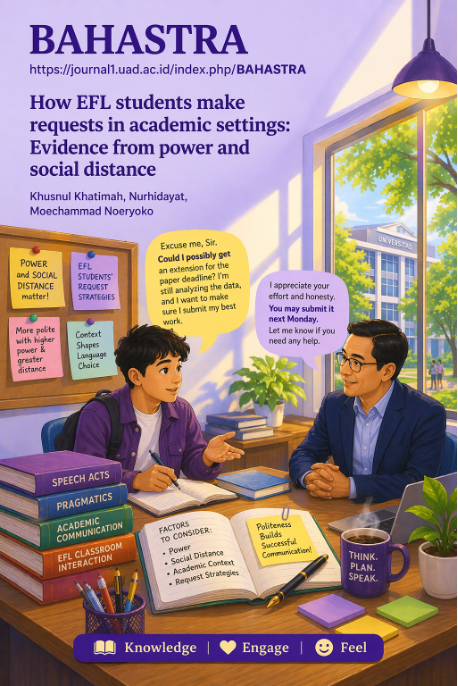
How EFL students make requests in academic settings: Evidence from power and social distance
DOI:
https://doi.org/10.26555/bs.v46i1.2041Keywords:
EFL Students , Power , Request Speech Acts , Social DistanceAbstract
This study examines the realization of request speech acts produced by English as a Foreign Language (EFL) students in academic contexts by considering variations in power and social distance. Requests constitute face-threatening acts (FTAs); therefore, their realization is strongly influenced by social and relational factors. This study employed a qualitative descriptive design supported by frequency counts and percentage distributions to quantify strategy use across situational configurations. The data were collected through a Discourse Completion Task (DCT) involving 34 undergraduate students from different semesters of the English Education Study Program at STKIP Taman Siswa Bima. The data were analysed based on request strategy classifications and mitigation devices and were interpreted through the framework of politeness theory and learner pragmatics. The findings generally indicate that conventionally indirect strategies tend to predominate in request realizations across configurations of power and social distance, though variation was observed across individual cases. In contexts characterized by asymmetrical power relations, students predominantly tended to avoid direct strategies and employed layered mitigation devices, such as apologies, politeness markers, and grounders. Meanwhile, social distance exerted a relatively consistent influence on the level of directness, as interactions with close interlocutors allowed for the use of more direct strategies. In addition, the qualitative analysis also identified recurrent patterns such as over-politeness, over-directness, and underuse of power. These tendencies are interpreted as possible reflections of local sociocultural norms and potential indications of pragmatic transfer, although pragmatic transfer was not the primary focus of the study.
References
Alkhonini, O. A., Al-Shboul, O. K., & Dakamsih, N. J. (2024). How Americans and Saudis make requests: A politeness theory analysis. Journal of Language Teaching and Research, 15(5), 1683–1689. https://doi.org/10.17507/jltr.1505.29
Almasaeed, N. (2023). Effects of social power and distance on the realization of requests in Jordanian Bedouin Arabic. Journal of Ethnic and Cultural Studies, 10(5), 29–44. https://doi.org/10.29333/ejecs/1728
Almegren, R. (2017). Speech act of greeting for American native speakers of English and Saudi native speakers of Arabic: A comparative study. International Journal of Applied Linguistics & English Literature, 6(7), 243–260. https://doi.org/10.7575/aiac.ijalel.v.6n.7p.243
AlTameemy, F., AlShraah, S., Majed, & Alshammari, A. (2024). Request-making pragmatics in EFL learners: A case of supportive moves. International Journal of Society, Culture, & Language, 12(1), 312-325.
Banikalef, A. A. A., & Bataineh, K. B. (2017). A sociolinguistic study of speech act realization patterns in Jordanians’ Facebook status updates. International Journal of Linguistics, 9(3), 264–283. https://doi.org/10.5296/ijl.v9i3.11245
Bartali, V. (2022). Request realisation strategies in Italian: The influence of the variables of distance and weight of imposition on strategy choice. Lodz Papers in Pragmatics, 18(1), 55-90. https://doi.org/10.1515/lpp-2022-0003
Bianchi, C. (2019). Asymmetrical conversations: Acts of subordination and the authority problem. Grazer Philosophische Studien, 96(3), 401-418. https://doi.org/10.1163/18756735-09603010
Blum-Kulka, S., & Olshtain, E. (1984). Requests and apologies: A cross-cultural study of speech act realization patterns (CCSARP). Applied Linguistics, 5(3), 196-213. https://doi.org/10.1093/applin/5.3.196
Brown, P., & Levinson, S.C. (1987). Politeness: Some universals in language usage. Cambridge University Press. https://doi.org/10.1017/CBO9780511813085
Chang, Y. F., & Ren, W. (2020). Sociopragmatic competence in American and Chinese children’s realization of apology and refusal. Journal of Pragmatics, 164, 27-39. https://doi.org/10.1016/j.pragma.2020.04.013
Darong, H. C. (2024). Teaching speech acts in EFL context. Frontiers in Education, 9, 1423498. https://doi.org/10.3389/feduc.2024.1423498
Ebadi, S., & Pursiah, F. (2015). The effect of social class on Persian EFL learners’ pragmatic performance of Speech act of compliment responses. Global Journal of Foreign Language Teaching, 5(2), 157–170. https://doi.org/10.18844/gjflt.v5i2.189
Economidou-Kogetsidis, M. (2015). Teaching email politeness in the EFL/ESL classroom. ELT Journal, 69(4), 415–424. https://doi.org/10.1093/elt/ccv031
Economidou-Kogetsidis, M., Woodfield, H. & Savvidou, C. (2020). Non-native EFL teachers’ email production and perceptions of e-(im)politeness. Journal of Politeness Research, 17(2), 155-187. https://doi.org/10.1515/pr-2020-0046
Dakhs, D. A. S., & Ahmed, M. M. (2021). “What I advise you to do is…” Giving advice in Egypt. The case of university teachers. Language and Dialogue, 11(3), 405-432. https://doi.org/10.1075/ld.00099.dak
Farkas, Z. (2022). Social position and social status: An institutional and relational sociological conception. Hum Stud 45, 417–445. https://doi.org/10.1007/s10746-022-09640-8
Hedayatnejad, F., Maleki, R., & Mehrizi, H. A. A. (2016). The effect of social status and gender on realization of refusal of suggestion among Iranian EFL intermediate learners. Journal of Language Teaching and Research, 7(1), 99–109. https://doi.org/10.17507/JLTR.0701.11
Han, T., & Burgucu-Tazegül, A. (2016). Realization of speech acts of refusals and pragmatic competence by Turkish EFL learners. The Reading Matrix: An International Online Journal, 16(1), 161–178.
Holtgraves, T. (2021), Understanding miscommunication: Speech act recognition in digital contexts. Cognitive Science, 45, e13023. https://doi.org/10.1111/cogs.13023
House, J. (2003). Teaching and learning pragmatic fluency in a foreign language: The case of English as a lingua franca. In G. Kasper & K. R. Rose (Eds.), Pragmatic development in a second language. Blackwell Publishing.
Huang, L. (2022). Revisiting L2 pragmatic competence through implicit vs. explicit instructional framework. Frontiers in Psychology, 13, 987729. https://doi.org/10.3389/fpsyg.2022.987729
Huang, L., & Lu, X. (2023). The difficulty of oral speech act production tasks in second language pragmatics testing. Frontiers in Psychology, 14, 1096399. https://doi.org/10.3389/fpsyg.2023.1096399
Ismiyati, I., Nababan, M., Santosa, R., & Wiratno, T. (2025). From street to elite: Analyzing politeness strategies in a socially divided bronx in vampires vs. the bronx. Forum for Linguistic Studies, 7(2), 1105–1114. https://doi.org/10.30564/fls.v7i2.8361
Kasper, G., & Rose, K. R. (2002). Pragmatic development in a second language. Blackwell Publishing.
Khavidaki, M.D. (2023). The interplay of contextual variables and language proficiency in request realization. Sage Open, 13(4), 21582440231220457. https://doi.org/10.1177/21582440231220457
Koppen, K., Ernestus, M. & van Mulken, M. (2019). The influence of social distance on speech behavior: Formality variation in casual speech. Corpus Linguistics and Linguistic Theory, 15(1), 139-165. https://doi.org/10.1515/cllt-2016-0056
Kulsawang, P., & Ambele, E. A. (2024). A systematic literature review of apology and request strategies in the EFL context. Indonesian Journal of English Language Teaching and Applied Linguistics, 9(1), 33-53. https://doi.org/10.21093/ijeltal.v9i1.1601
Lenchuk, I., & Ahmed, A. (2019). Are the speech acts of EFL learners really direct? The case of requests in the Omani EFL context. SAGE Open, 9(1), 1–13. https://doi.org/10.1177/2158244018825018
Markowitz, D. M. (2018). Academy awards speeches reflect social status, cinematic roles, and winning expectations. Journal of Language and Social Psychology, 37(3), 376-387. https://doi.org/10.1177/0261927X17751012
Mukhroji, M., Nurkamto, J., Subroto, H. E., & Tardjana, S. S. (2019). Pragmatic forces in the speech acts of EFL speakers at Kampung Inggris, Indonesia. Journal of Social Studies Education Research, 10(1), 38-60.
Nicholas, A., Blake, J., & Mozgovoy, M. (2023). Investigating pragmatic failure in L2 English email writing among Japanese university EFL learners: A learner corpus approach. Register Studies, 5(1), 23–51. https://doi.org/10.1075/rs.20016.nic
Nikmehr, A., & Jahedi, F. (2014). The effect of status on refusal strategies used by American native speakers of English and Iranian EFL university students. International Journal of Applied Linguistics & English Literature, 3(5), 91–99. https://doi.org/10.7575/aiac.ijalel.v.3n.5p.91
Nugroho, A., Astuti, N. W., & Atmojo, A. E. P. (2021). Acts of requesting as realised by English for specific purposes students. Journal of Pragmatics Research, 3(1), 46–58. https://doi.org/10.18326/jopr.v3i1.46-58
Qian, T., Sha, S., & Wu, S. (2024). Pragmatic transfer in second language acquisition in intercultural communication. Journal of Education, Humanities, and Social Sciences, 26, 117–123. https://doi.org/10.54097/0jqsns16
Saeli, H. (2016). Persian favour asking in formal and informal academic contexts: The impact of gender and academic status. Pragmatics, 26(2), 315–344. https://doi.org/10.1075/PRAG.26.2.06SAE
Situmorang, K. (2022). Request strategies used by international students in English as a lingua franca context. IJIET: International Journal of Indonesian Education and Teaching, 6(1), 155–168. https://doi.org/10.24071/ijiet.v6i1.3698
Sutton, P. S., & Shouse, A. W. (2018). Investigating the role of social status in teacher collaborative groups. Journal of Teacher Education, 70(4), 347-359. https://doi.org/10.1177/0022487117751125
Suwignyo, E., Rukmini, D., Hartono, R., & Pratama, H. (2024). Interlanguage impoliteness in criticism by the English learners from Javanese background over social status and distance. Journal of Education and Learning (EduLearn), 18(4), 1341-1349. https://doi.org/10.11591/edulearn.v18i4.21068
Taguchi, N. (2015). Instructed pragmatics at a glance: Where instructional studies were, are, and should be going. Language Teaching, 48(1), 1-50. https://doi.org/10.1017/S0261444814000263
Tal, S., & Arnon, I. (2018). SES effects on the use of variation sets in child-directed speech. Journal of Child Language, 45(6), 1423-1438. https://doi.org/10.1017/S0305000918000223
Thomas, J. (1983). Cross-cultural pragmatic failure. Applied Linguistics, 4(2), 91–112. https://doi.org/10.1093/applin/4.2.91
Wang, Y., Al-Shaibani, G. K. S., & Jiang, L. (2024). Pragmatic competence of EFL and ESL learners and its influencing factors: A systematic review. Eurasian Journal of Applied Linguistics, 10(3), 122–140.
Wierzbicka, A. (2006). English: Meaning and culture. Oxford University Press. https://doi.org/10.1093/acprof:oso/9780195174748.001.0001
Zhang, Y. (2024). The role of individual differences in second language pragmatics: A systematic review. International Journal of Applied Linguistics, 34(3), 812–830. https://doi.org/10.1111/ijal.12573
Additional Files
Published
Issue
Section
License
Copyright (c) 2026 khusnul khatimah

This work is licensed under a Creative Commons Attribution-ShareAlike 4.0 International License.
1.jpg)