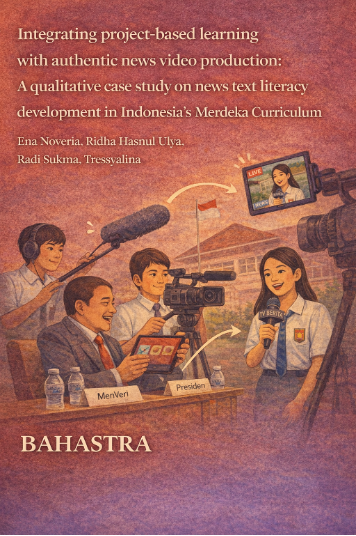
Integrating project-based learning with authentic news video production: A qualitative case study on news text literacy development in Indonesia's Merdeka Curriculum
DOI:
https://doi.org/10.26555/bs.v46i1.2036Keywords:
Authentic Learning , News Text Literacy , Project-Based LearningAbstract
Conventional news text instruction often neglects oral communicative competence, prioritizing written analysis over speaking performance. This study investigates the effectiveness of integrating Project-Based Learning (PjBL) with authentic news video production to enhance seventh-grade students' speaking skills within the Merdeka Curriculum. Employing a qualitative case study design, data were collected through methodological triangulation comprising limited participatory observation, semi-structured in-depth interviews, supportive questionnaires, and documentary analysis of student scripts and video products within a coastal-region SMP. Analysis followed Miles, Huberman, and Saldaña's interactive model through iterative cycles of data reduction, display, and conclusion verification. Findings revealed that 70 percent of students demonstrated enhanced comprehension of news text structure through functional internalization of 5W+1H elements and the inverted pyramid principle during rigorous scriptwriting. Learning motivation increased by 65 percent, attributed to the authentic experience of "becoming real reporters" that conferred social meaning upon academic tasks. Findings indicate that transforming video from passive input to active speaking output significantly improved students' fluency, confidence, and paralinguistic awareness through the 'authentic audience effect.' However, critical analysis reveals that high-stakes performance exacerbated speaking anxiety for marginal learners, necessitating differentiated scaffolding. The study concludes that authentic video production fosters 'performative multiliteracies,' shifting literacy from consumption to embodied public performance. These insights offer educators a critical framework for designing equitable speaking interventions that balance technological innovation with psychological safety.References
Alafnan, M. A. (2025). Enhancing educational outcomes using AlAfnan taxonomy: Integrating cognitive, affective, and psychomotor domains. International Journal of Evaluation and Research in Education, 14(3), 2419-2437. https://doi.org/10.11591/ijere.v14i3.33147
Amadi, A. (2023). Integration in a mixed-method case study of construction phenomena: From data to theory. Engineering, Construction, and Architectural Management, 30(1), 210-237. https://doi.org/10.1108/ECAM-02-2021-0111
Andabayeva, G., Movchun, V., Dubovik, M., Kurpebayeva, G., & Cai, X. (2024). Labor market dynamics in developing countries: Analysis of employment transformation at the macro-level. Journal of Innovation and Entrepreneurship, 13(1), 65. https://doi.org/10.1186/s13731-024-00417-0
Chen, C.-H., & Yeh, H.-C. (2025). Scripted synergy: Elevating EFL writing and creativity through collaborative digital storytelling. Technology, Pedagogy, and Education, 34(1), 91-104. https://doi.org/10.1080/1475939X.2024.2382970
Chen, C., & Lee, T. (2011). Emotion recognition and communication for reducing second‐language speaking anxiety in a web‐based one‐to‐one synchronous learning environment. British Journal of Educational Technology, 42(3), 417-440. https://doi.org/10.1111/j.1467-8535.2009.01035.x
Chen, Y. (2024). Effects of technology-enhanced language learning on reducing EFL learners' public speaking anxiety. Computer Assisted Language Learning, 37(4), 789-813. https://doi.org/10.1080/09588221.2022.2055083
Cladis, A. E. (2020). A shifting paradigm: An evaluation of the pervasive effects of digital technologies on language expression, creativity, critical thinking, political discourse, and interactive processes of human communications. E-Learning and Digital Media, 17(5), 341-364. https://doi.org/10.1177/2042753017752583
Clark, J. M., & Paivio, A. (1991). Dual coding theory and education. Educational Psychology Review, 3(3), 149-210. https://doi.org/10.1007/BF01320076
Cross, J. (2009). Effects of listening strategy instruction on news videotext comprehension. Language Teaching Research, 13(2), 151-176. https://doi.org/10.1177/1362168809103446
Dahlan, M. M., Halim, N. S. A., Kamarudin, N. S., & Ahmad, F. S. Z. (2023). Exploring interactive video learning: Techniques, applications, and pedagogical insights. International Journal of Advanced and Applied Sciences, 10(12), 220-230. https://doi.org/10.21833/ijaas.2023.12.024
Davin, K. J. (2016). Classroom dynamic assessment: A critical examination of constructs and practices. The Modern Language Journal, 100(4), 813-829. https://doi.org/10.1111/modl.12352
Ekstrand, M. D., Wright, K. L., & Pera, M. S. (2020). Enhancing classroom instruction with online news. Aslib Journal of Information Management, 72(5), 725-744. https://doi.org/10.1108/AJIM-11-2019-0309
Elhassan, H. A. M. (2025). Implementation challenges of project based learning during crisis situations: Strategies for educational continuity and quality. British Journal of Teacher Education and Pedagogy, 4(1), 1-11.
Ellens, D. J., Gaidica, M., Toader, A., Peng, S., Shue, S., John, T., Bova, A., & Leventhal, D. K. (2016). An automated rat single pellet reaching system with high-speed video capture. Journal of Neuroscience Methods, 271, 119-127. https://doi.org/10.1016/j.jneumeth.2016.07.009
Farahiba, A. S., Puspitasari, M., Khotimah, K., & Pramithasari, F. A. (2024). Characteristics and relationship between eco-literacy competencies and independent curriculum Indonesian language learning objectives middle school level in Indonesia. Jurnal Kependidikan: Jurnal Hasil Penelitian dan Kajian Kepustakaan di Bidang Pendidikan, Pengajaran, dan Pembelajaran, 10(4), 1392-1402. https://doi.org/10.33394/jk.v10i4.12828
Gidion, M. Z., & Ulya, R. H. (2025). Struktur, isi, dan unsur kebahasaan teks berita siswa kelas VII MTsN 7 Tanah Datar. Edu Research, 6(1), 1835-1849.
Gomez-del Rio, T., & Rodriguez, J. (2022). Design and assessment of a project-based learning in a laboratory for integrating knowledge and improving engineering design skills. Education for Chemical Engineers, 40, 17-28. https://doi.org/10.1016/j.ece.2022.04.002
Goshu, B. S., & Ridwan, M. (2024). Exploring the role of project-based learning in fostering critical thinking skills. Britain International of Linguistics Arts and Education (BIoLAE) Journal, 6(3), 149-166.
Graves, K. (2008). The language curriculum: A social contextual perspective. Language Teaching, 41(2), 147-181. https://doi.org/10.1017/S0261444807004867
Hapsarini, D. R., Erliana, C. I., Irwansyah, D., & Abdullah, D. (2023). Analyzing strategies for strengthening literacy competence at the junior high school level among school teams at the district and city levels in Indonesia. Indonesian Journal of Education (INJOE), 2(3), 561-581.
Hu, X. (2024). Multiliteracies meet new methods: The case for digital writing in English education case study in G-7 countries. Plos One, 19(7), e0304343. https://doi.org/10.1371/journal.pone.0304343
Hunaepi, H., & Suharta, I. (2024). Transforming education in Indonesia: The impact and challenges of the Merdeka belajar curriculum. Path of Science, 10(6), 5026-5039. https://doi.org/10.22178/pos.105-31
Islami, F., & Ulya, R. H. (2025). Pengaruh model project based learning berbantuan media audiovisual terhadap keterampilan menulis teks prosedur siswa kelas VII SMP Pembangunan Laboratorium UNP. EDU RESEARCH, 6(1), 1388-1398.
Karina, L., Ulya, R. H., Tamsin, A. C., & Hafrison, H. (2026). Pengaruh model project based learning berbantuan media autentik terhadap keterampilan menulis teks berita siswa kelas XII SMA Negeri 5 Merangin. Jurnal Manajemen Pendidikan, 14(1).
Kartika, A. (2024). Unveiling the Merdeka curriculum in Indonesia: Insights from educators and policymakers on its effectiveness and implications. INJURITY: Journal of Interdisciplinary Studies, 3(11), 802-819. https://doi.org/10.58631/injurity.v3i11.1378
Kumayas, T., Luntungan, G. S., Arsai, A. N., & Tatipang, D. P. (2025). Curriculum reform meets classroom realities: Selected Indonesian teachers' perspectives on the Merdeka curriculum. REiLA: Journal of Research and Innovation in Language, 7(1), 97-110. https://doi.org/10.31849/5x19dj04
LeeSing, A. C., & Miles, C. A. (1999). The relative effectiveness of audio, video, and static visual computer-mediated presentations. Canadian Journal of Education/Revue Canadienne de l'éducation, 212-221. https://doi.org/10.2307/1585929
Lemana II, H., Casamorin, D., Aguilar, A., Paladin, L., Laureano, J., & Frediles, J. (2023). Affective filters' extent of influence on oral communication: L2 learners' perceptions. International Journal of Educational Management and Development Studies, 4(1), 88-108. https://doi.org/10.53378/352969
Malgoubri, I. (2025). Empowering multilingual learners through culturally sustaining pedagogy and arts-based learning in Burkina Faso (Doctoral dissertation, The University of Nebraska-Lincoln).
Maros, M., Korenkova, M., Fila, M., Levicky, M., & Schoberova, M. (2023). Project-based learning and its effectiveness: Evidence from Slovakia. Interactive Learning Environments, 31(7), 4147-4155. https://doi.org/10.1080/10494820.2021.1954036
Martin, T. (2019). Review of student soft skills development using the 5Ws/H approach resulting in a realistic, experiential, applied, active learning and teaching pedagogical classroom. Journal of Behavioral and Applied Management, 19(1).
Mehmood, T. (2018). Bridging the gap: Change in class environment to help learners lower affective filters. Arab World English Journal, 9(3), 129-144. https://doi.org/10.24093/awej/vol9no3.9
Miles, M. B., Huberman, A.M., & Saldana, J. (2014). Qualitative data analysis: A methods sourcebook.
Mukhlis, M. (2024). The effect of ChatGPT-based project-based learning model and digital literacy on news text writing skills. JOLLT Journal of Languages and Language Teaching, 12(3), 1353-1365. https://doi.org/10.33394/jollt.v12i3.11433
Na, Z., Singh, C. K. S., Jie, D., & Lun, W. W. (2024). Scripting success: A systematic literature review of the process genre approach for writing in Asian education. Перспективы Науки и Образования, 1 (67), 48-69. https://doi.org/10.32744/pse.2024.1.3
Nicolaou, C., Matsiola, M., & Kalliris, G. (2019). Technology-enhanced learning and teaching methodologies through audiovisual media. Education Sciences, 9(3), 196. https://doi.org/10.3390/educsci9030196
Ningsi, T. N., & Ulya, R. H. (2025). Pengaruh project based learning terhadap keterampilan menulis teks biografi siswa fase E SMA Negeri 1 Sutera. Edu Research, 6(1), 1892-1903.
Omelianenko, O., & Artyukhova, N. (2024). Project-based learning: Theoretical overview and practical implications for local innovation-based development. Economics and Education, 9(1), 35-41. https://doi.org/10.30525/2500-946X/2024-1-6
Pintrich, P. R. (2003). A motivational science perspective on the role of student motivation in learning and teaching contexts. Journal of Educational Psychology, 95(4). https://doi.org/10.1037/0022-0663.95.4.667
Pintrich, P. R., Marx, R. W., & Boyle, R. A. (1993). Beyond cold conceptual change: The role of motivational beliefs and classroom contextual factors in the process of conceptual change. Review of Educational Research, 63(2), 167-199. https://doi.org/10.3102/00346543063002167
Rahma, A., Ulya, R. H., Nursaid, N., & Anggraini, D. (2026). Efektivitas PJBL-mind mapping terhadap keterampilan menulis teks tanggapan siswa SMP. Jurnal Manajemen Pendidikan, 14(1).
Rizzolatti, G., Cattaneo, L., Fabbri-Destro, M., & Rozzi, S. (2014). Cortical mechanisms underlying the organization of goal-directed actions and mirror neuron-based action understanding. Physiological Reviews, 94(2), 655-706. https://doi.org/10.1152/physrev.00009.2013
Roche, M., & Haar, J. (2020). Motivations, work-family enrichment and job satisfaction: An indirect effects model. Personnel Review, 49(3), 903-920. https://doi.org/10.1108/PR-06-2019-0289
Ruswandi, R., & Rahmah, L. S. (2025). Students' perceptions of utilizing PBL (Project-based learning) method and using video in writing narrative texts. IDEAS: Journal on English Language Teaching and Learning, Linguistics and Literature, 13(1), 284-304. https://doi.org/10.24256/ideas.v13i1.6332
Saad, A., & Zainudin, S. (2022). A review of Project-Based Learning (PBL) and Computational Thinking (CT) in teaching and learning. Learning and Motivation, 78, 101802. https://doi.org/10.1016/j.lmot.2022.101802
Sinta, D., Faqihuddin, A., Nurhuda, A., & Ab Rahman, E. S. B. E. (2024). The role of digital media in optimizing project-based learning to practice 21st century skills. Educative: Jurnal Ilmiah Pendidikan, 2(3), 129-138. https://doi.org/10.70437/educative.v2i3.477
Stornaiuolo, A., Higgs, J., Nichols, T. P., Leblanc, R. J., & de Roock, R. S. (2024). The platformization of writing instruction: Considering educational equity in new learning ecologies. Review of Research in Education, 47(1), 311-359. https://doi.org/10.3102/0091732X241227431
Susilo, J., Kusmana, S., & Anggraeini, R. (2024). The effectiveness of the project-based learning model assisted by audio visual media in writing opinion texts in vocational schools. BAHASTRA, 44(2), 259-273. https://doi.org/10.26555/bs.v44i2.1043
Wardana, M. P., & Ulya, R. H. (2026). Pengaruh model project based learning berbantuan media mind mapping terhadap keterampilan menulis teks berita siswa kelas VII MTsN 1 Kota Padang. Pendas: Jurnal Ilmiah Pendidikan Dasar, 11(01), 143-157.
Yaros, R. A. (2006). Is it the medium or the message? Structuring complex news to enhance engagement and situational understanding by nonexperts. Communication Research, 33(4), 285-309. https://doi.org/10.1177/0093650206289154
Zammit, K. P. (2011). Connecting multiliteracies and engagement of students from low socio-economic backgrounds: Using Bernstein's pedagogic discourse as a bridge. Language and Education, 25(3), 203-220. https://doi.org/10.1080/09500782.2011.560945
Zhang, L., & Ma, Y. (2023). A study of the impact of project-based learning on student learning effects: A meta-analysis study. Frontiers in Psychology, 14, 1202728. https://doi.org/10.3389/fpsyg.2023.1202728
Additional Files
Published
Issue
Section
License
Copyright (c) 2026 Ena Noveria, Ridha Hasnul Ulya, Radi Sukma, Tressyalina

This work is licensed under a Creative Commons Attribution-ShareAlike 4.0 International License.
1.jpg)