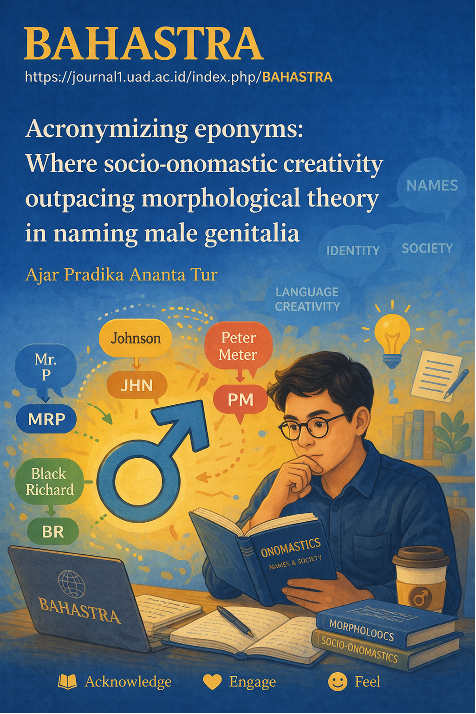
Acronymizing eponyms: Where socio‑onomastic creativity outpacing morphological theory in naming male genitalia
DOI:
https://doi.org/10.26555/bs.v46i1.2006Keywords:
Acronym, Eponym, Male Genitalia , Morphological Process , Socio-OnomasticsAbstract
This study investigates how Indonesian Instagram users craft male genitalia eponyms through acronymization, arguing that this practice is governed not by morphological rules but by socio-onomastic constraints. Analysis of 62 distinct names which were collected via phenomenological netnography and coded against Kridalaksana's sixteen acronym categories reveals that only four categories are attested, with 83.8% of items clustering in the "difficult to formulate" category. This concentration is not a classificatory residue but the central site of linguistic creativity, where users bypass structural regularity in favor of phonological naturalness and cultural salience. Rather than applying morphological rules to construct names, users select a culturally recognizable personal name as a target and retroactively manipulate source phrases to fit that onomastic template which is a process termed here as retrofitted eponymic acronymization. This bidirectional, name-driven process produces irregular acronyms that simultaneously function as taboo euphemisms, in-group solidarity markers, and performances of masculine identity in digital vernacular. These findings expose a fundamental inadequacy in Kridalaksana's framework, which presupposes linear rule-governed morphology and proves insufficient for digital taboo onomastics. The study calls for a hybrid typological model that integrates structural categories with a socio-onomastic creativity index accounting for taboo, identity, and digital context.
References
Abdel-Raheem, A., & Goubaa, M. (2025). Taboo language in a sample of Egyptian op-eds: A corpus-based socio-cognitive study. Discourse & Society, 36(6), 799-822. https://doi.org/10.1177/09579265241271491
Addeo, F., Delli Paoli, A., Esposito, M., & Ylenia Bolcato, M. (2019). Doing social research on online communities: The benefits of netnography. Athens Journal of Social Sciences, 7(1), 9–38. https://doi.org/10.30958/ajss.7-1-1
Ainiala, T., & Östman, J. R. (2017). Socio-onomastics: The pragmatics of names. John Benjamins Publishing Company. https://doi.org/10.1075/pbns.275
Az-Zahra, A. W., Wibowo, A. A., & Tur, A. P. A. (2025). Canting and communication: Women's role in preserving traditional batik culture in Kampung Batik Giriloyo, Yogyakarta. NOTION: Journal of Linguistics, Literature, and Culture, 7(2), 198–214. https://doi.org/10.12928/notion.v7i2.13631
Barrett, R. & Hall, K. (2024). Sexuality discourses: Indexical misrecognition and the politics of sex. Annual Review Anthropology, 53, 127-146. https://doi.org/10.1146/annurev-anthro-052721-092531
Beratha, N. L. S. (2023). The morphological processes of Balish. Linguistics and Culture Review, 7(S1), 144–152. https://doi.org/10.21744/lingcure.v7nS1.2281
Biagi, I. W. K. D. & Suryadmaja, G. (2025). Tren penggunaan slang di kalangan remaja di platform TikTok: Analisis makna dan penyebarannya. Journal of Linguistics and Language Teaching, 1(1), 22–29. https://doi.org/10.71094/jollt.v1i1.47
Bouzioti, D. (2023). Phenomenological research design and the lived experience. International Journal of Qualitative Methods, 22, 1–10. https://doi.org/10.1177/16094069231211142
Calista, A. L., & Tur, A. P. A. (2025). Tendency on power dynamics and social identity through negative sentiment utterances. COMMICAST, 6(3), 417–431. https://doi.org/10.12928/commicast.v6i3.14241
Crespo-Fernández, E. (2025). Taboo language research in the new millennium: A literature review. Complutense Journal of English Studies. 33, e102066. https://doi.org/10.5209/cjes.102066
Deliani, S., Zulkarnain, I., & Harahap, M. H. (2023). Akronim bahasa Indonesia dalam perspektif sosiolinguistik. Kongres Internasional Masyarakat Linguistik Indonesia, 249–255. https://doi.org/10.51817/kimli.v2023i2023.121
Djenar, D. N., & Ewing, M. C. (2015). Language varieties and youthful involvement in Indonesian fiction. Language and Literature: International Journal of Stylistics, 24(2), 108–128. https://doi.org/10.1177/0963947015573387
Fiadotava, A. & Chłopicki, W. (2025). Group boundaries in humor in the online public sphere. HUMOR, 38(1), 69-90. https://doi.org/10.1515/humor-2024-0064
Gede, P., Budasi, I. G., & Ramendra, D. P. (2024). Taboo in Balinese language spoken in Mundeh village: A descriptive qualitative research. Jurnal Impresi Indonesia, 3(1), 37–47. https://doi.org/10.58344/jii.v3i1.4515
Hysenaj, V. (2019). Pragmatics of names. Journal of Linguistic and Intercultural Education, 12(1), 77–88. https://www.anglisticum.org.mk/index.php/IJLLIS/article/view/1919
Kibbey, T. (2024). Linguistics Out of the Closet: The Interdisciplinarity of Gender and Sexuality in Language Science. Berlin, Boston: De Gruyter Mouton. https://doi.org/10.1515/9783110742510
Kovalchuk, O. (2022). Semantics and creation of eponyms in the English-speaking world. Studies in Media and Communication, 10(3), 124–131. https://doi.org/10.11114/smc.v10i3.5842
Kragh, H. (2023). A new literary style of science: The rise of acronyms in physics and astronomy. Physics in Perspective, 25, 175–198. https://doi.org/10.1007/s00016-024-00306-9
Li, S., Kit, C., & Cheng L. (2024). Unveiling the landscape of onomastics from 1972 to 2022. Names: A Journal of Onomastics, 72(3). https://doi.org/10.5195/names.2024.2576
Mahayana, I. M., Suwendri, N. M., & Suastha, P. M. (2025). Patterns of swear words in Denpasar: Anthropological linguistic study. Proceedings of the 3rd Warmadewa International Conference on Science, Technology, and Humanity. https://doi.org/10.4108/eai.27-10-2023.2352792
Manz, N., & McCullough, I. (2025). Eponyms in science: How long can they get? Scientometrics, 130, 3455–3482. https://doi.org/10.1007/s11192-025-05328-9
Mao, X. (2024) An overview of the characteristics of English acronyms. Open Journal of Modern Linguistics, 14, 907-913. https://doi.org/10.4236/ojml.2024.145047
Maraev, V., Breitholtz, E., Howes, C., Larsson, S., & Cooper, R. (2021). Something old, something new, something borrowed, something taboo: Interaction and creativity in humour. Frontiers in Psychology, 12:654615. https://doi.org/10.3389/fpsyg.2021.654615
Meidiani, D.G., Putri, M.L., & Sutjipto, V.W. (2025). Individual relationship analysis: A phenomenon of using instagram second account. WISSEN: Jurnal Ilmu Sosial dan Humaniora, 3(3), 248–264. https://doi.org/10.62383/wissen.v3i3.1067
Mendívil-Giró, J. (2021). Inflection, derivation and compounding. In Routledge handbook of morphology. Routledge. https://doi.org/10.4324/9780429318191-6
Nazri, S. M., & Latiff, A. (2019). Exploring desires and maneuvering on Instagram life: A phenomenology study. Proceeding of International Conference on Communication, Culture and Media Studies (CCCMS). https://journal.uii.ac.id/CCCMS/article/view/12674
Neubauer, B., Witkop, C., & Varpio, L. (2019). How phenomenology can help us learn from the experiences of others. Perspectives on Medical Education, 8(2), 90–97. https://doi.org/10.1007/s40037-019-0509-2
Neupane, P. (2024). Morphological processes in English and Sanskrit: A cross-linguistic study. Vox Batauli, 9(01), 72–79. https://doi.org/10.3126/vb.v9i01.70409
Nurazizah, E., Tur, A. P. A., Evans, M. A., & Jones, D. I. (2024). Depicting the politeness strategy of Tower of God's author. JoREL: Journal of Religion and Linguistics, 1(1), 22–29. https://doi.org/10.31763/jorelv1i1.3
Palupi, A. T. (2024). Netnographic research in understanding social media as a new public sphere. Digital Theory, Culture, and Society, 2(1), 27–36. https://doi.org/10.61126/dtcs.v2i1.31
Pilcher, J., Deakin-Smith, H., Aldrin, E., & Ngyuen, H. T. M. (2024). Name changing and gender: An analysis of name changes made in the United Kingdom via enrolled deed polls, 1998–2019. Journal of Socio-Onomastics, 4(1), 101–136. https://doi.org/10.59589/noso.42024.16876
Pos, D., Mikó, I., Talamas, E., Vilhelmsen, L., & Sharanowski, B. (2023). A revised terminology for male genitalia in Hymenoptera (Insecta), with a special emphasis on Ichneumonoidea. PeerJ, 11, e15874. https://doi.org/10.7717/peerj.15874
Putri, M. P., & Tur, A. P. A. (2024). The role of gestures in shaping the interpretation of speech acts in comics. Indonesian EFL Journal, 10(2), 301–310. https://doi.org/10.25134/ieflj.v10i2.9766
Rausová, J. (2017). Socio-onomastics — Is it possible to define this as a distinct discipline? Onomastica, 61(1), 281–293. https://doi.org/10.17651/onomast.61.1.18
Rimawati, E., Kristina, T., Nugraheni, S., & Margawati, A. (2023). Assessing reproductive health literacy: Terms of sex genital among caregivers in Semarang city. South Eastern European Journal of Public Health, 2, 1–7. https://doi.org/10.56801/seejph.vi.259
Sabrina, A., & Tur, A. P. A. (2023). The aesthetic-poetic translation analysis on Toety Heraty's poetry entitled 'the moon is high'. Metathesis, 7(2), 186–197. https://doi.org/10.31002/metathesis.v7i2.415
Sabrina, A., & Tur, A. P. A. (2025). Politeness maxim representations in Javanese culture: Revitalization strategy to reduce verbal sexual violence. Journal of Religion and Linguistics, 2(1), 15–29. https://doi.org/10.31763/jorel.v2i1.13
Sadat, A., Green, E., Forsythe, I., Munnelly, S., Eaton, G., Wynn, M., Pearson, F., & Dobson, E. (2025). Utilization of netnography as a health care research methodology: Scoping review. Journal of Medical Internet Research, 27, e78025. https://doi.org/10.2196/78025
Sampietro, A. (2024). 9 More than laughter: Multimodal humour and the negotiation of ingroup identities in mobile instant messaging interactions. In B. Priego-Valverde (Ed.), Interactional Humor: Multimodal Design and Negotiation, 263-288. Berlin, Boston: De Gruyter Mouton. https://doi.org/10.1515/9783110983128-010
Saputra, N., & Tur, A. P. A. (2025). Three generational bearers' diverging perception on nicknames in Rokan Hulu, Riau. NOTION: Journal of Linguistics, Literature, and Culture, 7(1), 39–50. https://doi.org/10.12928/notion.v7i1.11699
Sinkeviciute, V. (2019). The interplay between humour and identity construction: From humorous identities to identities constructed through humorous practices. Journal of Pragmatics, 152, 127–131. https://doi.org/10.1016/j.pragma.2019.07.005
Sitaresmi, N., Kusumah, E., Resmini, N., Rahmawati, R., & Johari, J. (2025). Proper name structures in the Sundanese community: Onomastic studies. KEMBARA Journal of Scientific Language Literature and Teaching, 11(1), 155–168. https://doi.org/10.22219/kembara.v11i1.38029
Stehnitska, L., Kiyko, S., & Kyrychenko, O. (2025). Metonymisation of medical eponyms based on personal names and their metonymic patterns in English clinical terminology. Studia Universitatis Babeș-Bolyai Philologia, 70(3), 223–239. https://doi.org/10.24193/subbphilo.2025.3.11
Sun, Y., Wang, G., & Feng, H. (2021). Linguistic studies on social media: A bibliometric analysis. Sage Open, 11(3). https://doi.org/10.1177/21582440211047572
Tavakol, M., & Sandars, J. (2025). Twelve tips for using phenomenology as a qualitative research approach in health professions education. Medical Teacher, 47(9), 1–6. https://doi.org/10.1080/0142159x.2025.2478871
Thomas, S. P., & Sohn, B. K. (2023). From uncomfortable squirm to self-discovery: A phenomenological analysis of the bracketing experience. International Journal of Qualitative Methods, 22. https://doi.org/10.1177/16094069231191635
Tufford, L., & Newman, P. (2010). Bracketing in qualitative research. Qualitative Social Work, 11(1), 80–96. https://doi.org/10.1177/1473325010368316
Tur, A. P. A., & Sabrina, A. (2024). Identifying Javanese cultural norms and addressing politeness maxims in mitigating verbal sexual violence. EduLite: Journal of English Education, Literature, and Culture, 9(1), 82–96. http://dx.doi.org/10.30659/e.9.1.82-96/
Tur, A. P. A., Ahdiani, U., Kurniawan, M. H., & Fadillah, D. (2023). Black comedy alike, how Indonesian middle low citizens communication model teasing about lockdown. Studies in Media and Communication, 11(16), 50–62. https://ideas.repec.org/a/rfa/smcjnl/v11y2023i6p50-62.html
Tur, A. P. A., Daulay, R., & Farida, H. (2024). Shifting echoes: Re-evaluating three generations perspectives on nicknames toward bullying. Humaniora, 15(2), 141–147. https://doi.org/10.21512/humaniora.v15i2.12261
Tur, A. P. A., Daulay, R., & Farida, H. (2025). Negotiating identity: The social transformation of traditional nicknames in the Mandailing community of Riau. International Journal of Society, Culture, & Language, 1–16. https://doi.org/10.22034/ijscl.2025.2048867.3844
Tur, A. P. A., Munandar, A., & Winarti, D. (2023b). Petangan Jawa: Installing traditional values in names. NOTION: Journal of Linguistics, Literature, and Culture, 5(1), 58–68. https://doi.org/10.12928/notion.v5i1.6891
Tur, A. P. A., Sabrina, A., Noor, A. M., Farahsani, Y., Puspita, I., & Kurniawan, M. H. (2023a). Depiction restoring women's power through eatery names. Wacana: Journal of the Humanities of Indonesia, 24(2), 245–267. https://doi.org/10.17510/wacana.v24i2.1159
Tur, A. P. A., Sabrina, A., Noor, A. M., Farahsani, Y., Puspita, I., & Kurniawan, M. H. (2023c). Reclaiming women's power by eatery names in two multicultural cities. International Journal of Communication and Society, 5(1), 58–71. https://doi.org/10.31763/ijcs.v5i1.791
Ubaidillah. (2022). Kerata basa: Gramatika budaya masyarakat Jawa. Jurnal Masyarakat Dan Budaya, 24(2), 207–218. https://doi.org/10.55981/jmb.2022.1586
Völkel, S. (2023). Named entities, naming practices, and their meanings: Linguistic types and cultural contexts. International Journal of Language and Culture, 10(2), 151–175. https://doi.org/10.1075/ijolc.00048.vol
Wharton, T., Bonard, C., Dukes, D., Sander, D., & Oswald, S. (2021). Relevance and emotion. Journal of Pragmatics 181, 259-269. https://doi.org/10.1016/j.pragma.2021.06.001
Wibowo, A. A., Puspita, I., Nugroho, A. S., Nasir, R. M., Nashir, M., Probosiwi, & Tur, A. P. A. (2024). Visual comparison of Rama's and Rahwana's characters in Javanese and Kelantanese wayang kulit. NOTION: Journal of Linguistics, Literature, and Culture, 6(1), 93–111. https://doi.org/10.12928/notion.v6i1.10201
Zaytseva, O., & Katyshev, P. (2023). Names of genitals: Nominative features and their functioning in pornography narrative. Legal Linguistics, 28(39), 96–104. https://doi.org/10.14258/leglin(2023)2816
Additional Files
Published
Issue
Section
License
Copyright (c) 2026 Ajar Pradika Ananta Tur

This work is licensed under a Creative Commons Attribution-ShareAlike 4.0 International License.
1.jpg)