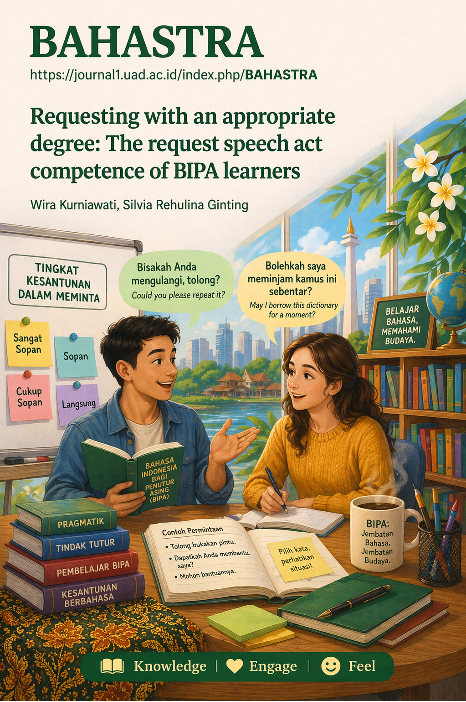
Requesting with an appropriate degree: The request speech act competence of BIPA learners
DOI:
https://doi.org/10.26555/bs.v46i1.1982Keywords:
BIPA Learners, Directive-Request Speech Acts , Pragmatic Competence , Second Language AcquisitionAbstract
BIPA learners not only need to understand the structure of the Indonesian language they are learning, but also its functional aspects in accordance with the situation and context of use. This study aims to analyze the request speech act competence of BIPA learners from the perspective of second language pragmatic acquisition. Based on a sociopragmatic perspective, utilizing the variables of Distance, Power, and Rank of Imposition proposed by Brown & Levinson, eight speech situations were constructed as instruments for data collection. Through a written discourse completion test, 17 upper-intermediate BIPA learners from Taiwan participated as respondents in this study. The data analysis employed the framework of request speech act realization as summarized by Schauer. The findings indicate that the BIPA learners have developed their pragmatic competence in producing request speech acts, although they still face difficulties in adjusting levels of politeness and situational context. Based on the realization of speech acts in terms of core and peripheral elements, the utterances produced tend to be overly long and excessively polite. This tendency is influenced by instructional emphasis on formal language, as well as differences in the pronominal system between Indonesian and Mandarin as their first language. The challenges identified are related to developing pragmatic competence, the influence of first-language cultural norms, and limited experience with real-life contexts. Thus, these upper-intermediate BIPA learners are at a transitional stage and are not yet fully flexible in adapting to contextual demands. The implications of this study highlight the importance of context-based BIPA instruction and the need for more explicit integration of pragmatic aspects in second language learning.
References
Alzeebaree, Y., & Yavuz, M. A. (2017). Realization of the speech acts of request and apology by middle eastern EFL learners. Eurasia Journal of Mathematics, Science, and Technology Education, 13(11), 7313–7327. https://doi.org/10.12973/ejmste/79603
Austin, J. L. (1962). Philosophical papers. Oxford University Press.
Bardovi-Harlig, K., Dörnyei, Z., & Dornyei, Z. (1998). Do language learners recognize pragmatic violations? Pragmatic versus grammatical awareness in instructed L2 learning. TESOL Quarterly, 32(2), 233–259. https://doi.org/10.2307/3587583
Blum-Kulka, S., & Olshtain, E. (1984). Requests and apologies: A cross-cultural study of speech act realization patterns (CCSARP). Applied Linguistics, 5(3), 196–213. https://doi.org/10.1093/applin/5.3.196
Brown, P., & Levinson, S. C. (1987). Politeness: Some universals in language usage. Lodz Papers in Pragmatics. Cambridge University Press. https://doi.org/10.1017/CBO9780511813085
Dadjowidjojo, S. (2008). PSIKOLINGUISTIK: Pengantar pemahaman bahasa manusia. Yayasan Obor Indonesia.
Ekasiswanto, R., Kurniawati, W., & Warouw, N. (2024). Design of BIPA learning based on short story “Basa-basi” for understanding the phenomenon of chit-chat in Indonesian society. Bahastra, 44(2), 224–244. https://doi.org/10.26555/bs.v44i2.1037
Firmansyah, M. R., Mulyati, Y., & Sundusiah, S. (2022). BIPA learners’ perceptions on teacher’s speech act in Indonesian language learning process. Proceedings of the Fifth International Conference on Language, Literature, Culture, and Education (ICOLLITE 2021), 595(Icollite), 448–453. https://doi.org/10.2991/assehr.k.211119.069
Haliq, A., Akhiruddin, A., & Ismail, A. (2025). Culture-based indonesian language program for foreign speakers (BIPA) at BIPA course institutions in Yogyakarta. Eralingua: Jurnal Pendidikan Bahasa Asing dan Sastra, 9(1), 31-48. https://doi.org/10.26858/eralingua.v9i1.66363
Inderasari, E., Hasanah, D. U., Faryabi, A., & Kurniawan, D. N. (2024). Indonesian language learning curriculum for foreign speakers (BIPA) based on moderation at UIN Raden Mas Said Surakarta. Bahastra, 44(1), 79–94. https://doi.org/10.26555/bs.v44i1.662
Iragui, J. C. (1996). Requests and apologies: A comparison between native and non-native speakers of English. Atlantis, 18(1–2), 53–61.
Kartika, D. (2017). Strategi dan penggunaan modifikasi dalam kesantunan tindak tutur memohon oleh mahasiswa Jepang pada program bahasa Indonesia penutur asing (BIPA). Indonesian Language Education and Literature, 2(2), 136–147. https://doi.org/10.24235/ileal.v2i2.1418
Khatimah, K., Ma’ruf, A., & Sulistyowati, S. (2024). Men more polite than women? Gender differences study of bimanese interaction in requesting. Community : Pengawas Dinamika Sosial, 10(1), 57. https://doi.org/10.35308/jcpds.v10i1.8903
Klimczak-Pawlak, A. (2014). Second language learning and teaching. Towards the Pragmatic Core of English for European Communication: The Speech Act of Apologising in Selected Euro-Englishes. Springer. https://doi.org/10.1007/978-3-319-03557-4
Kurniawati, W., Suhandano, & Kushartanti, B. (2021). Sosialisasi bahasa oleh orang tua kepada anak dalam realisasi tindak tutur bahasa pengasuhan anak: Studi pada masyarakat urban Kabupaten Sleman Daerah Istimewa Yogyakarta. Universitas Gadjah Mada.
Linguarum, P. (2025). Pragmatic competence development in refusals by Thai learners of Spanish. November, 11–25. https://doi.org/10.30827/portalin.viXV.33673
Lubis, M.M., Nasution, J., Bakkara, D. H., Kusniawaty, H., & Sembiring, E. S. M. (2025). Indonesian culture in comic media as a learning model for bahasa Indonesia bagi penutur asing (BIPA). Multidisciplinary Indonesian Center Journal (MICJO), 2(2), 918–925. https://doi.org/10.62567/micjo.v2i2.464
Masitoh. (2021). Kesantunan direktif bahasa Indonesia mahasiswa Program Studi Pendidikan Bahasa dan Sastra Indonesia. Jurnal Elsa, 19(2), 113–129. https://doi.org/10.47637/elsa.v19i2.395
Mayrita, H., Andriani, M., & Fransiska, E. J. (2023). Implications of illocutionary speech acts study in language learning for foreigners. ENGLISH FRANCA: Academic Journal of English Language and Education, 7(2), 409–422. https://doi.org/10.29240/ef.v7i2.8037
Mokoro, E. (2024). Pragmatic competence in second language learners. European Journal of Linguistics, 3(2), 15–28. https://doi.org/10.47941/ejl.2044
Morve, R. K., Wen, X., & Mansour, N. (2023). The role of English and the sociocultural structure of Bahasa: A study of Brunei Darussalam. Asian-Pacific Journal of Second and Foreign Language Education, 8(1). https://doi.org/10.1186/s40862-023-00186-5
Nabila, A., & Daulay, H. (2023). Cross-cultural pragmatics failure in ESL classroom. Conference on English Language Teaching, 308–317.
Santoso, N. M. (2019). The learning experiences of foreign language students in a culture trip. Bahasa dan Seni: Jurnal Bahasa, Sastra, Seni, dan Pengajarannya, 47(2), 129–139. https://doi.org/10.17977/um015v47i22019p129
Niu, R., Lu, K., & You, X. (2018). Oral language learning in a foreign language context: Constrained or constructed? A sociocultural perspective. System, 74, 38–49. https://doi.org/10.1016/j.system.2018.02.006
Nuridin, W. (2018). Developing pragmatic competence of Indonesian EFL learners through teaching speech acts of oral and written complaints. Englisia Journal, 6(1), 27–34. https://doi.org/10.22373/ej.v6i1.3167
Oktavianti, N. A., Herniwati, H., & Ansas, V. N. (2021). Positive politeness strategies in expressing requests in the “School 2013” Korean television drama. Journal of Korean Applied Linguistics, 1(1), 13–22. https://doi.org/10.17509/jokal.v1i1.33107
Pamungkas, N. A. R., & Wulandari, L. (2020). Pragmatics in EFL teaching: Avoiding pragmatic failure in cross-cultural communication. ACADEMICIA: An International Multidisciplinary Research Journal, 5(1), 74–91. https://doi.org/10.29407/jetar.v5i1.14310
Periera, S. (2018). Learning Indonesian language and its urgency for students in Timor Leste. ISCE, 2(2), 350–363.
Prameswari, H. Muzaki, I. Suyitno, G. Susanto, Y. N. (2023). ISLLAC : Journal of Intensive Studies on Language, Literature, Art, and Culture. ISLLAC: Journal of Intensive Studies on Language, Literature, Art, and Culture, 7(2), 248–264. https://doi.org/10.17977/um006v7i22023p248-264
Pütz, M., & Neff-Aertselaer, J. A. (2008). Developing contrastive pragmatics: Interlanguage and cross-cultural perspectives. In M. Pütz & J. N. van Aertselaer (Eds.), Developing Contrastive Pragmatics: Interlanguage and Cross-Cultural Perspectives. Walter de Gruyter GmbH & Co. KG. https://doi.org/10.1515/9783110207217
Rahmawati, I. Y., Wulansari, B. Y., Rusdiana, N. I., Pujiati, A., Aziza, R. P., Bariyah, S. K., & Blas, F. (2024). Actualization of Indonesian language and culture for teachers at San Fabian Elementary School Philippines. Satwika : Kajian Ilmu Budaya dan Perubahan Sosial, 8(2), 480–489. https://doi.org/10.22219/satwika.v8i2.35112
Rahmawati, L. E., Hidayat, N., & Kurniawan, A. (2021). Impoliteness of directive speech acts in online Indonesian language learning. Journal of Pragmatics Research, 3(2), 97–107. https://doi.org/10.18326/jopr.v3i2.97-107
Reiter, R. M. (2000). Politeness In Britain and study of requests. John Benjamis Publishing Company.
Rofiuddin, A., Susanto, G., Anggari, P., & Ariani, D. (2019). The integration of Indonesian culture in BIPA learning as a learning model. First International Conference on Advances in Education, Humanities, and Language, 3–7. https://doi.org/10.4108/eai.23-3-2019.2284907
Rose, G., & Kasper K.R. (2002). Pragmatic development in a second language. Pragmatic Development in Second Language Acquisition. Blackwell Publishing. https://doi.org/10.1111/j.1467-1770.2002.tb00022.x
Schauer, G. A. (2009). Interlanguage pragmatic development. Continuum International Publishing Group.
Searle, J. R. (1969). Speech acts: An essay in the philosophy of language. Cambridge University Press. https://doi.org/10.1017/CBO9781139173438
Sun, Q., & Zhang, L. J. (2021). A sociocultural perspective on English-as-a-foreign-language (EFL) teachers’ cognitions about form-focused instruction. Frontiers in Psychology, 12, 1–14. https://doi.org/10.3389/fpsyg.2021.593172
Taguchi, N. (2011). Pragmatic development as a dynamic, complex process: General patterns and case histories. Modern Language Journal, 95(4), 605–627. https://doi.org/10.1111/j.1540-4781.2011.01246.x
Taguchi, N. (2015). Instructed pragmatics at a glance: Where instructional studies were, are, and should be going. Language Teaching, 48(1), 1–50. https://doi.org/10.1017/S0261444814000263
Trosborg, A. (1995). Interlanguage pragmatics. Mouton de Gruyter. https://doi.org/10.1515/9783110885286
Turistiati, A. T., Putra, R.D. K., Jauhari, S. A., & Ramadhan, F. A.H. (2025). Learning the Indonesian language and culture as a gateway to intercultural communication. Dinamisia: Jurnal Pengabdian Kepada Masyarakat, 9(3), 941–948. https://doi.org/10.31849/dinamisia.v9i3.26948
Wirawan, A.K., & Nakti, E. K. M. (2023). ISLLAC: Journal of Intensive Studies on Language, Literature, Art, and Culture, 7(2), 248–264. https://doi.org/10.17977/um006v7i22023p248-264
Yu, X. (2025). Pragmatic failure of college students in cross-cultural communication. OALib, 12(10), 1–10. https://doi.org/10.4236/oalib.1113968
Zhu, W. (2012). Polite requestive strategies in emails: An investigation of pragmatic competence of Chinese EFL learners. RELC Journal, 43(2), 217–238. https://doi.org/10.1177/0033688212449936
Zuchdi, D., & Nurhadi. (2019). Culture based teaching and learning for Indonesian as a foreign language in Yogyakarta. Cakrawala Pendidikan, 38(3), 465–476. https://doi.org/10.21831/cp.v38i3.26297
Additional Files
Published
Issue
Section
License
Copyright (c) 2026 Wira Kurniawati, Silvia

This work is licensed under a Creative Commons Attribution-ShareAlike 4.0 International License.
1.jpg)