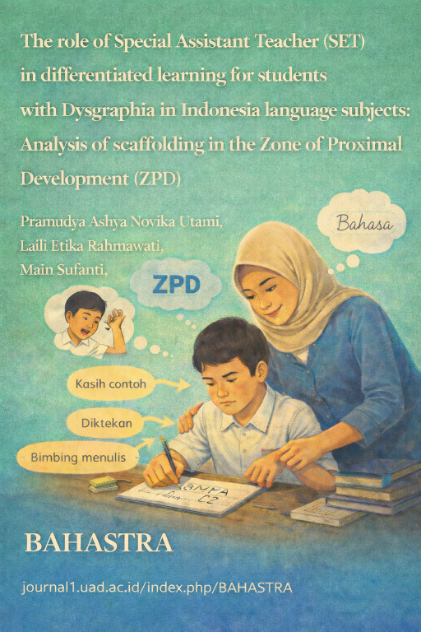
The role of Special Assistant Teacher (SET) in differentiated learning for students with Dysgraphia in Indonesia language subjects: Analysis of scaffolding in the Zone of Proximal Development (ZPD)
DOI:
https://doi.org/10.26555/bs.v46i1.1934Keywords:
Dysgraphia, Special Education Teachers (SETs), Differentiated Instruction, Scaffolding, Zone of Proximal Development (ZPD)Abstract
The urgency of this study is aligned with the fourth goal of the Sustainable Development Goals (SDG) and the fourth mission of Asta Cita Indonesia, which emphasize inclusive and equitable quality education. This study aims to: (1) describe the role of the special assistant teacher (SET) in differentiated learning for dysgraphic students in Indonesian language subjects; (2) explain the function of SET in implementing differentiated learning; and (3) analyze the collaboration between the Indonesian language teacher and SET in supporting dysgraphic students’ learning development. This qualitative study employed participatory observation in class 11 Social Studies at Al-Firdaus High School, Surakarta. Data were collected through classroom observation and interviews with the SET, the Indonesian language teacher, and dysgraphic students. Using scaffolding theory within the zone of proximal development (ZPD) as the analytical framework, the findings show that: (1) SET acts as a “more capable peer” by providing individual mentoring and simplifying instructions to enhance comprehension; (2) SET functions to maintain students’ focus, reduce task complexity, and provide guided examples tailored to students’ needs; and (3) effective collaboration includes joint planning, material and assessment adjustments, and coordinated assistance during learning. The study concludes that scaffolding within the ZPD supports dysgraphic students’ participation and that structured collaboration between SET and subject teachers strengthens inclusive differentiated learning practices.References
Aiyuda, N., Hafizah, N., & Fitria, N. (2025). Becoming an effective shadow teacher: Characteristics, skills, and strategies. KnE Social Sciences, 10(7), 103–117. https://doi.org/10.18502/kss.v10i7.18307
Alhossyan, F. (2023). Collaboration between special and general education teachers: A systematic review. Information Sciences Letters, 12(4), 1021–1029. https://digitalcommons.aaru.edu.jo/cgi/viewcontent.cgi?article=1816&context=isl
Alsudairy, N. A. (2024). Effects of a training program to improve co-teaching and collaboration skills for in-service teachers of special and general education. Sage Open, 14(4). https://doi.org/10.1177/21582440241288076
Chamdani, M., Wahyudi, Suryandari, K. C., & Rahmadani, D. (2025). Pengaruh guru pendamping khusus terhadap implementasi pendidikan inklusif. Social, Humanities, and Educational Studies (SHEs): Conference Series, 1236–1243. https://jurnal.uns.ac.id/SHES/article/view/107376
Demir, S. (2021). The impact of differentiated instructional media on the motivation and opinions of students towards science learning in terms of learning styles. Shanlax: International Journal of Education, 9(3), 16–25. https://doi.org/https://orcid.org/0000-0002-2331-9861
Dwijayati, C. D. C., & Rahmawati, L. E. (2021). Kendala literasi baca tulis sebagai implementasi gerakan literasi nasional di SMA Negeri 1 Pangkalan Bun. Tabasa: Jurnal Bahasa, Sastra Indonesia, dan Pengajarannya, 2(1), 17–32. https://doi.org/10.22515/tabasa.v2i1.2685
Ertugruloglu, E., Mearns, T., & Admiraal, W. (2023). Scaffolding what, why, and how? A critical thematic review study of descriptions, goals, and means of language scaffolding in bilingual education contexts. Educational Research Review, 40, 100550. https://doi.org/10.1016/j.edurev.2023.100550
Frierson, S., Middleton, A., Jones, S., & Tennent, I. (2021). Dysgraphia. Scottish Rite for Children.
Gaitas, S., Sarabando, T., Alves, C., Martins, M. A., Leite, G., & Laranjeira, R. (2025). Teacher instructional arrangements for supporting social and academic needs of students with special educational needs in regular classrooms. European Journal of Special Needs Education, 40(3), 473–488. https://doi.org/10.1080/08856257.2024.2380593.
Gou, P., Li, W., & Teng, T. (2025). Correction: How can scaffolding effectively promote students’ problem-solving ability: A meta-analysis. The Asia-Pacific Education Researcher. https://doi.org/10.1007/s40299-025-01035-4
Hanaa, H., & Evani, E. M. (2022). Peran penting guru pembimbing khusus dalam pendidikan inklusi di SDI Al-Muttaqin. Jurnal Review Pendidikan Dasar: Jurnal Kajian Pendidikan dan Hasil Penelitian, 8(3), 167–171. https://doi.org/10.26740/jrpd.v8n3.p167-171
Kotilainen, N., Sirkko, R., & Takala, M. (2025). Collaboration between subject teachers and special education teachers in finnish lower secondary schools. Education Inquiry, 1–16. https://doi.org/10.1080/20004508.2025.2518776
Kreps, A., Brown, I., Wenzel, T. J., & Cole, R. (2024). Structuring materials to support student learning: analysis of instructional materials from a professional development workshop. Journal of Chemical Education, 101(11), 4603–4613. https://doi.org/10.1021/acs.jchemed.4c00783
Kunhoth, J., Al Maadeed, S., Saleh, M., & Akbari, Y. (2023). Exploration and analysis of on-surface and in-air handwriting attributes to improve dysgraphia disorder diagnosis in children based on machine learning methods. Biomedical Signal Processing and Control, 83, 1–14. https://doi.org/10.1016/j.bspc.2023.104715
Mais, A., & Yaum, L. A. (2025). Innovative differentiated learning for inclusive schools: Supporting students with special needs. Jurnal Kependidikan: Jurnal Hasil Penelitian dan Kajian Kepustakaan di Bidang Pendidikan, Pengajaran, dan Pembelajaran, 11(2), 747–758. https://doi.org/10.33394/jk.v11i2.15089
Maryam, B., Sören, H., & Gunilla, L. (2020). Putting scaffolding into action: Preschool teachers’ actions using interactive whiteboard. Early Childhood Education Journal, 48(1), 79–92. https://doi.org/10.1007/s10643-019-00971-3
Mihajlovic, C. (2024). Perceptions of collaboration between general and special educators in physical education. Adapted Physical Activity Quarterly (APAQ), 41(2), 1–24. https://journals.humankinetics.com/view/journals/apaq/41/2/article-p306.xml
Miles, M. B., Huberman, A. M., & Saldana, J. (2014). Qualitative data analysis: A methods sourcebook (3rd ed.). Sage Publications, Inc.
Montanero, M., Mayo, A. M., Borrero, R., Fernández-Sánchez, M.-J., & Carmona, Á. (2025). Peer tutoring as a strategy for inclusive education in primary education: A case study. International Journal of Inclusive Education, 29(14), 2417–2439. https://doi.org/10.1080/13603116.2024.2352469
Myklebust, J. O. (2023). Special classes and teacher assistants as support measures for students with special educational needs. In Lifelong Learning Book Series, 31, 135–145). https://doi.org/10.1007/978-3-031-24247-2_10
Ningsih, A., Suriansyah, A., Harsono, A. M. B., Annisa, M., & Novitawati. (2024). Kolaborasi guru kelas dan guru pendamping dalam meningkatkan kualitas pembelajaran inklusif. Joyful Learning Journal, 13(4), 101–109. https://journal.unnes.ac.id/journals/jlj/article/view/18071/2625
Pamuji, S. S., & Setyami, I. (2021). Keterampilan berbahasa (1st ed.). Guepedia.
Petersson-Bloom, L., & Holmqvist, M. (2022). Strategies in supporting inclusive education for autistic students—a systematic review of qualitative research results. Autism & Developmental Language Impairments, 7. https://pmc.ncbi.nlm.nih.gov/articles/PMC9620685/
Rahmawati, L. E., Purnomo, E., Hadi, D. A., Wulandari, M. D., & Purnanto, A. W. (2022). Studi eksplorasi bentuk-bentuk gejala disleksia pada anak. Jurnal Obsesi: Jurnal Pendidikan Anak Usia Dini, 6(5), 4003–4013. https://doi.org/10.31004/obsesi.v6i5.2495
Ramlan, S. A., Isa, I. S., Ismail, A. P., Osman, M. K., & Soh, Z. H. C. (2024). Development of potential dysgraphia handwriting dataset. Data in Brief, 54, 1–14. https://doi.org/https://doi.org/10.1016/j.dib.2024.110534
Raslan, G. (2024). The impact of the zone of proximal development concept (Scaffolding) on the students problem solving skills and learning outcomes. BUiD Doctoral Research Conference 2023, 59–66. https://doi.org/10.1007/978-3-031-56121-4_6
Schnepel, S., Luger, S., Wehren-Müller, M., & Moser Opitz, E. (2025). The role of teacher attitudes and collaboration for inclusive teaching practices. Teaching and Teacher Education, 168, 105240. https://doi.org/10.1016/j.tate.2025.105240
SenoTaji, A. D., & Sufanti, M. (2024). Peningkatan keterampilan menulis cerita fiksi melalui metode pendekatan proses. Sastranesia, 12(1), 145–154. https://ejournal.stkipjb.ac.id/index.php/sastra/article/view/3506
Shutaleva, A., Martyushev, N., Nikonova, Z., Savchenko, I., Kukartsev, V., Tynchenko, V., & Tynchenko, Y. (2023). Sustainability of inclusive education in schools and higher education: Teachers and students with special educational needs. Sustainability, 15(4), 3011. https://doi.org/10.3390/su15043011
Stenberg, M., Bengtsson, M., Mangrio, E., & Carlson, E. (2024). Supporting each other towards independence: A Narrative Analysis of first‐year nursing students’ collaborative process. Nursing Inquiry, 31(3). https://doi.org/10.1111/nin.12627
Subianto, P., & Raka, G. R. (2024). Visi, misi, dan program calon presiden dan wakil presiden 2024-2029. https://mmc.tirto.id/documents/2023/10/26/1276-visi-misi-indonesia-maju-2024-final.pdf?x=2676
Susanti, A., & Ngatmini. (2024). Solusi terhadap penderita disleksia dan disgrafia. Multiverse: Open Multidiscplinary Journal, 3(1), 33–39. https://doi.org/https://doi.org/10.57251/multiverse.v3i1.1407
Tilak, S., Gumpert, M., & Myers, T. A. (2025). Effects of technology-mediated professional development on special education teacher collective efficacy. Education and Information Technologies, 30(12), 16487–16513. https://doi.org/10.1007/s10639-025-13432-9
Tomlinson, C. A., & Moon, T. R. (2013). Assessment and student success in a differentiated classroom. ASCD.
United Nations. (2015). The 17 goals. https://Sdgs.Un.Org/Goals
Vioreza, N., Hilyati, W., & Lasminingsih, M. (2023). Education for sustainable development: Bagaimana urgensi dan peluang penerapannya pada kurikulum merdeka? Pusaka: Journal of Educational Review, 1(1), 34–48. https://doi.org/https://doi.org/10.56773/pjer.v1i1.11
Vygotsky, L. S. (1978). Mind in society: The development of higher psychological processes (M. Cole, V. John-Steiner, S. Scribner, & E. Souberman, Eds.). Harvard University Press.
Wearmouth, J. (2023). Special educational needs and disability (4th ed.). Routledge.
Wood, D., Bruner, J. S., & Ross, G. (1976). The role of tutoring in problem solving. Journal of Child Psychology and Psychiatry, 17(2), 89–100. https://doi.org/10.1111/j.1469-7610.1976.tb00381.x
Woolfson, L. M. (2025). Is inclusive education for children with special educational needs and disabilities an impossible dream? British Journal of Educational Psychology, 95(3), 725–737. https://doi.org/10.1111/bjep.12701
YarAhmadi, M., & Behbahani, H. K. (2025). The effect of interventionist dynamic assessment on Iranian EFL learners’ vocabulary learning and retention: A sociocultural inquiry. Language Testing in Asia, 15(1), 2. https://doi.org/10.1186/s40468-024-00337-6
Additional Files
Published
Issue
Section
License
Copyright (c) 2026 Laili Etika Rahmawati, Pramudya Ashya Novika Utami, Main Sufanti

This work is licensed under a Creative Commons Attribution-ShareAlike 4.0 International License.
1.jpg)