The role of track changes in enhancing editing accuracy: Disentangling tool effect and metacognitive learning processes in academic manuscript editing
DOI:
https://doi.org/10.26555/bs.v46i1.1923Keywords:
Academic Manuscript Editing , Cognitive Load , Editing Accuracy , Metacognition, Revision TrackingAbstract
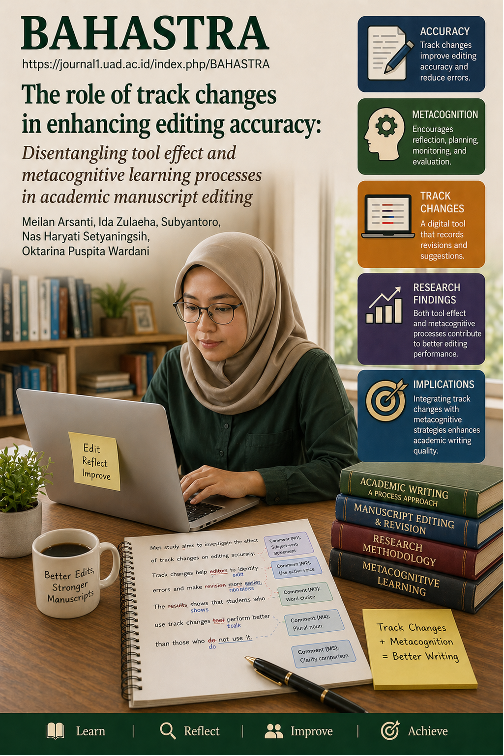
While the digitization of academic editing is often considered to linearly improve performance, the internal mechanisms that differentiate the impact of tools and learning processes are rarely explored. This study aims to analyze the effects of using the Track Changes feature on editing accuracy and its relationship to metacognitive regulation and cognitive load of aspiring editors. Using a quasi-experimental Non-equivalent Control Group Design, this study involved aspiring student editors divided into an experimental group (Track Changes) and a control group (conventional). Data were collected through an editing accuracy test and analyzed using Normalized Gain and Cohen's d effect size. The results showed that the experimental group experienced a significant increase in editing accuracy (g = 0.53) compared to the control group (g = 0.19). Inferential analysis yielded a Cohen's d value of 1.18, indicating a large effect of tool use on editorial performance. These findings demonstrate that Track Changes functions as a cognitive scaffold that reduces external cognitive load, particularly on surface-level errors such as mechanics and typography. However, improvements in logic and discourse were limited, suggesting that this technology is more effective as a metacognitive mediator than as a substitute for higher-order linguistic reasoning. The unique contribution of this study lies in the empirical separation of the tool's technical impact from natural learning progression, which provides a theoretical basis for integrating technology into professional editing education curricula.
References
Aeni, E. S., & Permana, I. (2022). Pemanfaatan fitur track change pada perkuliahan editing di perguruan tinggi. Semantik, 11(2), 203–214. https://doi.org/10.22460/semantik.v11i2.p203-214
Biggs, J., & Tang, C. (2011). Teaching for quality learning at university. McGraw-Hill.
Chapelle, C. A. (2022). Computer-assisted language learning. Language Learning & Technology.
Conijn, R., Speltz, E. D., Zaanen, M. V., Waes, L. V., & Chukharev-Hudilainen, E. (2022). A product- and process-oriented tagset for revisions in writing. Written Communication, 39(1), 97–128. https://doi.org/10.1177/07410883211052104
Davis, F. D. (1993). User acceptance of information technology: System characteristics, user perceptions, and behavioral impacts. International Journal of Man-Machine Studies, 38(3), 475–487. https://doi.org/10.1006/imms.1993.1022
Flavell, J. H. (1979). Metacognition and cognitive monitoring a new area of cognitive—developmental inquiry. American psychologist, 34(10), 906–911. https://doi.org/10.1037/0003-066X.34.10.906
Flower, L., & Hayes, J. R. (1981). A cognitive process theory of writing. College Composition and Communication, 32(4), 365–387. https://doi.org/10.2307/356600
Fraenkel, J. R., Wallen, N., & Hyun, H. (2022). How to design and evaluate research in education.
Hattie, J. (2009). Visible learning. Routledge. https://doi.org/10.4324/9780203887332
Hertzog, C., & Light, L. L. (2004). Memory and aging: Four hypotheses in search of data. Annual Review of Psychology, 55, 333–363. https://doi.org/10.1146/annurev.psych.55.090902.141521
Hutchins, E. (1995). Cognition in the wild. MIT Press. https://doi.org/10.7551/mitpress/1881.001.0001
Hyland, K., & Hyland, F. (2019). Feedback in second language writing. Cambridge University Press. https://doi.org/10.1017/9781108635547
Imre, V., K. (2023). Theorizing technological mediation in the outdoor classroom. Postdigital Science and Education, 5(3), 754–776. https://doi.org/10.1007/s42438-022-00315-2
Kasneci, E., (2023). ChatGPT for good? Nature Human Behaviour, 7, 468–471. https://doi.org/10.1038/s41562-023-01580-3
Klieme, E., Hartig, J., & Rauch, D. (2008). The concept of competence in educational contexts. In J. Har-tig, E. Klieme, & D. Leutner (Eds.), Assessment of competencies in educational contexts. Hogrefe & Huber. https://www.researchgate.net/publication/232495759
Li, S., & Alsanad, A. (2022). Automated writing evaluation systems and academic writing. Computer Assisted Language Learning. https://doi.org/10.1080/09588221.2021.1877085
Lofthus, A. M., & Silseth, K. (2019). Students’ meaning-making in peer group interactions: A sociocultural perspective on learning and writing. Learning, Culture, and Social Interaction, 21, 1–12. https://doi.org/10.1016/j.lcsi.2019.100318
Loginov, A. (2025). Digital metacognition: Awareness, regulation, and analysis of thinking in digital environments. Neurocomputing, 2(4), 100-110. https://doi.org/10.1016/j.nexres.2025.100770
Luo, H., (2025). Designing for metacognition: How digital tools mediate higher-order thinking in online learning. Computers & Education. https://doi.org/10.1016/j.compedu.2024.105120
Marzuki, A. G. (2025). Blended learning and english proficiency: Evaluating digital pedagogies in Indonesian secondary schools. https://doi.org/10.20944/preprints202506.1282.v1
Ng, W. (2021). New digital technology in education. Switzerland: Springer.
Panadero, E. (2017). A review of self-regulated learning. Educational Psychology Review, 29(3), 1–34. https://doi.org/10.3389/fpsyg.2017.00422
Paul, R., & Elder, L. (2019). The miniature guide to critical thinking: Concepts and tools (8th ed.). Foundation for Critical Thinking. https://doi.org/10.5771/9781538133842
Pividori, M., & Greene, C. S. (2024). A publishing infrastructure for artificial intelligence (AI)–assisted academic authoring. Journal of The American Medical Informatics Association, 31(9), 2103–2113.
https://doi.org/10.1093/jamia/ocae139
Posner, M. I., & Petersen, S. E. (1990). The attention system of the human brain. Annual Review of Neuroscience, 13, 25–42. https://doi.org/10.1146/annurev.ne.13.030190.000325
Rahmayanti, P., Oka, I. G. & Putra, I. N. (2020). Improving the students’ writing skills by using track changes in paired writing correction. English Learning Innovation, 1-35. https://doi.org/10.22219/englie.v1i1.13131
Ruan, Q., Kuznetsov, I., & Gurevych, I. (2024). Re3: a holistic framework and dataset for modeling collaborative document revision. https://doi.org/10.18653/v1/2024.acl-long.255
Schraw, G., & Dennison, R. S. (1994). Assessing metacognitive awareness. Contemporary Educational Psychology, 19(4), 460–475. https://doi.org/10.1006/ceps.1994.1033
Setiawan, B., & Purbandini, A. (2021). Pembelajaran penyuntingan teks akademik berbasis digital. Jurnal Pendidikan Bahasa dan Sastra Indonesia, 10(2), 145–156.
Shadish, W. R., Cook, T. D., & Campbell, D. T. (2002). Experimental and quasi-experimental designs for generalized causal inference. Houghton Mifflin, 35(8).
Shulgina. (2024). Visual cues and cognitive load in text editing: An eye-tracking study. Learning and Instruction.
Sugihastuti, S. (2018). Penulis karya ilmiah dan copyediting. Deskripsi Bahasa, 3(1), 30–36. https://doi.org/10.22146/db.v3i1.398
Sweller, J., Ayres, P. & Kalyuga, S. (2011). Cognitive load theory. Springer New York. https://link.springer.com/book/10.1007/978-1-4419-8126-4
Sweller, J. (2019). Cognitive load theory, evolutionary educational psychology, and instructional design (pp. 291–306). https://doi.org/10.1007/978-3-319-29986-0_12
Sweller, J., Van Merriënboer, J. J., & Paas, F. (2019). Cognitive architecture and instructional design: 20 years later. Educational psychology review, 31(2), 261-292. https://doi.org/10.1007/s10648-019-09465-5
Taylor, S. (2020). Educational research and policy: Approaches and perspectives. Routledge.
Teng, F. (2020). The benefits of metacognitive reading strategy awareness instruction for young learners of English as a second language. Metacognition and Learning, 15(2), 251–278. https://doi.org/10.1007/s11409-020-09224-7
Vygotsky, L. S. (1978). Mind in society. Harvard University Press.
Warschauer, M., Tseng, W., Yim, S., Webster, T., Jacob, S., Du, Q., & Tate, T. (2023). The affordances and contradictions of AI-generated text for writers of English as a second or foreign language. Journal of Second Language Writing, 62. https://doi.org/10.1016/j.jslw.2023.101071
Wijaya, A., Van den Heuvel-Panhuizen, M., & Doorman, M. (2016). Opportunity-to-learn context-based tasks provided by mathematics textbooks. Educational Studies in Mathematics, 89(1), 41–65. https://doi.org/10.1007/s10649-015-9595-1
Wijaya, R. A. & Frost, K. (2026). Evaluating the logic of a policy-driven national language test in Indonesia: A critical discursive investigation of the Test of Indonesian Proficiency (UKBI). Language Testing, 43(4), 523-540. https://doi.org/10.1177/02655322251351710
Zakir, S., Hoque, M. E., Susanto, P., Nisaa, V., Alam, M. K., Khatimah, H., & Mulyani, E. (2025). Digital literacy and academic performance: The mediating roles of digital informal learning, self-efficacy, and students’ digital competence. Frontiers in Education, 10, 1590274. https://doi.org/10.3389/feduc.2025.1590274
Additional Files
Published
Issue
Section
License
Copyright (c) 2026 Meilan Arsanti, Ida Zulaeha , Subyantoro Subyantoro, Nas Haryati Setyaningsih

This work is licensed under a Creative Commons Attribution-ShareAlike 4.0 International License.
1.jpg)