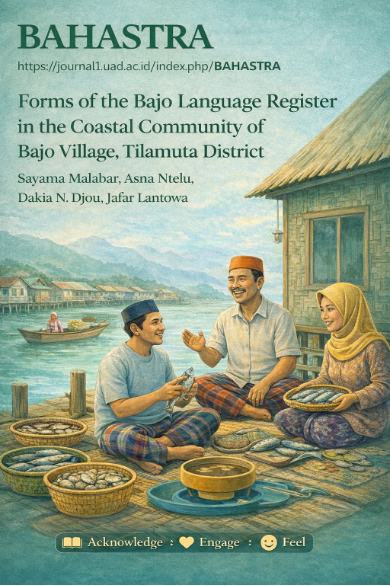
Forms of the Bajo language register in the coastal community of Bajo Village, Tilamuta District
DOI:
https://doi.org/10.26555/bs.v46i1.1852Keywords:
Bajo Language , Bajo Village, Language Register, Sociolinguistics , Tilamuta DistrictAbstract
This study examines the forms of language registers in the Bajo language as used by the coastal community of Bajo Village, Tilamuta District. While previous studies have primarily focused on language attitudes and contact phenomena, this research addresses a critical gap by analyzing how registers operate as domain-specific systems of meaning that organize knowledge, social roles, and everyday practices. Using a qualitative descriptive approach, data were collected through observation and elicitation of naturally occurring utterances across three key domains: fishing, trade, and education. The findings reveal that Bajo registers extend beyond lexical variation and function as structured semiotic systems embedded in social life. In the fishing domain, registers encode ecological knowledge, procedural labor, and maritime cognition through stable lexical items and morphologically marked verbs. In the trading domain, registers construct economic roles, transactional processes, and material classifications, reflecting both market-based and reciprocal forms of exchange. In the educational domain, registers emerge within a context of institutional bilingualism, where Bajo mediates the transmission of formal knowledge, supports classroom interaction, and localizes educational practices. This study argues that Bajo registers function simultaneously as communicative tools, cognitive frameworks, and cultural archives. Their continued use across multiple domains demonstrates that linguistic vitality is sustained not only through attitudes but through the functional integration of language in economic and institutional practices. By foregrounding the epistemic and social dimensions of register, this study contributes to sociolinguistic scholarship on language maintenance in multilingual coastal communities.
References
Abassi, E., & Zatorre, R. J. (2025). Influence of social and semantic contexts on phonetic encoding in naturalistic conversations. The Journal of the Acoustical Society of America, 158(4), 2723–2739. https://doi.org/10.1121/10.0039532
Adams, Z., Ludwiczak, A., Sharma, D., & Osman, M. (2022). Verbal interaction in a social dilemma. Rationality and Society, 34(3), 334–367. https://doi.org/10.1177/10434631221094555
Akmal, S., Masni, M., Koma, A., Faizuddin, A., & ’Ulfitri, N. (2026). Preserving language, resolving conflict: Insights from Aceh and Patani. Jurnal Ilmiah Peuradeun, 14(1), 619–644. https://doi.org/10.26811/peuradeun.v14i1.1898
Al-khresheh, M. H. (2025). The role of heritage language maintenance in shaping identity and cohesion among migrant populations: A case study of Saudi Arabia. International Journal of Population Studies, 12(1), 46. https://doi.org/10.36922/ijps.7070
Ambrish, I., Sodhi, S., & Liberman, Z. (2025). Does children’s developing understanding of linguistic register impact their social preferences? Social Development, 34(2), e12797. https://doi.org/10.1111/sode.12797
Antunes, N., Schiefenhövel, W., d’Errico, F., Banks, W. E., & Vanhaeren, M. (2020). Quantitative methods demonstrate that environment alone is an insufficient predictor of present-day language distributions in New Guinea. PLOS ONE, 15(10), e0239359. https://doi.org/10.1371/journal.pone.0239359
Arifin, A., Anriani, H. B., & Bahri, S. (2020). The strategy for preventing cramp and barotrauma disease towards Bajo divers in Taka Bonerate, Indonesia. Enfermería Clínica, 30, 119–121. https://doi.org/10.1016/j.enfcli.2019.07.059
Awal, A. (2024). Endangered languages: A systematic qualitative study of socio-cultural impacts and revitalisation. Sustainable Multilingualism, 25(1), 65–101. https://doi.org/10.2478/sm-2024-0013
Badara, A., Marwati, M., Fahruddin, F., & Suardika, K. (2019). Maritime ecolexicon in bajo community of Kolaka regency coast and its implications for ecology. IOP Conference Series: Earth and Environmental Science, 382(1), 012032. https://doi.org/10.1088/1755-1315/382/1/012032
Boni, Y., Afiat, N., Suyuti, N., Jumaidin, L. O., & Melati, M. (2024). Preserving coastal and marine resources: The existence of local wisdom among the Bajau Tribe. Journal of Global Innovations in Agricultural Sciences, 663–671. https://doi.org/10.22194/JGIAS/24.1336
Boutet, J., Fiala, P., & Simonin-Grumbach, J. (2025). Sociolinguistics or sociology of language. International Journal of the Sociology of Language, 2025(292), 41–57. https://doi.org/10.1515/ijsl-2024-0057
Creswell, J. W., & Creswell, J. D. (2018). Research design: Qualitative, quantitative, and mixed methods approaches (Fifth edition). SAGE.
Díaz, N. Y. (2022). A multidimensional analysis of two registers of English for Navy submariners. Language Value, 15(2), 81–111. https://doi.org/10.6035/languagev.7019
Ekawati, R. (2019). Power through linguistic modalities in Indonesian presidential speeches. Discourse and Interaction, 12(1), 5–28. https://doi.org/10.5817/DI2019-1-5
Fang, Z., Cao, P., & Murray, N. (2020). Language and meaning making: Register choices in seventh- and ninth-grade students’ factual writing. Linguistics and Education, 56, 100798. https://doi.org/10.1016/j.linged.2020.100798
Gal, S. (2019). Making registers in politics: Circulation and ideologies of linguistic authority. Journal of Sociolinguistics, 23(5), 450–466. https://doi.org/10.1111/josl.12374
Gaparalievich, K. K., Adylbekova, B. Y., & Amin, M. Y. M. (2024). Quantifying linguistic heritage: Philological insights for high-impact language preservation. E-Learning and Digital Media, 20427530241268427. https://doi.org/10.1177/20427530241268427
Goulart, L. (2022). Register variation in understudied academic contexts. Research in Corpus Linguistics, 10(2), i–v. https://doi.org/10.32714/ricl.10.02.01
Goulart, L., Gray, B., Staples, S., Black, A., Shelton, A., Biber, D., Egbert, J., & Wizner, S. (2020). Linguistic perspectives on register. Annual Review of Linguistics, 6(1), 435–455. https://doi.org/10.1146/annurev-linguistics-011718-012644
Halliday, M. A. K. (1978). Language as social semiotic: The social interpretation of language and meaning. Edward Arnold.
Holmes, J. (2013). An introduction to sociolinguistics (4. ed). Routledge. https://doi.org/10.4324/9781315833057
Hudson, R. A. (2012). Sociolinguistics (2. ed). Cambridge Univ. Press. https://doi.org/10.1017/CBO9781139166843
Jalaludin, N., & Maulud, I. (2021). Sikap bahasa penutur bahasa Bajo di Kota Ternate: Tinjauan sosiolinguistik. TEKSTUAL, 19(1), 12. https://doi.org/10.33387/tekstual.v19i1.3087
Jódar, F. R. (2019). On lexical preferences in colloquial and formal registers in L1 and L2. Studia Romanica Posnaniensia, 46(4), 149–162. https://doi.org/10.14746/strop.2019.464.013
Kaneyasu, M., & Kuhara, M. (2020). Dimensions of recipe register and native speaker knowledge: Observations from a writing experiment. Pragmatics. Quarterly Publication of the International Pragmatics Association (IPrA), 30(4), 532–556. https://doi.org/10.1075/prag.18053.kan
Kulkarni, M. (2015). Language‐based diversity and faultlines in organizations. Journal of Organizational Behavior, 36(1), 128–146. https://doi.org/10.1002/job.1954
Kundra, S., Sarwal, A., Prasad, R. R., & Singh, R. (2025). Safeguarding linguistic diversity in Fiji: An overview of Indigenous language revitalisation. Cogent Arts & Humanities, 12(1), 2581224. https://doi.org/10.1080/23311983.2025.2581224
Li, H., Dunn, J., & Nini, A. (2023). Register variation remains stable across 60 languages. Corpus Linguistics and Linguistic Theory, 19(3), 397–426. https://doi.org/10.1515/cllt-2021-0090
Mallinson, C. (2024). Linguistic variation and linguistic inclusion in the US educational context. Annual Review of Linguistics, 10(1), 37–57. https://doi.org/10.1146/annurev-linguistics-031120-121546
Masullo, C., Casado, A., Leivada, E., & Sorace, A. (2025). Register variation and linguistic background modulate accuracy in detecting morphosyntactic errors. Isogloss. Open Journal of Romance Linguistics, 11(1), 1–36. https://doi.org/10.5565/rev/isogloss.527
Moleong, L. J. (1989). Metologi penelitian kualitatif. PT Remaja Rosdakarya.
Michon, E. (2021). Language use and professional discourse as an important component of forensic anthropology. Forensic Anthropology, 3(4). https://doi.org/10.5565/rev/isogloss.527
Miles, M. B., & Huberman, A. M. (1994). Qualitative data analysis: An expanded sourcebook. Sage.
Miles, M. B., Huberman, A. M., & Saldaña, J. (2014). Qualitative data analysis: A methods sourcebook (Third edition). SAGE Publications, Inc.
Ntelu, A., Malabar, S., Djou, D., & Lantowa, J. (2022). Pemertahanan bahasa Bajo di Kabupaten Boalemo. Salingka, 19(1), 75–96.
Padilla-Iglesias, C., Gjesfjeld, E., & Vinicius, L. (2020). Geographical and social isolation drive the evolution of Austronesian languages. PLOS ONE, 15(12), e0243171. https://doi.org/10.1371/journal.pone.0243171
Parera, J. D. (1988). Morfologi. Penerbit PT Gramedia.
Pescuma, V. N., Serova, D., Lukassek, J., Sauermann, A., Schäfer, R., Adli, A., Bildhauer, F., Egg, M., Hülk, K., Ito, A., Jannedy, S., Kordoni, V., Kuehnast, M., Kutscher, S., Lange, R., Lehmann, N., Liu, M., Lütke, B., Maquate, K., … Knoeferle, P. (2023). Situating language register across the ages, languages, modalities, and cultural aspects: Evidence from complementary methods. Frontiers in Psychology, 13, 964658. https://doi.org/10.3389/fpsyg.2022.964658
Puumala, E., & Maïche, K. (2021). Whether you like it or not, this is the future! : Everyday negotiations of the community’s boundary in urban space. Citizenship Studies, 25(6), 808–824. https://doi.org/10.1080/13621025.2021.1968718
Raviv, L., Meyer, A., & Lev‐Ari, S. (2020). The role of social network structure in the emergence of linguistic structure. Cognitive Science, 44(8), e12876. https://doi.org/10.1111/cogs.12876
Rymes, B., & Smail, G. (2021). Citizen sociolinguists scaling back. Applied Linguistics Review, 12(3), 419–444. https://doi.org/10.1515/applirev-2019-0133
Sharma, D. (2017). Scalar effects of social networks on language variation. Language Variation and Change, 29(3), 393–418. https://doi.org/10.1017/S0954394517000205
Sifatu, W. O., Bahtiar, & Sueratman, N. E. A. (2019). Synchronization of local knowledge with formal regulations supporting natural resource conservation in Bajo communities in West Muna District. IOP Conference Series: Earth and Environmental Science, 382(1), 012029. https://doi.org/10.1088/1755-1315/382/1/012029
Smaldino, P. E. (2019). Social identity and cooperation in cultural evolution. Behavioural Processes, 161, 108–116. https://doi.org/10.1016/j.beproc.2017.11.015
Sudaryanto. (2015). Metode dan aneka teknik analisis bahasa: Pengantar penelitian wahana kebudayaan secara linguistis. Sanata Dharma University Press.
Szmrecsanyi, B., & Engel, A. (2023). A variationist perspective on the comparative complexity of four registers at the intersection of mode and formality. Corpus Linguistics and Linguistic Theory, 19(1), 79–113. https://doi.org/10.1515/cllt-2022-0031
Takwa, T. & Sarmadan. (2025). Relasi kekerabatan bahasa Bugis dengan bahasa Bajo di Sulawesi Tenggara. Arus Jurnal Psikologi dan Pendidikan, 4(2), 104–113. https://doi.org/10.57250/ajpp.v4i2.1280
Temirgazina, Z. K. (2019). The number of participants as a communicative situation factor: A typology of situations with three participants. RUDN Journal of Language Studies, Semiotics, and Semantics, 10(1), 108–120. https://doi.org/10.22363/2313-2299-2019-10-1-108-120
Tuan, M. N., Thi Thanh Thuy, P., Cuong, H. H. N., & Hien, N. T. (2025). On determining multiple languages through technological examination for conservation management using machine learning. Forum for Linguistic Studies, 7(5). https://doi.org/10.30564/fls.v7i5.9110
Wardhaugh, R., & Fuller, J. M. (2015). An introduction to sociolinguistics (Seventh edition). Wiley Blackwell.
Yudiastini, N. M. (2019). Kontak bahasa antara komunitas tutur bahasa Bajo dengan komunitas tutur bahasa Sasak di Pulau Lombok. MABASAN, 2(1), 114–130. https://doi.org/10.26499/mab.v2i1.127
Yurchenko, A., Arutiunian, V., Maas Shitova, N., Bergelson, M., & Dragoy, O. (2023). Register switching involving lexical-semantic processing in Russian: An ERP study. Journal of Neurolinguistics, 65, 101111. https://doi.org/10.1016/j.jneuroling.2022.101111
Zhunussova, T. B., & Ryspayeva, D. S. (2025). Formation of cultural values: Case study in the era of globalization. Journal of Culture and Values in Education, 8(3), 138–158. https://doi.org/10.46303/jcve.2025.31
Additional Files
Published
Issue
Section
License
Copyright (c) 2026 Sayama Malabar, Asna Ntelu, Jafar Lantowa

This work is licensed under a Creative Commons Attribution-ShareAlike 4.0 International License.
1.jpg)