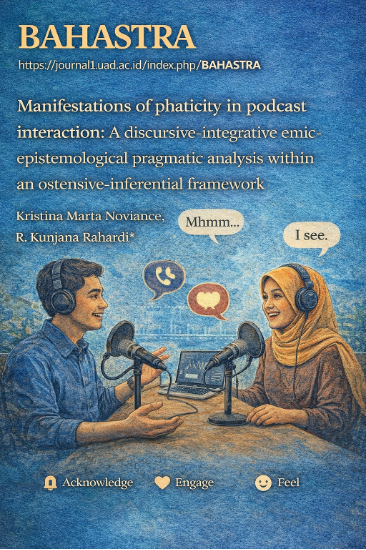
Manifestations of phaticity in podcast interaction: A discursive-integrative emic- epistemological pragmatic analysis within an ostensive-inferential framework
DOI:
https://doi.org/10.26555/bs.v46i1.1841Keywords:
Communication Third-Wave Pragmatics , Discursive Pragmatics , Phatic Communion, Podcast Interaction, Ostensive-InferentialAbstract
This study investigates the manifestations and pragmatic meanings of phaticity in podcast interactions through a discursive-integrative emic–epistemological pragmatic approach grounded in the ostensive–inferential framework. The research aims to uncover how phatic practices are produced, interpreted, and function interactionally within contemporary podcast discourse. The data consist of podcast utterances that exemplify various forms of phatic communion in natural language use. The substantive data source comprises podcast discourse containing identifiable phatic elements, while the locational data source includes a range of podcasts accessed throughout the research period. Data were collected using a non-participatory observation method, specifically through close and repeated listening to the selected podcast episodes. A systematic note-taking technique was employed to document relevant phatic expressions, enabling effective data organization, categorization, and analytical traceability. Data collection was deemed complete once all instances had been exhaustively classified into analytically relevant types serving as the basis for interpretation. Data analysis was conducted using a contextual pragmatic method that integrates conventional context and virtual context, with particular attention to the multimodal cybertextual environment of podcast interactions. In line with the principles of third-wave pragmatics, the analysis also incorporates social, societal, and cultural dimensions, emphasizing participants’ emic perspectives while maintaining epistemological rigor. The analytical procedure involved data identification, classification or reduction, pragmatic interpretation, and systematic presentation of findings. The findings reveal three dominant manifestations of pragmatic meanings of phaticity in podcast interactions: (1) greeting-related phatic meanings, functioning to initiate and sustain interpersonal engagement; (2) humor-related phatic meanings, serving to build rapport and interpersonal alignment; and (3) emphasis-related phatic meanings, which reinforce attentiveness and interactional involvement. These findings demonstrate that phaticity in podcast discourse operates as a dynamic pragmatic resource shaped by inferential intentions, discursive context, and digitally mediated interaction.References
Adu-Amankwah, D., & McDowell, J. (2003). An ethnopragmatic study of jokes and joking in an Akan community. Folklore.
Alexander, J. C. (2006). Cultural pragmatics: Social performance between ritual and strategy. Social Performance: Symbolic Action, Cultural Pragmatics, and Ritual. https://doi.org/10.1017/CBO9780511616839.002
Ameka, F. (1992). The meaning of phatic and conative interjections. Journal of Pragmatics, 291(23). https://doi.org/10.1001/jama.291.23.2840
Arundale, R. B. (2013). Face as a research focus in interpersonal pragmatics: Relational and emic perspectives. Journal of Pragmatics, 58, 108-120. https://doi.org/10.1016/j.pragma.2013.05.013
Barbulet, G. (2013). Social Media- A pragmatic Approach: Contexts & Implicatures. Procedia - Social and Behavioral Sciences, 83, 422-426. https://doi.org/10.1016/j.sbspro.2013.06.083
Bezemer, J., & Jewitt, C. (2018). Multimodality: A guide for linguists. Research Methods in Linguistics (2nd Edition).
Bezemer, J., & Kress, G. (2016). Multimodality, learning and communication: A social semiotic frame. In Multimodality, Learning and Communication: A Social Semiotic Frame. https://doi.org/10.4324/9781315687537
Bhattacharyya, S. (2013). Banter: An Alternative Strategy in Creating a Learning Community. Creative Education, 04(03). https://doi.org/10.4236/ce.2013.43030
Heyes, B. S. (2020). Just banter? Friendship, teasing, and experimental aggression in adolescent peer networks. Developmental Science, 23(3). https://doi.org/10.1111/desc.12926
Carbaugh, D., & van Over, B. (2013). Interpersonal pragmatics and cultural discourse. Journal of Pragmatics, 58, 142-145. https://doi.org/10.1016/j.pragma.2013.09.013
Chatting, D., Kirk, D. S., Yurman, P., & Bichard, J.-A. (2015). Designing for family phatic communication. Proceedings of the 2015 British HCI Conference on-British HCI ’15. https://doi.org/10.1145/2783446.2783566
Coupland, J., Coupland, N., & Robinson, J. D. (1992). “How are you?”: Negotiating phatic communion. Language in Society. https://doi.org/10.1017/S0047404500015268
de Saussure, L. (2013). Cognitive pragmatics ways into discourse analysis: The case of discursive presuppostions. Lodz Papers in Pragmatics, 8(1). https://doi.org/10.1515/lpp-2012-0004
Driver, C. (2019). Triadicity, thirdness, and the transcendent function. The Self and the Quintessence. https://doi.org/10.4324/9781315207834-4
Fox, N. J., & Alldred, P. (2023). Applied research, diffractive methodology, and the research-assemblage: Challenges and opportunities. Sociological Research Online, 28(1). https://doi.org/10.1177/13607804211029978
Frosh, P. (2011). Phatic morality: Television and proper distance. International Journal of Cultural Studies, 14(4). https://doi.org/10.1177/1367877911403248
Goddard, C. (2010). Ethnosyntax, ethnopragmatics, sign-functions, and culture. Ethnosyntax: Explorations in Grammar and Culture. https://doi.org/10.1093/acprof:oso/9780199266500.003.0003
Senft, G. (2012). Phatic communion Gunter. Max Planck Institute for Psycholinguistics.
Harley, D. (2013). Scholarly communication: Cultural contexts, evolving models. Science, 342(6154). https://doi.org/10.1126/science.1243622
Haugh, M. (2006). Emic perspectives on the positive-negative politeness distinction. Culture, Language and Representation, 3(October).
Haugh, M., Kadar, D. Z., & Michael, M. (2013). Interpersonal pragmatics: Issues and debates. Journal of Pragmatics, 58, 1-11. https://doi.org/10.1016/j.pragma.2013.09.009
Hickey, C., & Roderick, M. (2022). When jokes aren’t funny: Banter and abuse in the everyday work environments of professional football. European Sport Management Quarterly, 24(2), 383-403. https://doi.org/10.1080/16184742.2022.2124299
Kazemian, B. (2018). Discursive pragmatics: Handbook of pragmatics highlights. Intercultural Pragmatics.
Kobuta, S. (2022). Pragmatic functions of the stylstic devices in the author’s chracteristics of the supporting characters in “Death of a Hero” by Richard Aldington. Journal of Vasyl Stefanyk Precarpathian National University, 9(2). https://doi.org/10.15330/jpnu.9.2.53-61
Kulkarni, D. (2014). Exploring Jakobson’s “phatic function” in instant messaging interactions. Discourse and Communication, 8(2). https://doi.org/10.1177/1750481313507150
Lau, C., Chiesi, F., & Saklofske, D. H. (2022). The heart of humor: A network analysis of the temperamental basis of humor and humor personality traits. Personality and Individual Differences, 185. https://doi.org/10.1016/j.paid.2021.111253
Lawless, W., & Magrath, R. (2021). Inclusionary and exclusionary banter: English club cricket, inclusive attitudes and male camaraderie. Sport in Society, 24(8). https://doi.org/10.1080/17430437.2020.1819985
Locher, M. A., & Graham, S. L. (2010). Interpersonal pragmatics. Interpersonal Pragmatics. https://doi.org/10.1515/9783110214338
Mahsun. (2007). Metode penelitian bahasa: Tahapan strategi, metode, dan tekniknya (Edisi Revisi). Raja Grafindo Persada.
Marsh, D. (1989). Small talk—analysing phatic discourse. RELC Journal, 20(2). https://doi.org/10.1177/003368828902000209
Maulida, F., Rozi, F., & Pratama, H. (2022). Creation of humorous situation by flouting conversational maxims accompanied by facial expression in “Friends.” English Education Journal, 12(1). https://doi.org/10.15294/eej.v12i1.51956
Mey, J. L. (2002). Symbolic domination and postcolonial contestation: Resources and conditions. Journal of Pragmatics, 34(3), 285-330. https://doi.org/10.1016/S0378-2166(02)80003-0
Nicolle, S., & Clark, B. (1998). Phatic interpretations: Standarisation and conventionalisation. Revista Alicantina de Estudios Ingleses, 11. https://doi.org/10.14198/raei.1998.11.14
Onwuegbuzie, A., & Leech, N. (2005). On becoming a pragmatic researcher: The importance of combining quantitative and qualitative research methodologies. International Journal of Social Research Methodology: Theory and Practice, 8(5), 375-387. https://doi.org/10.1080/13645570500402447
Pang, S. L., & Samp, J. A. (2022). Goals, power, and similarity: Responses to banter in initial interactions. Western Journal of Communication, 87(3), 370-391. https://doi.org/10.1080/10570314.2022.2142918
Wardman, P. N. (2021). Humour or humiliation? When classroom banter becomes irresponsible sledging in upper-primary school contexts. Discourse, 42(3), 394-407. https://doi.org/10.1080/01596306.2019.1707777
Porter, J. E. (2017). Professional communication as phatic. Business and Professional Communication Quarterly, 80(2). https://doi.org/10.1177/2329490616671708
Rahardi, R. K. (2017). Language phatic in specific culture perspective. 1st International Conference on Education, Language, and Arts, 1165–1174.
___________. (2019). Phatic communion in the perspective of language dignity. Journal of Language and Literature, 19(2), 91-97. https://doi.org/10.24071/joll.v19i2.2133
___________. (2019a). Contexts as the determining roles of Javanese phatic ‘Monggo’: Culture-specific pragmatics perspective. Indonesian Language Education and Literature, 5(1), 47-60. https://doi.org/10.24235/ileal.v5i1.5035
___________. (2019b). Integrating social, societal, cultural, and situational context to develop pragmatics course learning materials: Preliminary study. Jurnal Gramatika: Jurnal Penelitian Pendidikan Bahasa dan Sastra Indonesia, 5(2). https://doi.org/10.22202/jg.2019.v5i2.3572
___________. (2019c). Pragmatic perspective on phatic functions and language dignity in a culture-based society. Asia Proceedings of Social Sciences. https://doi.org/10.31580/apss.v4i1.554
___________. (2023). Social–societal context element changes in cyberpragmatics perspective. Theory and Practice in Language Studies, 13(11), 2771–2779. https://doi.org/10.17507/tpls.1311.06
Rahardi, R. K., & Budhiono, R. H. (2024). Information layers of ostentive communication of hoaxes in the perspective of relevance theory of Sperber &. SUAR BETANG, 19(2), 207–218. https://doi.org/10.26499/surbet.v19i2.23484
Rahardi, R. K., & Firdaus, W. (2023). Expert judgements of integrated cyberpragmatics learning model with socio-semiotics multimodality-based cybertext contexts. Aksara, 35(2). https://doi.org/10.29255/aksara.v35i2.4160.211--227
Sugiyo, R., & Purwastuti, L.A. (2017). Local wisdom-based character education model in elementary school in Bantul Yogyakarta Indonesia. Sino-US English Teaching. https://doi.org/10.17265/1539-8072/2017.05.003
Schandorf, M. (2013). Mediated gesture: Paralinguistic communication and phatic text. Convergence. https://doi.org/10.1177/1354856512439501
Scollon, R., & Scollon, S. W. (2001). Intercultural communication: A discurse approach. SocioLinguistics. https://doi.org/10.1128/EC.00123-08
Scott-Phillips, T. C. (2015). Nonhuman primate communication, pragmatics, and the origins of language. Current Anthropology, 56(1). https://doi.org/10.1086/679674
Sikka, T. (2008). Pragmatics, poststructuralism, and hermeneutics: An examination of discursive-consensus formation and its ethical implications. Journal of Pragmatics, 40(2). https://doi.org/10.1016/j.pragma.2006.11.004
Sun, Y., Wang, G., & Feng, H. (2021). Linguistic studies on social media: A bibliometric analysis. SAGE Open, 11(3). https://doi.org/10.1177/21582440211047572
Wang, V., & Tucker, J. V. (2016). Phatic systems in digital society. Technology in Society, 46, 140-148. https://doi.org/10.1016/j.techsoc.2016.06.002
Waskul, D., & Lust, M. (2004). Role-playing and playing roles: The person, player, and persona in fantasy role-playing. Symbolic Interaction, 27(3). https://doi.org/10.1525/si.2004.27.3.333
Wilson, D. (2003). Relevance and lexical pragmatics. Pragmatics.
___________. (2017). Irony, hyperbole, jokes and banter. In Formal Models in the Study of Language: Applications in Interdisciplinary Contexts. https://doi.org/10.1007/978-3-319-48832-5_11
Ye, W., & Kang, S. H. (2017). The evolved survival of SM entertainment in the Chinese market: Legitimation strategies and organizational survival. Kritika Kultura. https://doi.org/10.13185/KK2017.02913
Žegarac, V., & Clark, B. (1999). Phatic interpretations and phatic communication. Journal of Linguistics, 35(2). https://doi.org/10.1017/S0022226799007628
Additional Files
Published
Issue
Section
License
Copyright (c) 2026 KRISTINA MARTA NOVIANCE

This work is licensed under a Creative Commons Attribution-ShareAlike 4.0 International License.
1.jpg)