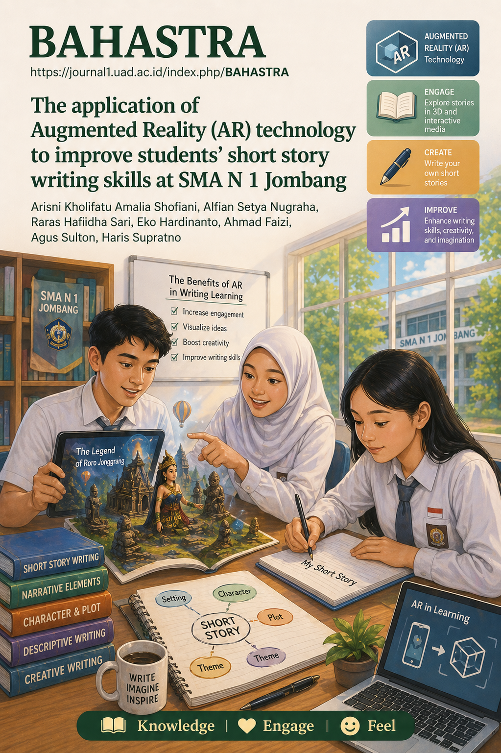
The application of Augmented Reality (AR) technology to improve students' short story writing skills at SMA N 1 Jombang
DOI:
https://doi.org/10.26555/bs.v46i1.1772Keywords:
Augmented Reality , Technology Based Learning, Writing Short StoriesAbstract
This study aims to analyze the effectiveness of the application of Augmented Reality technology. Reality (AR) in improving the short story writing skills of high school students, who still face obstacles in developing ideas, narrative structure, and learning motivation. The study used a quasi-experimental design with a pre-test and post-test. control group This design involved 60 eleventh-grade students at SMA Negeri 1 Jombang. Data were collected through short story writing tests, motivational questionnaires, and interviews, and analyzed using paired- reference tests. sample t- test, independent t- test, and effect The results showed that the experimental group using AR experienced a significant increase compared to the control group, with an average score increase of 25.95% compared to 7.05%. Statistical tests showed a significant difference (p < 0.05) with an effect The size of the medium-high category. In addition, students' learning motivation in the experimental group was higher (8.5/10) than in the control group (6/10). These findings indicate that AR effectively improves the quality of short story writing in terms of ideas, narrative structure, and language style, as well as increasing student engagement in learning. This study contributes to the development of technology-based writing learning models by systematically integrating AR into the writing process. The limitations of the study lie in the limited duration of the intervention and the narrow sample scope. Future research is recommended to test the implementation of AR on a wider scale and over a longer period.
References
Al-haddad, S., Chick, N., Safi, F., Al-haddad, S., Chick, N., & Safi, F. (2024). Teaching statistics: A technology-enhanced supportive instruction ( TSI ) model during the covid-19 pandemic and beyond. Journal of Statistics and Data Science Education, 0(0), 1–23. https://doi.org/10.1080/26939169.2024.2315939
Al‑Refaey, S. R. (2022). Using mobile augmented reality applications for enhancing EFL writing skills of early childhood education students and their engagement. Mansoura University.
Al-Ali, R., & Wardat, Y. (2025). The effectiveness of using augmented reality technology in science education to enhance creative thinking skills among gifted eighth‑grade students. EJ MSTE, 21(6), em2644. https://doi.org/10.29333/ejmste/16416
Alfa, D. N., & Astuti, T. (2025). Development of digital learning media integrated with augmented reality on the material of intrinsic elements of fictional texts. Jurnal Kependidikan, 11(1), 293-304. https://doi.org/10.33394/jk.v11i1.13672
Askarian, M., Movahedi, M., Vardanjani, H. M., Askarian, A., & Ghotbabadi, Z. R. (2023). Roadmap to recovery: Implemented and attitude toward school reopening strategies during the COVID-19 pandemic, a scoping review. Journal of education and health promotion, 12(1), 235. https://doi.org/10.4103/jehp.jehp_1160_22
Aslam, M. (2024). Testing normality of data for uncertain level of significance. Journal of Statistical Theory and Applications, 23(4), 480–499. https://doi.org/10.1007/s44199-024-00098-4
Babatimehin, T., Christiana, O., & Ogungbaigbe, T. S. (2025). Assessing the effect size and homogeneity of selected standardized tests in education. JOSSE, 3(2), 92–118. https://doi.org/10.37812/josse.v3i2.1829
Baiti, N. B. (2024). Development of augmented reality‑based flipbook media to build creativity, imagination, and writing skills. Science: Journal of Educational Research.
Borsuk, A., & Bouse, B. (2012). Between page and screen: Remaking literature through art and technology. siglio press.
Chang, H. Y. (2022). Ten years of augmented reality in education: A meta‑analysis of 134 (quasi)‑experimental studies. Computers & Education, 187, 104504. https://doi.org/10.1016/j.compedu.2022.104641
Chen, C.-H., Koong, C.-S., & Liao, C. (2022). Influences of integrating dynamic assessment into a speech recognition learning design to support students’ English speaking skills, learning anxiety, and cognitive load. Educational Technology & Society, 25(1), 1–14.
Cohen, W. G., Zhang, B., Lee, D. R., Ampah, S. B., Sobol, S. E., & Cook-Sather, S. D. (2023). Middle ear condition at the time of pediatric myringotomy tube placement: Pain associations following intraoperative fentanyl/ketorolac and seasonal variation. Anesthesia & Analgesia, 136(5). https://doi.org/10.1213/ANE.0000000000006230
Cui, F., Zhao, W., Mu, D.-L., Zhao, X., Li, X.-Y., Wang, D.-X., Jia, H.-Q., Dai, F., & Meng, L. (2021). Association between cerebral desaturation and postoperative delirium in thoracotomy with one-lung ventilation: A prospective Cohort study. Anesthesia & Analgesia, 133(1).
https://doi.org/10.1213/ANE.0000000000005489
Darmawansah, D., Lin, C.-J., & Hwang, G.-J. (2022). Empowering the collective reflection-based argumentation mapping strategy to enhance students’ argumentative speaking. Computers & Education, 184, 104516. https://doi.org/10.1016/j.compedu.2022.104516
Dureja, R., & Madduri, B. (2023). A rare case of bilateral Phthiriasis palpebrarum with crab louse. Indian Journal of Ophthalmology-Case Reports, 3(1), 148-150. https://doi.org/10.4103/ijo.IJO_1819_22
Elsayir, H. A. (2024). The role of effect size and significance test in research design and analysis. Edelweiss applied science and technology, 8(6), 287-295. https://doi.org/10.55214/25768484.v8i6.2062
Ford, D. R. (2023). Teaching the actuality of revolution: Aesthetics, unlearning, and the sensations of struggle. Iskra Books.
Garg, A., Azad, S., & Radhakrishnan, S. (2021). Percutaneous paravalvular leak closure with their outcomes: A single center experience. Annals of Cardiac Anaesthesia, 24(3), 302-307. https://doi.org/10.4103/aca.ACA_157_20
Geroimenko, V. (Ed.) . (2020). Augmented reality in education: A new technology for teaching and learning. Springer Nature. https://doi.org/10.1007/978-3-030-42156-4
Gupta, A., Wadhwa, J., Aggarwal, V., Mehta, N., Abraham, D., Aneja, K., & Singh, A. (2022). Anesthetic efficacy of supplemental intraligamentary injection in human mandibular teeth with irreversible pulpitis: A systematic review and meta-analysis. J Dent Anesth Pain Med, 22(1), 1–10. https://doi.org/10.17245/jdapm.2022.22.1.1
Hapsari, T. P. R. ‑N., & Wulandari, A. (2020). Analisis kelayakan buku ajar milenial berbasis Augmented Reality (AR) sebagai media pembelajaran teks prosedur di Magelang. Diglosia: Jurnal Kajian Bahasa, Sastra, dan Pengajarannya, 3(4), 351–364. https://doi.org/10.30872/diglosia.v3i4.125
Hapsari, T. P. R. ‑N., Wulandari, A., Harefa, R. T., Lase, W. N., Telaumbanua, R., Bawamenewi, A., Puspita, R., Putro, W. W., & Yugopuspito, P. (2020). Augmented reality untuk meningkatkan keterampilan menulis, berbicara, keterampilan berpikir kritis dalam pembelajaran Bahasa Indonesia kelas V SD. Journal on Education, 6(9), 79–88. https://www.jurnalsyntaxadmiration.com/index.php/jurnal/article/view/1515
Harefa, R. T., Lase, W. N., Telaumbanua, R., & Bawamenewi, A. (2023). Pengembangan media augmented reality untuk meningkatkan kemampuan menulis teks deskripsi siswa SMP. Journal on Education, 6(1), 3241–3247. https://doi.org/10.31004/joe.v6i1.3379
Henuk, E. (2025). Kemampuan menulis cerpen berdasarkan pengalaman dan menemukan penulisan kata dan kesalahan penggunaan: Analisis siswa kelas XI. Ciencias: Jurnal Ilmiah Pendidikan Bahasa dan Sastra Indonesia.
Heydemans, C. (2024). Systematic literature review: Use of augmented reality as a tool in educational settings. Learning Technology Journal.
Huang, L., & Musah, A. A. (2024). The influence of augmented reality on creativity, student behavior, and pedagogical strategies in technology‑infused education management. Journal of Pedagogical Research, 8(2), 260–275. https://doi.org/10.33902/JPR.202425376
Ibáñez, M.-B., & Delgado-Kloos, C. (2018). Augmented reality for STEM learning: A systematic review. Computers & Education, 123, 109–123. https://doi.org/10.1016/j.compedu.2018.05.002
Kazlaris, G. C., Keramopoulos, E., Bratsas, C., & Kokkonis, G. (2025). Augmented reality in education through collaborative learning: A systematic literature review. Multimodal Technologies and Interaction, 9(9), 94. https://doi.org/10.3390/mti9090094
Lakens, D. (2013). Calculating and reporting effect sizes to facilitate cumulative science: A practical primer for T-tests and ANOVAs. Frontiers in Psychology, 4, 1–12. https://doi.org/10.3389/fpsyg.2013.00863
Li, M., Wang, X.-X., Chen, Y., & Cukurova, M. (2026). Augmented reality and generative learning in K-12 writing: Performance outcomes and the mediating roles of motivation and metacognition. Computers & Education, 244, 105538. https://doi.org/10.1016/j.compedu.2025.105538
Lin, H., Wan, S., Gan, W., Chen, J., & Chao, H.-C. (2022). Metaverse in education: Vision, opportunities, and challenges. ArXiv pre‑print. https://doi.org/10.1109/BigData55660.2022.10021004
Maulana, I. (2024). The impact of virtual and augmented reality on enhancing higher‑order thinking skills (HOTS): A study in Indonesian context. International Conference on Smart Learning Environments, 3(1). https://doi.org/10.57142/picsar.v3i1.377
McLaren, B. M., Richey, J. E., Nguyen, H., & Hou, X. (2022). How instructional context can impact learning with educational technology: Lessons from a study with a digital learning game. Computers & Education, 178, 104366. https://doi.org/10.1016/j.compedu.2021.104366
Mishra, P., Pandey, C. M., Singh, U., Gupta, A., Sahu, C., & Keshri, A. (2019). Descriptive statistics and normality tests for statistical data. Annals of Cardiac Anaesthesia, 22(1). https://doi.org/10.4103/aca.ACA_157_18
Niyas, V. K. M., Rahulan, S. D., Arjun, R., & Sasidharan, A. (2021). ICU-acquired candidemia in covid-19 patients: An experience from a tertiary care hospital in Kerala, South India. 4–5.
Novitaningrum, A. (2023). Empowering teachers with augmented reality (AR) tools to enhance students’ writing skills. Journal of Community Service, 1(2), 66–71.
Oto-millera, N., Pellicer-ortín, S., & Bustamante, J. C. (2025). Augmented reality in English language acquisition among gifted learners: A systematic scoping review (2020-2025). Appl. Sci. 15, 11487. https://doi.org/10.3390/app152111487
Özdemir, E. Ç., & Akyol, H. (2021). Effect of augmented reality‑based reading activities on some reading variables and class participation. International Journal of Progressive Education, 17(4). https://doi.org/10.29329/ijpe.2021.366.9
___________. (2022). The design of augmented reality‑based synectic model device in writing short stories. Mediasi: Jurnal Komunikasi, Seni, dan Pembelajaran.
Puspita, R. (2020). Peningkatan keterampilan menulis cerpen siswa: Studi di Jurnal Sarasvati. Jurnal Sarasvati, 79–88.
Radianti, J., Majchrzak, T. A., Fromm, J., & Wohlgenannt, I. (2020). A systematic review of immersive virtual reality applications for higher education: Design elements, lessons learned, and research agenda. Computers & Education, 147, 103778. https://doi.org/10.1016/j.compedu.2019.103778
Rahayu, N. I., Muktiarni, M., & Hidayat, Y. (2024). ASEAN journal of science and engineering an application of statistical testing: A guide to basic parametric statistics in educational research using SPSS. ASJE, 4(3), 569–582. https://doi.org/10.17509/ajse.v4i3.76092
Rohman, A. N., Mustofa, M., & Heriyawati, D. F. (2024). The use of augmented reality‑based learning media: A descriptive qualitative study in English learning. FTL Journal, 9(1), 1-18. https://doi.org/10.18196/ftl.v9i1.18789
Sari, N. W. A. P., Sudrajat, Y., Casande, S., Syarif, M., & Monarchi, A. M. (2024). Augmented reality in improving writing skills learning experiences in vocational high school students. JTP-Jurnal Teknologi Pendidikan, 26(3), 860-872. https://doi.org/10.21009/jtp.v26i3.49844
Setiawan, A., Yunitasari, I., Pratiwi, D. J., Dela, Y. I., & Jatmiko, W. A. (2025). Developing augmented reality-based flashcards to enhance science literacy in elementary schools. Pedagogia: Jurnal Ilmiah Pendidikan, 17(1), 90-103. https://doi.org/10.55215/pedagogia.v17i1.49
Setiawan, J. D., Ihsan, M. S., Saputro, R., Munadi, M., Paryanto, P., & Alimi, S. (2022). Evaluation and development of wireless monitoring systems for an autonomous sailboat. Journal of Physics: Conference Series, 2193(1), 012050. IOP Publishing. https://doi.org/10.1088/1742-6596/2193/1/012050
Sugiri, V. E., & Cahyadi, R. (2020). Terapan augmented reality untuk buku cerita “Petualangan Jaka Aksara.” Jurnal Multimedia dan IT, 4(2), 18–30. https://doi.org/10.46961/jommit.v4i2.333
Tashakkori, A., & Teddlie, C. (2003). Handbook of mixed methods in social & behavioral research.
Tolibovna, Q. M. (2023). The role of augmented reality in developing writing skills. International Journal of Future Education, 7(1), 45–60.
Trikotama, R. M. A. (2024). Application of augmented reality in education: urgency in Society 5.0 in Indonesia. Jurnal HIPKIN JER.
Usodo, B., & Budhi, E. (2025). Effectiveness of augmented reality application on critical thinking skills of elementary school students based on learning interest. Jurnal JPSD, 12(1), 39–49. https://doi.org/10.26555/jpsd.v12i1.a30760
Utama, N. W. (2025). Pengembangan media pembelajaran berbasis flipbook digital untuk kemampuan menulis teks deskripsi. Jurnal Riset Ilmu Pendidikan, Bahasa, dan Budaya, 2(3), 244–252. https://doi.org/10.61132/semantik.v2i3.851
Wayan, N., Permata, A., Sudrajat, Y., & Casande, S. (2024). Augmented reality in improving writing skills learning experiences in vocational high school students. Jurnal Teknologi Pendidikan, 26(3), 860–872. https://doi.org/10.21009/jtp.v26i3.49844
Additional Files
Published
Issue
Section
License
Copyright (c) 2026 Arisni Kholifatu Amalia Shofiani, Alfian Setya Nugraha, Raras Hafiidha Sari; Eko Hardinanto; Agus Sulton; Ahmad Faizi; Haris Supratno

This work is licensed under a Creative Commons Attribution-ShareAlike 4.0 International License.
1.jpg)