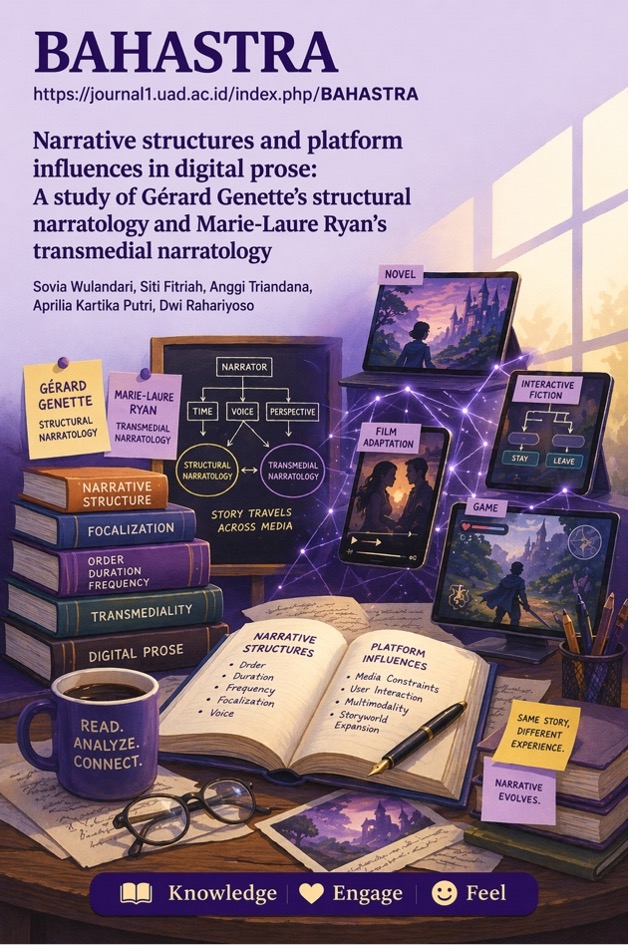
Narrative structures and platform influences in digital prose: A study of Gérard Genette’s structural narratology and Marie-Laure Ryan’s transmedial narratology
DOI:
https://doi.org/10.26555/bs.v46i1.1741Abstract
The main aim of this research is to elaborate the narrative structure of digital prose across various online platforms and examine how digital media characteristics influence storytelling forms. A qualitative approach and the integration of Gérard Genette’s structural narratology with Marie-Laure Ryan’s transmedial narratology are applied. The object of this research is the selected texts from Wattpad, Webtoon, Fizzo, and Karyakarsa. The findings of this research show that digital prose tends to apply linear yet accelerated and fragmented narrative structures, characterized by dominant internal focalization and homodiegetic narration to enhance reader engagement. Furthermore, each platform shapes narrative configuration differently. For example, Webtoon emphasizes multimodal and spatialized storytelling, Wattpad facilitates participatory, community-driven narrative; third, Fizzo promotes compressed, fast-paced storytelling; and fourth, Karyakarsa integrates a narrative production with social and economic interaction. These results reveal that digital prose is not simply an extension of printed literature, but it is a platform-dependent narrative form which is shaped by the interaction between textual strategies (narratology structure) and technological affordances (transmedial narratology). This study contributes to digital narratology by highlighting how platform features actively reconfigure narrative structures and reader–text relationships in contemporary storytelling.
References
Angelina, W., Nugroho, A., & Sari, I. P. (2025). Analisis struktur naratif kumpulan cerpen remaja antibaper toxic karya Walidah Ariyani, dkk. Jurnal Perspektif Pendidikan, 19(1), 30-39. https://doi.org/10.31540/jpp.v19i1.3437
Archie The RedCat. (2020). Sri Asih [Webtoon comic]. Ilustrated by Devita Krisanti. https://www.webtoons.com/id/fantasy/sri-asih/list?title_no=1975
Ariana, R. (2025). Diamnya istriku. https://www.fizzo.org/page/share/?bid=7879095358024842493&isNew=1&from=copy_link&group=2&d=8004348200971564798&language=id®ion=ID
Bell, A., Ensslin, A., & Rustad, H. K. (Eds.). (2014). Analyzing digital fiction. Routledge. https://doi.org/10.4324/9780203078112
Bell, A., Ensslin, A., Van der Bom, I., & Smith, J. (2018). Immersion in digital fiction. International Journal of Literary Linguistics, 7(1), 1-22. https://doi.org/10.15462/ijll.v7i1.105
Bold, M. R. (2018). The return of the social author: Negotiating authority and influence on Wattpad. Convergence: The International Journal of Research into New Media Technologies, 24(2), 117–136. https://doi.org/10.1177/1354856516654459
Clerc, J., Lourdeaux, D., Sallak, M., Barbier, J., & Ravaine, M. (2025). Modeling interactive narrative systems: A formal approach. Arxiv preprint arxiv:2508.05653.
Cohn, N. (2013). The visual language of comics: Introduction to the structure and cognition of sequential images. Bloomsbury.
Creswell, J. W., & Poth, C. N. (2016). Qualitative inquiry and research design: Choosing among five approaches. Sage publications.
Denzin, N. K., & Lincoln, Y. S. (2018). The sage handbook of qualitative research (5th ed.). Sage.
Ensslin, A. (2014). Literary gaming. MIT Press. https://doi.org/10.7551/mitpress/9450.001.0001
Ermawan, E., Fitriana, R., & Mugiyanti, M. (2019). Analisis naratologi cerpen Mihime karya. IDEA: Jurnal Studi Jepang, 1(1), 1-12. https://doi.org/10.33751/idea.v1i1.1086
Flick, U. (2014). An introduction to qualitative research (5th ed.). Sage.
Genette, G. (1980). Narrative discourse: An essay in method. Cornell University Press.
Hanafi, H. (2024). Narrative structures and reader agency in hypertext fiction: A comparative analysis of selected literary texts. The Creative Launcher Journal. https://doi.org/10.53032/tcl.2024.9.5.15
Holdstock, S. (2024). Using interactive fiction to stimulate metalinguistic talk in the English classroom. Literacy, 58(1), 48-57. https://doi.org/10.1111/lit.12348
Hossain, M. S. (2025). Digital narratives and reader engagement: Transforming literary forms in the digital era. Asian Journal of Education and Social Studies, 51(4), 97–108. https://doi.org/10.9734/ajess/2025/v51i41851
Jenkins, H. (2006). Convergence culture: Where old and new media collide. New York University Press.
Khlifi, R. (2025). Digital narrative in Shelley Jackson’s patchwork: Hypertext as a mode of reading and writing. International Journal of Language and Literary Studies, 7(2), 462-475. https://doi.org/10.36892/ijlls.v7i2.2045
Kornel, N. (2020). Seriality in digital storytelling: Episodic structures in web-based narratives. Narrative Inquiry, 30(2), 345–367.
Kress, G., & van Leeuwen, T. (2001). Multimodal discourse: The modes and media of contemporary communication. Arnold Publishers.
Liguori, A., Sung, K. J., McLaughlin, L., & Stuttle, J. (2023). What digital storytelling means to the new generation of researchers. Social Sciences, 12(9), 485. https://doi.org/10.3390/socsci12090485
Lim, H. S., & Lee, Y. H. (2009). A study on the characteristics of visual storytelling in webtoons. Journal of the Korea Contents Association, 9(5), 259–268.
Liu, Y., & Sun, J. (2021). Exploring user engagement in online creative communities: Motivations and participation patterns. Online Information Review, 45(1), 56–74.
Lullaby, L. (2018). Dear J. https://www.wattpad.com/story/162526316-%E2%9C%94-1-dear-j
Miles, M. B., Huberman, A. M., & Saldaña, J. (2014). Qualitative data analysis: A methods sourcebook (3rd ed.). Sage.
Mittell, J. (2015). Complex TV: The poetics of contemporary television storytelling. New York University Press.
Mulyaningtyas, R., & Ekafebriyanti, V. (2021). Pemanfaatan noveltoon sebagai media pembelajaran prosa di SMA. Tabasa: Jurnal Bahasa, Sastra Indonesia, dan Pengajarannya, 2(2), 87-106. https://doi.org/10.22515/tabasa.v2i2.3938
Nisya, R. K., & Sutrisna, D. (2024). Transformasi cerita anak ke dalam bentuk digital mahasiswa program studi Pendidikan Bahasa dan Sastra Indonesia. Jurnal Genre (Bahasa, Sastra, dan Pembelajarannya), 6(2), 400-411. https://doi.org/10.26555/jg.v6i2.11597
Novy, C. (2024). Hello, KKN! https://karyakarsa.com/Citranovy/series/hello-kkn
Page, R. (2018). Narratives online: Shared stories and social media. Cambridge University Press. https://doi.org/10.1017/9781316492390
Permatasari, W., Munir, S., & Noviadi, A. (2024). Struktur sastra dalam novel Gita Cinta dari SMA karya Eddy D. Iskandar. Diksatrasia: Jurnal Ilmiah Pendidikan Bahasa dan Sastra Indonesia, 8(2), 482-492. https://doi.org/10.25157/diksatrasia.v8i2.15193
Palinkas, L. A., Horwitz, S. M., Green, C. A., Wisdom, J. P., Duan, N., & Hoagwood, K. (2015). Purposeful sampling for qualitative data collection and analysis in mixed method implementation research. Administration and Policy in Mental Health and Mental Health Services Research, 42(5), 533–544. https://doi.org/10.1007/s10488-013-0528-y
Phillips, J. (2017). Janet H. Murray, Hamlet on the holodeck: The future of narrative in cyberspace. MIT Press.
Ridholia, A. R., Purnamasari, H., & Amrullah, I. (2023). Struktur naratif dalam novel Spoiler karya Dita Safitri: Kajian naratologi. LOA: Jurnal Ketatabahasaan dan Kesusastraan, 18(1). https://doi.org/10.26499/loa.v18i1.5250
Roth, C., Bender-Salazar, R., & Pitt, B. (2025). Stories and systems: Educational interactive storytelling to teach media literacy and systemic thinking. ArXiv preprint arXiv:2508.11059.
Rukmanah, H., & Nurjanah, N. (2025). Struktur naratif dan nilai budaya dalam wawacan Selarasa: Analisis teks naskah kuno hasil transliterasi di situs Sipena. Jaladri: Jurnal Ilmiah Program Studi Bahasa Sunda, 11(1), 28-33. https://doi.org/10.33222/jaladri.v11i1.4531
Ryan, M.-L. (2004). Narrative across media: The languages of storytelling. University of Nebraska Press.
___________. (2013). Transmedial narratology and transmedia storytelling. Poetics Today, 34(3), 361–388. https://doi.org/10.1215/03335372-2325250
Sandelowski, M. (2010). What's in a name? Qualitative description revisited. Research in Nursing & Health, 33(1), 77–84. https://doi.org/10.1002/nur.20362
Saputra, A., & Qadriani, N. (2024). Teknik penceritaan dalam novel Laut Bercerita karya Leila S. Chudori (Analisis narratologi Gerard Genette). Canon: Jurnal Penelitian Bahasa dan Sastra, 2(2), 139-152.
Scolari, C. A. (2009). Transmedia storytelling: Implicit consumers, narrative worlds, and branding in contemporary media production. International Journal of Communication, 3, 586–606.
Skains, R. L. (2022). Neverending stories: The popular emergence of digital fiction. Bloomsbury Publishing. https://doi.org/10.5040/9781501364914
Tsabita, A. S., Harini, Y. N. A., & Aisyah, N. L. (2025). Konstruksi naratif KKN di Desa Penari dalam utasan postingan, novel, dan film: Kajian sastra bandingan. Tonil: Jurnal Kajian Sastra, Teater, dan Sinema, 22(1), 1-14. https://doi.org/10.24821/tnl.v22i1.14306
Universitas Sanata Dharma. (2023, Oktober 23). Sastra digital: Sebuah genre baru yang butuh pendekatan baru. https://web.usd.ac.id/fakultas/sastra/detail.php?id=berita&noid=1281
Wright, T. B., & Weible, J. L. (2024). Current attitudes on digital interactive fiction and text adventure games within learning contexts: A systematic literature review. Journal of Research in Science, Mathematics, and Technology Education, 7(1), 23-51. https://doi.org/10.31756/jrsmte.713
Additional Files
Published
Issue
Section
License
Copyright (c) 2026 Sovia Wulandari, Siti Fitriah, Anggi Triandana, Aprilia Kartika Putri, Dwi Rahariyoso

This work is licensed under a Creative Commons Attribution-ShareAlike 4.0 International License.
1.jpg)