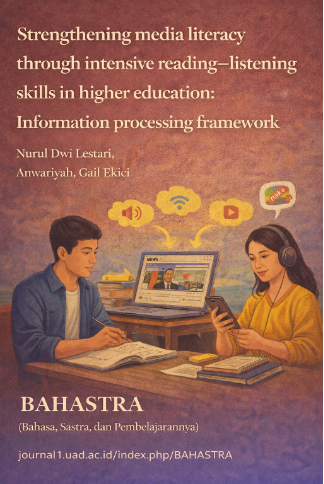
Strengthening media literacy through intensive reading–listening skills in higher education: Information processing framework
DOI:
https://doi.org/10.26555/bs.v46i1.1660Keywords:
Intensive reading, Intensive listening, Media literacyAbstract
Intensive reading and listening skills are things that need to be optimized for students of the Indonesian Language Education Study Program at UIN Kediri. This is because the profile of graduates of this study program, one of which is to become novice educators in the field of Indonesian. This study aims to describe (1) the dominance of micro skills in understanding academic discourse, (2) the limitations of macro-level meaning in intensive reading and listening, and (3) the reconstruction of micro-macro relationships in language learning theory. The method in this study uses a mixed research method that combines qualitative and quantitative methods. This study uses a Concurrent Design model. The results of the study show that of the six indicators of intensive reading skills, there is one indicator that needs to be improved, namely the ability to find the main idea. Meanwhile, the other five indicators have met the effectiveness aspect. As for the four indicators of intensive listening skills, there are two indicators that need to be improved, namely inferential listening and reorganization. Learning innovations as an implication of these findings, among others, can be carried out through the use of gradual scaffolding, development of question banks, combining bottom-up and top-down strategies, paraphrasing activities, identifying keywords, utilizing HOTS questions, and other innovative exercises.References
Alonzo, D., Oo, C. Z., Wijarwadi, W., & Hannigan, C. (2025). Using social media for assessment purposes: Practices and future directions. Frontiers in psychology, 13, 1075818. https://doi.org/10.3389/fpsyg.2022.1075818
Anderson, L. W., & Krathwohl, D. R. (2001). A taxonomy for learning, teaching, and assessing: A revision of Bloom’s taxonomy of educational objectives. Longman.
Anderson, L. W., & Krathwohl, D. R. . A. (2016). Taxonomy for learning, teaching, and assessing: A revision of Bloom’s taxonomy of educational objectives. Pearson.
Anderson, R. C., & Pearson, P. D. (1984). A schema-theoretic view of basic processes in reading.
Aryadoust, V., & Luo, L. (2023). The typology of second language listening constructs: A systematic review. Language Testing, 40(2), 375-409. https://doi.org/10.1177/02655322221126604
Asmayawati., Yufiarti., & Yetti, E. (2024). Pedagogical innovation and curricular adaptation in enhancing digital literacy: A local wisdom approach for sustainable development in Indonesia context. Journal of Open Innovation: Technology, Market, and Complexity, 10(1), 100233. https://doi.org/10.1016/j.joitmc.2024.100233
Baddeley, A. D., Hitch, G. J., & Allen, R. J. (2021). A multicomponent model of working memory. Edited by & N. Cowan (Eds.) In R. H. Logie, V. Camos. Oxford University Press. https://doi.org/10.1093/oso/9780198842286.003.0002
Baddeley, A. (2012). Working memory: Theories , models , and controversies. Annual Review of Psychology, 1–29. https://doi.org/10.1146/annurev-psych-120710-100422
Bintoro, T., & Winarsih, M. (2022). Integrating information and media literacy into pre-service special education teachers teaching and learning. Jurnal Pendidikan dan Pengajaran, 55(1), 42–52. https://doi.org/10.23887/jpp.v55i1.44744
Bua, T.M., & Mangiri, J. (2023). Kemampuan membaca pemahaman mahasiswa di masa pandemi. Jurnal Elementaria Edukasia, 6(2), 529–540. https://doi.org/10.31949/jee.v6i2.5260
Buckingham, D., & Livingstone, S. (2005). Literacy in the digital age: Understanding media messages and contexts. Literasi Media Press.
Bunardi, A. F., & Prestianta, A. M. (2023). The relationship between media literacy and information processing ability in 360-degree video. Komunikator, 15(1), 19-30. https://doi.org/10.18196/jkm.18182
Butterfuss, R., McCarthy, K. S., & McNamara, D. (2023). The main idea strategy: A strategy to improve reading comprehension through inferential thinking. Read & Writ.
Casado, G.V.L., & Tesone, L.S. (2024). Reading comprehension of expository texts in English as foreign language students : A systematic review. Reading and Writing, 37, 2481-2519. https://doi.org/10.1007/s11145-023-10479-3
Creswell, J. W., & Clark, P.V. L. (2018). Designing and conducting mixed methods research. SAGE Publications.
Dimyati, M., & Mudjiono, M. (2006). Belajar dan pembelajaran. Rineka Cipta.
Fachriza, A., Wulaningrum, N., Virgiyanti, D. F., & Munif, D. N. M. N. (2025). Contextualizing top-down and bottom-up approaches in teaching academic listening at a pesantren-based university. Darussalam English Journal (DEJ), 5(1), 80-105. https://doi.org/10.30739/dej.v5i1.3752
Fernandes, R., Willison, J., & Boyle, C. (2024). Characteristics of facilitated critical thinking when students listen to and speak English as an additional language in Indonesia. Thinking Skills and Creativity, 52, 101513. https://doi.org/10.1016/j.tsc.2024.101513
Flavell, J. H. (1979). Metacognition and cognitive monitoring: A new area of cognitive–developmental inquiry. American Psychologist, 34(10), 906–911. https://doi.org/10.1037/0003-066X.34.10.906
Gebremeskel, T. A., Bachore, M. M., & Bushisho, E. W. (2024). The effects of multiple intelligence based reading tasks on EFL students reading skills achievements: The case of university students in Ethiopia. Heliyon, 10(13). https://doi.org/10.1016/j.heliyon.2024.e33591
Halaluddin, H.W . (2019). Analisis data kualitatif. Sekolah Tinggi Theologia Jaffray.
Kellner, D., & Share, J. (2007). Critical media literacy, democracy, and the reconstruction of education. Edited by In D. Macedo & S. R. Steinberg (Eds.). Media Literacy.
Khodjakulova, N. (2025). A mixed-methods study on advancing critical listening in english language teaching: Project-based interview tasks in the Uzbek undergraduate context. Bilingual Publishing Group, 07(12), 698–709. https://doi.org/10.30564/fls.v7i12.11324
Kintsch, W. (2018). Revisiting the construction–integration model of text comprehension and its implications for instruction. Edited by & R. B. Ruddell (Eds.). Routledge. https://doi.org/10.4324/9781315110592-12
Lalremruati. (2019). Graphic novels as substitutions of traditional books to improve. India’s Higher Education Authority UGC Approved, 19(1), 1–5.
Luke, A., & Freebody, P. (1999). A map of possible practices: Further notes on the four resources model. Practically Primary, 4(2), 5–8.
Megawati, E., Megawanti, P., & Dinda, M. (2019). Tingkat literasi media mahasiswa pendidikan bahasa. Simposium Nasional Ilmiah dengan Tema Peningkatan Kualitas Publikasi Ilmiah Melalui Hasil Riset dan Pengabdian Kepada Masyarakat, 285–90.
New London Group. (1996). A Pedagogy of multiliteracies: Designing social futures. Harvard Educational Review. https://doi.org/10.17763/haer.66.1.17370n67v22j160u
Wulan, P.D.R.E. (2014). Improving students’ reading comprehension by using know, want to know, and learn (KWL) technique. Vision: Journal for Language and Foreign Language Learning, 3(2). https://doi.org/10.21580/vjv3i2291
Pandawa, Nurhayati, Hairudin, & Sakdiyah, M. (2009). Pembelajaran membaca. Departemen Pendidikan Nasional Direktorat Jendral Peningkatan Mutu dan Tenaga Kependidikan Pusat Pengembangan dan Pemberdayaan Pendidik dan Tenaga Kependidikan Bahasa.
Pravana, N.K., Piryani, S., Chaurasiya, S.P., Kawan, R., Thapa, R.K., Shrestha, S., & Brouwer, I.D. (2017). Literal and inferential listening comprehension: The role of L1 vs. L2 auditory working memory capacity. Development Studies Research, 3(1).
Rahman, M. N., Chowdhury, S., & Mazgutova, D. (2023). Rethinking teaching listening skills: A case study. Language Teaching Research Quarterly, 33, 176-190. https://doi.org/10.32038/ltrq.2023.33.10
Rice, M., Wijekumar, K., Lambright, K., & Bristow, A. (2023). Inferencing in reading comprehension: Examining variations in definition, instruction, and assessment. Technology, Knowledge, and Learning, 29(3), 1169-1190. https://doi.org/10.1007/s10758-023-09660-y
Rogde, K., Hagen, Å. M., Melby‐Lervåg, M., & Lervåg, A. (2019). The effect of linguistic comprehension instruction on generalized language and reading comprehension skills: A systematic review. Campbell Systematic Reviews, 15(4), e1059. https://doi.org/10.1002/cl2.1059
Rumelhart, D. E. (1980). Schemata: The building blocks of cognition: Theoretical issues in reading comprehension. Edited by In R. Spiro et al. (Eds.). Erlbaum.
Saddhono, K., & Slamet, St. Y. 2014. Pembelajaran keterampilan berbahasa Indonesia: Teori dan aplikasi. Graha Ilmu.
Sanjaya, W. (2014). Perancangan pembelajaran: Proses dan penerapannya dalam sistem pendidikan. Kencana.
___________. (2014). Media komunikasi pembelajaran. PT Fajar Interpratama Mandiri.
Selvam, C., Mutisyab, D., Sandhya, R.T.P., & Rangannaa, K. (2017). The effects of a paraphrasing and text structure intervention on the main idea generation and reading comprehension of students with reading disabilities in grades 4 and 5. Physiology & Behavior, 176(1), 139–48. https://doi.org/10.1080/10888438.2019.1684925
Sudiana, I. N. (2007). Membaca. UM Press.
Sugiyono. (2013). Cara mudah menyusun skripsi, tesis, dan disertasi. Alfabeta.
Sumantri, D. (2017). Literasi media dan pengaruhnya terhadap pembentukan karakter generasi digital. Penerbit Ombak.
Suryana, E., Lestari, A., Harto, K., Raden, N., & Palembang, F. (2022). Teori pemrosesan informasi dan implikasi dalam pembelajaran. Jurnal Ilmiah Mandala Education, 8(3), 1853-1862. https://doi.org/10.58258/jime.v8i3.3498
Suryani, I., Dewi, U., & Chuma, M. M. (2023). Scaffolding strategies to support English language learning in reading comprehension: A case study. Child Education Journal, 5(1), 24-35. https://doi.org/10.33086/cej.v5i1.3790
Susanto, A. (2017). Bimbingan dan konseling di taman kanak-kanak. Kencana.
Suyono, K. (2002). Pelatihan terintegrasi berbasis kompetensi pelajaran menyimak. Depdiknas.
Tarigan, H.G. (2008). Membaca sebagai suatu keterampilan berbahasa. Angkasa.
___________. (2015). Berbicara sebagai suatu keterampilan berbahasa. Angkasa.
Tsimpli, I. M. (2023). High-level listening comprehension in advanced english as a second language: Effects of the first language and inhibitory control.
Vygotsky, L. S. (1978). Mind in society: The development of higher psychological processes. Harvard University Press.
Widoyoko, E.P. (2017). Evaluasi program pembelajaran. Pustaka Pelajar.
Yang, H., Fan, L., & Yin, H. (2023). Knowledge mapping of the research on lexical inferencing: A bibliometric analysis. Frontiers in Psychology, 14, 1101241. https://doi.org/10.3389/fpsyg.2023.1101241
Additional Files
Published
Issue
Section
License
Copyright (c) 2026 Nurul Dwi Lestari

This work is licensed under a Creative Commons Attribution-ShareAlike 4.0 International License.
1.jpg)