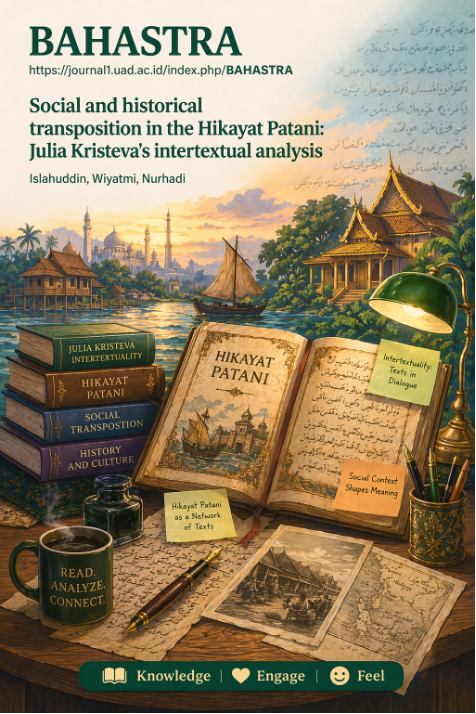
Social and historical transposition in the Hikayat Patani: Julia Kristeva's intertextual analysis
DOI:
https://doi.org/10.26555/bs.v46i1.1565Keywords:
Hikayat Patani , History, Intertextual , Social TranspositionAbstract
Hikayat Patani is a literary work born from the Patani community that describes its social and historical conditions. This qualitative study examines social and historical transposition in the Hikayat Patani using Julia Kristeva's intertextual approach. The research data source is Hikayat Patani, with data collected through text reading and mapping, systematic recording, and contextual analysis. Data analysis includes suprasegmental and intertextual techniques. The study reveals the following social transpositions: 1) Patani port center; 2) Patani trade center; 3) Patani community is prosperous and prosperous; 4) development of Sungai Tambangan; and 5) treasurer in the government. Historical transpositions include: 1) Patani kingdom of the Islamic sultanate; 2) names of the sultans of Patani; 3) Patani led by a female king; 4) female monarch names; and 5) Patani kingdom maritime kingdom. The research reinforces Kristeva's intertextual theory in Malay literature analysis and underscores the role of Hikayat Patani as a source of history, culture, and Islamization. These findings support the development of local culture-based teaching materials and the strengthening of Patani Malay identity.
References
Abdullah, W. S. (2001). Hikayat Patani: Sumber sejarah Melayu Patani. Pustaka Antara.
Al-Fatani, F. A. (2012). Dilema basa Yawi di Selatan Thai: Antara kesetiaan bahasa dan cabaran semasa. Jurnal Melayu, (9), 99-112.
Allen, G. (2004). Intertextuality. Routledge.
Amirell, S. (2011). The blessings and perils of female rule: New perspectives on the reigning queens of Patani, c. 1584–1718. Journal of Southeast Asian Studies, 42(2), 303–323. https://doi.org/10.1017/S0022463411000063
Andaya, B. W. (2008). Leaves of the same tree: Trade and ethnicity in the Straits of Melaka. University of Hawai‘i Press. https://doi.org/10.21313/hawaii/9780824831899.001.0001
Anwar, S., & Muhammad, J. N. S. (2016). Perhubungan gender dalam masyarakat tradisional berdasarkan Hikayat Patani. Journal of Business and Social Development, 4(2), 25–47.
Aslan, H., & Suhardi, M. (2020). Dinamika pendidikan Islam di Thailand pada abad 19-20. Nazhruna: Jurnal Pendidikan Islam, 3(1), 38-54. https://doi.org/10.31538/nzh.v3i1.476
Aziz, A. S. (2015). Konflik politik antara Melayu Patani dan Kerajaan Siam-Thai: Satu kajian puisi-puisi Melayu Patani di laman sesawang. Prosiding Diskusi Karya Patani USM, 2-13.
Baroroh-Baried, S., Sutrisno, S., Soeratno, S. C., & Istanti, K. Z. (1994). Pengantar teori filologi. Badan Penelitian dan Publikasi Fakultas (BPPF) Seksi Filologi, Fakultas Sastra Universitas Gadjah Mada.
Bougas, W. A. (1990). Patani in the beginning of the XVII century. Archipel, 39, 113–138. https://doi.org/10.3406/arch.1990.2624
Bradley, F. R. (2009). Moral order in a time of damnation: The “Hikayat Patani” In historical context. Journal of Southeast Asian Studies, 40(2), 267–293. https://doi.org/10.1017/S0022463409000150
Braginsky, V. I. (1998). Yang indah, berfaedah, dan kamal: Sejarah sastera Melayu dalam abad 7–19. INIS.
Braginsky, V. I. (2004). The heritage of traditional Malay literature: A historical survey of genres, writings, and literary views. KITLV Press. https://doi.org/10.1163/9789004489875
Creswell, J. W., & Creswell, J. D. (2018). Research design: Qualitative, quantitative, and mixed methods approaches (5 ed). SAGE Publications.
Fang, Y. L. (2011). Sejarah kesusastraan Melayu klasik. Yayasan Pustaka Obor Indonesia.
Friedman, S. S. (1993). Spatialization: A strategy for reading narrative. Narrative, 1(1), 12–23.
Halid, R. I. B. R. (2018). The nobat in early Malay literature: A look into the Hikayat Patani. Indonesia and the Malay World. https://doi.org/10.1080/13639811.2018.1444963
Hamid, S., Bin, M. N., & Yaapar, M. S. (2015). Sejarah kehebatan pemerintahan Raja Perempuan Patani dalam novel Ratu-Ratu Patani. Prosiding Diskusi Karya Patani USM.
Hariyono, S., & Bewe, N. (2022). Bissu’s transvestites in the Buginese-Makassar tradition through the transformation of faisal oddang’s literary works: An intertextuality study. Manusya, 25. https://doi.org/10.1163/26659077-24020006
Hariyono, S., & Nurhadi (2020). Opposition buginese society in novel silariang cinta yang (tak) direstui: An intertextuality study. Advances in Social Science, Education, and Humanities Research, 461, 423-427. https://doi.org/10.2991/assehr.k.200804.083
Islahuddin, Tawandorloh, K., & Chema, A. (2020a). Konflik sosial dalam Hikayat Patani. Stilistika: Jurnal Pendidikan Bahasa dan Sastra, 13(2), 198–215. https://doi.org/10.30651/st.v13i2.5026
Islahuddin, Tawandorloh, K., Hama, R., & Chapakia, F. (2020b). Transformasi dalam novel Ratu-ratu Patani karya Isma Ae Mohamad: Kajian intertekstual Julia Kristeva. BAHASTRA, 40(1), 20-28. https://doi.org/10.26555/bahastra.v40i1.14960
Istanti, K. Z. (2010). Studi teks sastra Melayu & Jawa (Hikayat Ahmad Muhammad, Hujjatussiddiq Li Daf Azzindiq, Syeh Bagenda Mardam) sebuah antologi. Elmatera.
Jacq-Hergoualc’h, M. (1997). Archaeological research in the Malay Peninsula. Journal of the Siam Society, 85, 45–70.
Kristeva, J. (1980). Desire in language: A semiotic appoarch to literature and art. Basil Blackwell.
___________. (1986). The Kristeva reader. Columbia University Press.
Mahmud, A. R., & Al-Fatani, A. F. (2018). Kelantan-Patani: Ulama dan intelektualisme Melayu Wilayah Timur. Majlis Agama Islam dan Adat Istiadat Melayu Kelantan.
Moleong, J. L. (2010). Metodologi penelitian kualitatif. Remaja Rosdakarya.
Nuraida, D. (2015). Kemajuan ekonomi dan politik kerajaan Melayu Patani pada masa pemerintahan Raja Ungu (tahun 1624-1635). Buletin Al-Turas, 21(1), 105-126. https://doi.org/10.15408/bat.v21i1.3829
Perret, D. (2022). The Sultanate of Patani: Sixteenth Seventeenth centuries domestic issues. Dalam D. Perret & J. S. Alves (Eds.), Patani Through Foreign Eyes: Sixteenth and Seventeenth Centuries. Archipel Hors Série. https://doi.org/10.4000/archipel.2800
Piah, M. H. (1989). Puisi Melayu tradisional: Satu pembicaraan genre dan fungsi. Dewan Bahasa dan Pustaka.
Porath, N. (2011). The "Hikayat Patani": The kingdom of Patani in the Malay and Thai political world. Journal of the Malaysian Branch of the Royal Asiatic Society, 84(2), 45-65. https://doi.org/10.1353/ras.2011.0016
Rahman, A. H. (2018). Penggunaan bahasa Melayu dalam naskhah Melayu Patani. Dewan Bahasa dan Pustaka.
Reid, A. (1988). Southeast Asia in the age of commerce 1450–1680. Yale University Press.
Salleh, S. H. H. (2010). Hikayat Patani. Dewan Bahasa dan Pustaka.
Satha-anand, C. (1993). Kru-ze: A theatre for renegotiating muslim identity. Sojourn: Journal of Social Issues in Southeast Asia, 8(1), 195–218. https://doi.org/10.1355/SJ8-1I
Skinner, C. (1965). The Hikayat Patani: The story of Patani. Martinus Nijhoff.
Steel, D. G., Milner, A. C., & Mohamed, M. (1990). The sultanate of Patani: Sixteenth–Seventeenth century trade and state formation. Archipel, 39, 95–130.
Sugiyono. (2008). Metode penelitian pendidikan pendekatan kuantitatif, kualitatif, dan R&D. Alfabeta.
Suhrke, A. (1977). Loyalists and separatists: The muslims in Southern Thailand. Asian Survey, 17(3), 237–250. https://doi.org/10.2307/2643498
Sulong, K., & Machali, I. (2016). Dampak konflik dan resolusi konflik terhadap sistem pendidikan Agama Islam di Sekolah Songserm Islam Seksa Patani, Thailand Selatan. Ulul Albab, 17(2), 147-162. https://doi.org/10.18860/ua.v17i2.3546
Syukri, I. (1985). History of the Malay kingdom of Patani (translated by Conner Bailey and Jhon N. Miksic). Ohio University Press.
Teeuw, A., & Wyatt, D. K. (1970). Hikayat Patani (Bibliotheca Indonesica 5). Martinus Nijhoff. https://doi.org/10.1007/978-94-015-2598-5_4
Welch, D. J., & McNeill, J. R. (1989). Archaeological investigations of Pattani history. Journal of Southeast Asian Studies, 20(1), 27–41. https://doi.org/10.1017/S0022463400019822
Additional Files
Published
Issue
Section
License
Copyright (c) 2026 Islahuddin Islahuddin, Wiyatmi Wiyatmi, Suminto A. Sayuti

This work is licensed under a Creative Commons Attribution-ShareAlike 4.0 International License.
1.jpg)