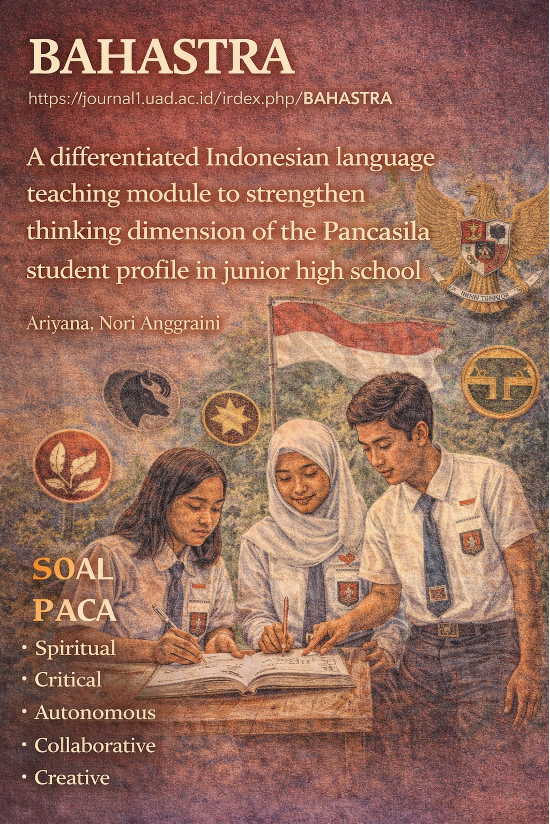
A differentiated Indonesian language teaching module to strengthen thingking critical dimension of the Pancasila student profile in junior high school
DOI:
https://doi.org/10.26555/bs.v46i1.1456Keywords:
Critical Thinking Skills , Differentiated Learning , Independent Curriculum , Pancasila Student ProfileAbstract
This study aims to analyze the implementation of a differentiation-based Indonesian language teaching module to strengthen the critical thinking dimension of the Pancasila Student Profile within the framework of the Independent Curriculum. This research employed a qualitative approach using a case study design to gain an in-depth understanding of classroom practices and teachers’ experiences in implementing differentiated learning. The study was conducted with ninth-grade students at State Junior High School 2 Mekar Baru, Tangerang Regency. The participants included two Indonesian language teachers, one school headmaster, and fourth-grade students involved in the learning process, with five students selected as interview participants through purposive sampling. Data was gathered by means of observing classroom activities, conducting semi-structured interviews, and analyzing documents such as teaching modules, lesson plans, and student work. The data were analyzed using the interactive model of Miles and Huberman, which involves data reduction, data display, and conclusion drawing. The findings revealed that the implementation of differentiation-based teaching modules supports student-centered learning and strengthens the critical thinking dimension of the Pancasila Student Profile, and teachers implemented various instructional strategies such as guided reading, storytelling, group discussions, and creative writing activities to accommodate students’ diverse learning needs. These practices increased student engagement, encouraged collaborative learning, and supported students in analyzing texts and expressing their ideas critically. However, several challenges were identified, including limited preparation time, large class sizes, and the need for additional teacher training. Overall, differentiation-based Indonesian language teaching modules have strong potential to support academic development and character education within the Independent Curriculum.
References
Almujab, S. (2023). Pembelajaran berdiferensiasi: Pendekatan efektif dalam menjawab kebutuhan diversitas siswa. Oikos: Jurnal Kajian Pendidikan Ekonomi dan Ilmu Ekonomi, 8(1), 148-165. https://journal.unpas.ac.id/index.php/oikos/article/view/12528
Annisa, D. N., Agustina, R. L., Noormaliah, N., Lismayanti, H., & Rafiah, H. (2024). Problematika guru dalam menerapkan projek penguatan profil pelajar pancasila (P5) kelas IV SDN Purwosari Baru 1. ALACRITY : Journal of Education, 475–495. https://doi.org/10.52121/alacrity.v4i2.389
Astuti, M., Agustin, L., Alhusaini, M. Y., Anggraini, T., & Adellia, S. (2025). Pembelajaran berdiferensiasi perspektif kurikulum merdeka. Indo-MathEdu Intellectuals Journal, 6(1), 66–76. https://doi.org/10.54373/imeij.v6i1.2326
Astuti, P. (2009). A needs analysis in developing a writing curriculum for Efl education students: A case study at the department of English education of Semarang State University. Language Circle - Journal of Language and Literature, 4(1). https://doi.org/10.15294/lc.v4i1.908
Aulia, D., Hadiyanto, & Rusdinal. (2023). Analisis kebijakan kurikulum merdeka melalui implementasi proyek penguatan profil pelajar pancasila di sekolah dasar. Jurnal Pemikiran dan Pengembangan Sekolah Dasar (JP2SD), 11(1), 122–133. https://doi.org/10.22219/jp2sd.v11i1.25923
Chang, H. (2022). The longitudinal transition of the moral character latent profile of elementary school students and predictive factor verification in Korea. Acta Psychologica, 230, 103710. https://doi.org/10.1016/j.actpsy.2022.103710
Creswell, J. W. (2014). Research design: Qualitative, quantitative, and mixed method approaches creswell 4th edition (4th ed.). Sage Publication.
Dewi, F. C. D., Faizah, A. N. F., Muniroh, D. M., Hermawan, C. H., & Maisyaroh, M. (2025). Perspektif guru tentang penerapan pembelajaran berdiferensiasi dalam pembelajaran: Studi kasus. Biologiei Educația, 5(1). https://doi.org/10.62734/be.v5i1.401
Duke, N. K., Ward, A. E., & Pearson, P. D. (2021). The science of reading comprehension instruction. The Reading Teacher, 74(6), 663–672. https://doi.org/10.1002/trtr.1993
Dwitami, D., Khotimah, H.H., Kulsum, U.M., & Shidiqqa, Q.A. (2025). Efektivitas kurikulum merdeka terhadap guru dan siswa: Transformasi pembelajaran yang adaptif dan inklusif. Jurnal Ilmu Pengetahuan Naratif, 06(1). https://ijurnal.com/1/index.php/jipn
Fujii, A. (2024). Exploring autonomy support and learning preference in higher education: Introducing a flexible and personalized learning environment with technology. Discover Education, 3(1), 26. https://doi.org/10.1007/s44217-024-00111-z
Gea, C. K., Sitorus, P. J., & Simanjuntak, H. (2024). Pengaruh pembelajaran berdiferensiasi bermodel project based learning terhadap kemampuan menulis teks puisi pada fase d (VIII) smp. JKIP Jurnal Kajian Ilmu Pendidikan, 4(2), 391–401. https://doi.org/10.55583/jkip.v4i2.858
Gumilar, E. B. G., & Permatasari, K. G. (2023). Penerapan profil pelajar pancasila dalam pembelajaran kurikulum merdeka pada MI/SD. Al-Azkiya: Jurnal Pendidikan MI/SD, 8(2), 170–183. https://doi.org/10.32505/azkiya.v8i2.6908
Ibad, W. (2022). Penerapan profil pelajar pancasila di tingkat sekolah dasar. JIEES : Journal of Islamic Education at Elementary School JIEES, 3(2), 84–94. https://doi.org/10.47400/jiees.v3i2.47
Jatmiko, H. T. P., & Putra, R. S. (2022). Refleksi diri guru bahasa Indonesia dalam pembelajaran berdiferensiasi di sekolah penggerak. Lingua Franca:Jurnal Bahasa, Sastra, dan Pengajarannya, 6(2), 224-232. https://doi.org/10.30651/lf.v6i2.14701
Johnson, R. B., & Christensen, L. (2014). Educational research quantitative, qualitative, and mixed approaches fifth edition. SAGE Publications.
Ma, L., & Xu, L. (2025). Critical thinking dispositions and foreign language learning: A moderated mediation analysis of self-efficacy and gender. International Journal of Educational Research, 133, 102740. https://doi.org/10.1016/j.ijer.2025.102740
Mahbubi, M. (2025). Integrasi kurikulum merdeka dan AI dalam PAI: Membangun generasi muslim cerdas, berkarakter, dan adaptif di era digital. ALMUSTOFA: Journal of Islamic Studies and Research, 2(1), 467-480. https://ejournal.bamala.org/index.php/almustofa/
Marni, Y. (2023). Filsafat pancasila dalam pendidikan karakter di sekolah dasar. Didaktik : Jurnal Ilmiah PGSD STKIP Subang, 8(2), 2679–2687. https://doi.org/10.36989/didaktik.v8i2.567
Mulyani, S., Nurmeta, I. K., & Maula, L. H. (2023). Analisis implementasi profil pelajar pancasila di sekolah dasar. Jurnal Educatio FKIP UNMA, 9(4), 1638–1645. https://doi.org/10.31949/educatio.v9i4.5515
Nabila, W., Andriana, E., & Rokmanah, S. (2023). Kesulitan guru dalam menerapkan proyek penguatan profil pelajar pancasila di sekolah dasar. Didaktik: Jurnal Ilmiah PGSD FKIP Universitas Mandiri, 9(5), 2865-2874. https://journal.stkipsubang.ac.id/index.php/didaktik/article/view/2164
Piquer-Piriz, A. M., & Pérez-Valenzuela, A. (2023). Content and language integrated learning (CLIL) and project-based learning (PBL) in pre-primary education: A European Perspective. Spinger Nature. https://doi.org/10.1007/978-3-031-04768-8_10
Pratama, R., & Febriani, E. A. (2024). Kendala-kendala dalam pelaksanaan proyek penguatan profil pelajar pancasila (P5) tema kearifan lokal di SMAN 2 Kinali. Naradidik: Journal of Education and Pedagogy, 3(4), 366–376. https://doi.org/10.24036/nara.v3i4.239
Purnawanto, A. T. (2023). Pembelajaran berdiferensiasi. JURNAL PEDAGOGY, 16(1), 34–54. https://doi.org/10.63889/pedagogy.v16i1.152
Putri, D., Samhati, S., Widodo, M., Ariyani, F., & Rusminto, N.E. (2025). Efektivitas E-LKPD berdiferensiasi dalam pembelajaran menulis teks prosedur berbasis project based pada siswa kelas VII SMP. ESTETIK : Jurnal Bahasa Indonesia, 8(1), 40–51. https://doi.org/10.29240/estetik.v8i1.12683
Ritonga, M., Sartika, R., & Wijaya, A. (2024). Pembelajaran berdiferensiasi: Menjawab kebutuhan pendidikan personal di era society 5.0. Pedagogik: Jurnal Pendidikan, 19(2), 163–170. https://doi.org/10.33084/pedagogik.v19i2.8272
Rustam, R., Akbar, O., & Saputra, A. B. (2024). Design thinking dalam pembelajaran berdiferensiasi bahasa Indonesia mahasiswa pendidikan profesi guru. Semantik, 13(1), 43–56. https://doi.org/10.22460/semantik.v13i1.p43-56
Sadriani, A., & GH, M. (2024). Dampak penerapan pembelajaran berdiferensiasi pada keterlibatan siswa di kelas multikultural di SMA Kota Makassar. Jurnal Ilmiah Wahana Pendidikan, 10(17), 884–893. https://doi.org/10.5281/zenodo.14188812
Sanulita, H. (2023). Pendekatan berdiferensiasi dalam pembelajaran bahasa. Jurnal Kajian Pembelajaran dan Keilmuan, 7(2), 196-204. https://doi.org/10.26418/jurnalkpk.v7i2.69035
Shi, Y., Larson, M., & Jonker, C. M. (2015). Recurrent neural network language model adaptation with curriculum learning. Computer Speech & Language, 33(1), 136–154. https://doi.org/10.1016/j.csl.2014.11.004
Smythe, F. (2023). Navigating plurilingual learning: An inclusive education approach. European Journal of Education, 58(2), 299–313. https://doi.org/10.1111/ejed.12551
Sugiyono. (2011). Metode penelitian kuantitatif kualitatif dan R&D. Alfabeta.
Suryaningtyas, A.K., & Nursikin, M. (2024). Implementasi pendidikan agama Islam humanistik dalam pembelajaran berdiferensiasidi SMP Islam Sudirman 2 Salatiga. Al-Ihda’ : Jurnal Pendidikan Dan Pemikiran, 19(2), 1574–1579. https://doi.org/10.55558/alihda.v19i2.162
Ulviani, M. (2024). Pembelajaran terdiferensiasi untuk meningkatkan keterampilan berbicara pada siswa SMA di Indonesia: Sebuah eksperimen di kelas. Ranah: Jurnal Kajian Bahasa, 13(2), 502-510. https://doi.org/10.26499/rnh.v13i2.7796
Utari, D., & Afendi, A. R. (2022). Implementation of pancasila student profile in elementary school education with project-based learning approach. EduLine: Journal of Education and Learning Innovation, 2(4), 456–464. https://doi.org/10.35877/454RI.eduline1280
Vendrell, M., & Johnston, S.-K. (2026). Scaffolding critical thinking with generative AI: Design principles for integrating large language models in higher education. Computers and Education: Artificial Intelligence, 100572. https://doi.org/10.1016/j.caeai.2026.100572
Widiastuti, Y., Rifki, M., & Arief, N. F. (2023). Pengembangan bahan ajar berdiferensiasi pada materi menulis artikel opini untuk siswa SMA. Lingua: Jurnal Bahasa, Sastra, dan Pengajarannya, 19(1). http://journal.unnes.ac.id/nju/index.php/lingua
Wiguna, I. B. A. A., & Oka, A. A. G. (2023). Pembelajaran berdiferensiasi dalam mata pelajaran seni budaya pada era distrupsi. Widya Sundaram: Jurnal Pendidikan Seni dan Budaya, 1(1), 14–27. https://doi.org/10.53977/jws.v1i1.991
Yunita, V., Sujinah, S., & Yarno, Y. (2024). Pengembangan modul ajar berdiferensiasi berbasis ADDIE pada mata pelajaran bahasa Indonesia di SMK Negeri 2 Bojonegoro. Jurnal Pendidikan Madrasah, 9(1), 115-122. https://doi.org/10.14421/jpm.2024.115-122
Yuxian, J. (2025). Bridging the knowledge-skill gap: The role of large language model and critical thinking in education. Computers & Education, 235, 105357. https://doi.org/10.1016/j.compedu.2025.105357
Additional Files
Published
Issue
Section
License
Copyright (c) 2026 Ariyana Ariyana

This work is licensed under a Creative Commons Attribution-ShareAlike 4.0 International License.
1.jpg)