The Impact of renewable energy learning cycle 5E integrated STEM-EDP to improve students’ entrepreneurial thinking
DOI:
https://doi.org/10.12928/jrkpf.v13i2.2385Keywords:
Entrepreneurial Thinking, Deep Learning, Learning Cycle 5E, STEM-EDPAbstract
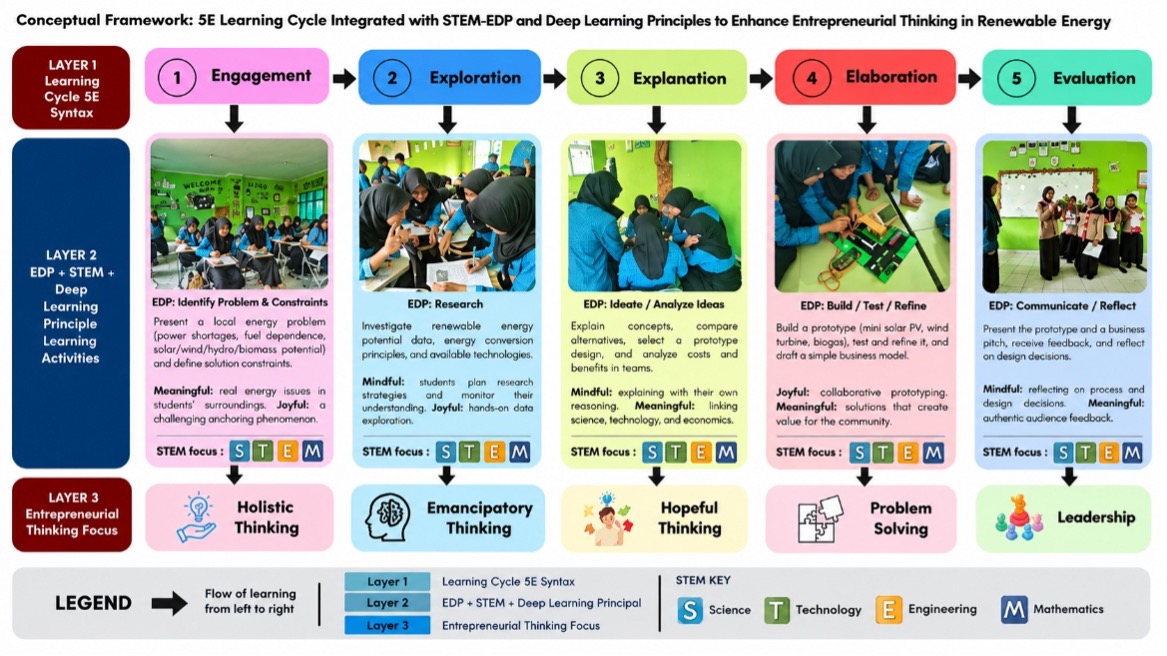
The purpose of this study is to determine how well the 5E Learning Cycle model, when combined with STEM-EDP and deep learning principles, may improve students' entrepreneurial thinking when learning about renewable energy. The study employed a quasi-experimental design with a nonequivalent control group at a public senior high school in East Lampung Regency, involving 60 students divided equally into experimental and control classes. Data were collected using essay tests. The experimental class obtained a higher average N-Gain score (0.67) than the control class (0.56). ANCOVA results indicated a statistically significant difference between the classes after controlling for pretest scores, F(1, 57) = 23.831, p < .001, with a partial eta squared (η²p) of 0.295. These findings indicate that integrating the 5E Learning Cycle model with STEM-EDP and deep learning principles can effectively enhance students’ entrepreneurial thinking through renewable energy projects involving problem identification, solution design, prototype development, testing, and evaluation.
References
[1] S. Arifin and N. M. Siew, "Integration of Socioscientific Approach and Design Thinking: An Entrepreneurial Creative Thinking Module for STEM Education," J. Balt. Sci. Educ., vol. 22, no. 5, pp. 767-780, Oct. 2023, doi: https://doi.org/10.33225/jbse/23.22.767
[2] N. M. Siew and J. Ahmad, "The Effects of Socioscientific Issues Approach With Thinking Wheel Maps on Entrepreneurial Science Thinking Among Fifth Graders," J. Balt. Sci. Educ., vol. 22, no. 1, pp. 100-112, Feb. 2023, doi: https://doi.org/10.33225/jbse/23.22.100
[3] J. Astutik, S. Sutoyo, A. Lutfi, and N. A. Fadzillah, "Innovative project design-based learning: Enhancing students' critical thinking skills and sciencepreneurship for sustainable science education in junior high school," Edelweiss Appl. Sci. Technol., vol. 10, no. 2, pp. 461-476, Feb. 2026, doi: https://doi.org/10.55214/2576-8484.v10i2.12113
[4] K. Sandhu, P. Sarkar, and K. Subburaj, "Entrepreneurial thinking in engineering design education: a comparative study of cognitive paradigms with insights from industry and academia," Entrep. Educ., vol. 9, no. 2, pp. 259-302, Jun. 2026, doi: https://doi.org/10.1007/s41959-025-00158-5
[5] J. Ahmad and N. M. Siew, "An Entrepreneurial Science Thinking Module Based On The Socioscientific Issues Approach With Thinking Wheel Map For Primary School Students In STEM," Probl. Educ. 21st Century, vol. 80, no. 1, pp. 30-51, Feb. 2022, doi: https://doi.org/10.33225/pec/22.80.30
[6] H. ÖZKUL, "Identifying the entrepreneurship and problem-solving skills of fourth-grade students through engineering design-based STEM activities," Humanit. Soc. Sci. Commun., vol. 12, no. 1, p. 1220, Jul. 2025, doi: https://doi.org/10.1057/s41599-025-05612-2
[7] B. Dahl and A. Grunwald, "How lower secondary pupils work with design in green entrepreneurship in STEM education competitions," Int. J. Technol. Des. Educ., vol. 32, no. 5, pp. 2467-2493, Nov. 2022, doi: https://doi.org/10.1007/s10798-021-09706-1
[8] M. Farrokhnia, O. Noroozi, Y. Baggen, T. Lans, H. Biemans, and L. Pittaway, "Fostering University Students' Entrepreneurial Opportunity Identification Capability: A Systematic Literature Review," Entrep. Educ. Pedagog., vol. 9, no. 1, pp. 45-91, Jan. 2026, doi: https://doi.org/10.1177/25151274241309938
[9] H. Peschl, C. Deng, and N. Larson, "Entrepreneurial thinking: A signature pedagogy for an uncertain 21st century," Int. J. Manag. Educ., vol. 19, no. 1, p. 100427, Mar. 2021, doi: https://doi.org/10.1016/j.ijme.2020.100427
[10] S. Yang, S. Yu, and L. Li, "Resource acquisition, entrepreneurial competence, and entrepreneurial growth performance of new farmers," Front. Sustain. Food Syst., vol. 9, Jun. 2025, doi: https://doi.org/10.3389/fsufs.2025.1545721
[11] P. Crespí, M. Queiruga-Dios, and A. Queiruga-Dios, "The Challenge of Developing Entrepreneurial Competence in the University Using the Project-Oriented Learning Methodology," Front. Psychol., vol. 13, Jul. 2022, doi: https://doi.org/10.3389/fpsyg.2022.966064
[12] S. Chairunnisya, Abdurrahman, I. W. Distrik, K. Herlina, U. Rosidin, and G. F. Rabbani, "Engineering Design Process (EDP) Strategy Integrated PjBL-STEM in Learning Program: Need Analysis to Stimulate Numeracy Literacy Skills on Renewable Energy Topic," J. Penelit. Pendidik. IPA, vol. 9, no. 12, pp. 11197-11206, Dec. 2023, doi: https://doi.org/10.29303/jppipa.v9i12.6088
[13] A. Tasyani, K. Herlina, C. Ertikanto, and Abdurrahman, "Socio Scientific Issue Integrated STEM-PjBL in Teachers' Perspective: Can Its Implementation in Learning Programs Improve Students' Creative Thinking Skills on the Topic of Renewable Energy?," J. Penelit. Pendidik. IPA, vol. 11, no. 1, pp. 89-98, Jan. 2025, doi: https://doi.org/10.29303/jppipa.v11i1.9534
[14] I. S. Melati, Abdurrahman, V. Viyanti, U. Lampung, and K. Herlina, "PBL Model Integrated STEM-EDP with Deep Learning Principles to Improve Computational Thinking Skills," EduFisika J. Pendidik. Fis., vol. 11, no. 2, pp. 257-268, 2026, doi: 10.59052/edufisika.v11i2.56938.
[15] N. A. Rahman, D. A. Uswatun, and A. Sutisnawati, "Development of STEM EDP-Based Scientific Attitude Assessment Instrument in Elementary School Science," J. Cakrawala Pendas, vol. 11, no. 2, pp. 453-465, 2025, doi: 10.31949/jcp.v11i2.12910.
[16] E. Miarti, N. Hasnunidah, and A. Abdurrahman, "The Effect of Learning Cycle 5E on Critical Thinking Skills for Junior High School Students," Sci. Educ., vol. 10, no. 2, p. 177, Dec. 2021, doi: https://doi.org/10.24235/sc.educatia.v10i2.9127
[17] L. P. Ayida, A. Abdurrahman, B. A. Wicaksono, and K. Herlina, "Implementation of the 5E Model Integrated STEM-EDP to Enhance High School Students' Creative Problem-Solving Ability," J. Pendidik. Fis. dan Teknol., vol. 11, no. 1, pp. 171-179, May 2025, doi: https://doi.org/10.29303/jpft.v11i1.8717
[18] H. Ruiz-Martín and R. W. Bybee, "The cognitive principles of learning underlying the 5E Model of Instruction," Int. J. STEM Educ., vol. 9, no. 1, p. 21, Dec. 2022, doi: https://doi.org/10.1186/s40594-022-00337-z
[19] M. Okur and H. Güngör Seyhan, "Mobile Technology-Enhanced 5E Learning Model in Physics Labs: An Analysis of Graph Drawing and Interpretation Skills," J. Sci. Educ. Technol., vol. 34, no. 6, pp. 1441-1466, Dec. 2025, doi: https://doi.org/10.1007/s10956-025-10222-3
[20] M. Marwany, B. Nirmala, and S. Muslim, "The Concept of Independent Learning to Stimulate Creativity of Early Children: A Study of Ki Hajar Dewantara's Philosophy," AL-ISHLAH J. Pendidik., vol. 15, no. 2, pp. 1489-1496, Apr. 2023, doi: https://doi.org/10.35445/alishlah.v15i2.1496
[21] A. M. Diputera, Zulpan, and G. N. Eza, "Memahami Konsep Pendekatan Deep Learning dalam Pembelajaran Anak Usia Dini yang Meaningful, Mindful, dan Joyful: Kajian Melalui Filsafat Pendidikan," J. BUNGA RAMPAI USIA EMAS, vol. 10, no. 2, pp. 108-120, Dec. 2024, doi: https://doi.org/10.24114/jbrue.v10i2.65978
[22] A. N. Maula and A. Widiyono, "Implementasi Learning Cycle 5E Terhadap Kemampuan Berpikir Kritis Peserta Didik pada Mapel IPA di Sekolah Dasar," J. Pendidik. Ilmu Pengetah. Alam, vol. 5, no. 2, pp. 73-82, Nov. 2024, doi: https://doi.org/10.56842/jp-ipa.v5i2.304
[23] R. Wahyuningsih, Y. Budianti, and A. Aarrahim, "Penerapan Model Pembelajaran Learning Cycle 5e Terhadap Hasil Belajar IPA Siswa Sekolah Dasar," J. Elem. Edukasia, vol. 6, no. 2, pp. 844-857, Jun. 2023, doi: https://doi.org/10.31949/jee.v6i2.5087
[24] A. W. Sari and D. J. Arta, "Implementasi Deep Learning: Suatu Inovasi Pendidikan," WASPADA (Jurnal Wawasan Pengemb. Pendidikan), vol. 13, no. 1, p. 121, Apr. 2025, doi: https://doi.org/10.61689/waspada.v13i1.727
[25] N. Nurhaswinda et al., "Tutorial uji normalitas dan uji homogenitas dengan menggunakan aplikasi SPSS," J. Cahaya Nusant., vol. 1, no. 2, pp. 55-68, 2025, [Online]. Available: https://jurnal.cahayapublikasi.com/index.php/jcn/article/view/25
[26] F. Fleischmann, "What Is Entrepreneurial Thinking," in Handbuch Entrepreneurship, Wiesbaden: Springer Fachmedien Wiesbaden, 2015, pp. 1-12. doi: https://doi.org/10.1007/978-3-658-05263-8_2-1
[27] Ratana Subha Tusitadevi and Suhandi Astuti, "Meta Analisis Efektivitas Model Pembelajaran Problem Based Learning dan Problem Solving Terhadap Kemampuan Berpikir Kritis pada Mata Pelajaran Matematika Kelas V," INVENTA, vol. 5, no. 1, pp. 1-15, Mar. 2021, doi: https://doi.org/10.36456/inventa.5.1.a3528
[28] E. I. N. Davidi, E. Sennen, and K. Supardi, "Integrasi Pendekatan STEM (Science, Technology, Enggeenering and Mathematic) Untuk Peningkatan Keterampilan Berpikir Kritis Siswa Sekolah Dasar," Sch. J. Pendidik. dan Kebud., vol. 11, no. 1, pp. 11-22, Jan. 2021, doi: https://doi.org/10.24246/j.js.2021.v11.i1.p11-22
[29] M. B. Ulum, P. D. A. Putra, and L. Nuraini, "Identifikasi penggunaan EDP (Engineering Design Process) dalam berpikir engineer siswa SMA melalui Lembar Kerja Siswa (LKS)," J. Ris. dan Kaji. Pendidik. Fis., vol. 8, no. 2, p. 53, Oct. 2021, doi: https://doi.org/10.12928/jrkpf.v8i2.20753
[30] L. S. Vygotsky, Mind in Society: The Development of Higher Psychological Processes. Harvard University Press, 1978.
Published
Issue
Section
License
Copyright (c) 2026 Ratna Arianty Sutrisno, Abdurrahman Abdurrahman, Fatkhur Rohman, Kartini Herlina

This work is licensed under a Creative Commons Attribution-NonCommercial 4.0 International License.