Effectiveness of AR–PhET and video–hands-on inquiry laboratory conditions for improving students’ analytical thinking in electromagnetic induction
DOI:
https://doi.org/10.12928/jrkpf.v13i2.2365Keywords:
Analytical Thinking Skills, Augmented Reality, PhET Interactive Simulations, Electromagnetic Induction, Laboratory InquiryAbstract
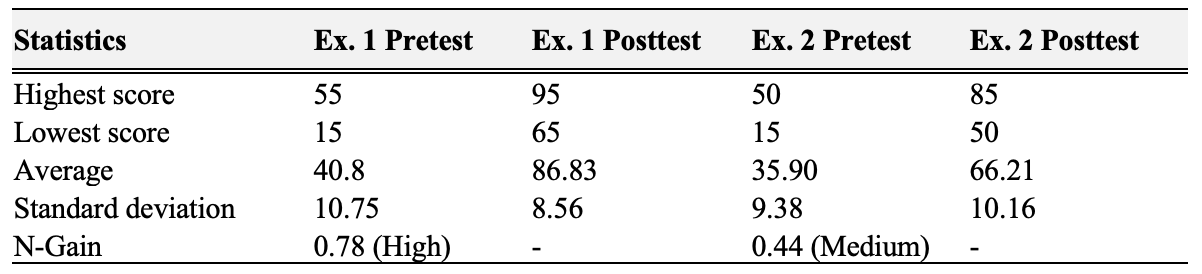
Developing students' analytical thinking skills in the context of electromagnetic induction requires learning experiences that bridge abstract concepts with observable evidence. This quasi-experimental study compares two laboratory-inquiry conditions at SMA Negeri 3 Langsa: (1) the use of Augmented Reality (AR) to observe initial phenomena, followed by PhET interactive simulations for inquiry-based activities; and (2) the use of instructional videos, followed by simple hands-on experiments. The instructional modules spanned two 90-minute sessions for each condition. Analytical thinking performance was assessed through pretest and posttest essay tasks and quantified using normalized gain (N-gain); group differences were analyzed using the Mann–Whitney U test. The mean N-gain was 0.78 for the AR–PhET condition and 0.44 for the video–hands-on condition, with a Mann–Whitney U test result of p = 0.001. While these findings indicate a difference between the two instructional approaches, the specific effect of AR cannot be isolated, as both the observation medium and the laboratory medium differed simultaneously. The study sample consisted of 60 students: 30 from Class XII.4 (Experimental Group 1) and 30 from Class XII.9 (Experimental Group 2).
References
[1] A. Purba and A. Saragih, "All Fields of Science J-LAS The Role of Technology in Transforming Indonesian Language Education in the Digital Era," Alfitriana Purba; Alkausar Saragih AFoSJ-LAS, vol. 3, no. 3, p. 43, [Online]. Available: https://j-las.lemkomindo.org/index.php/AFoSJ-LAS/index
[2] L. S. Keiler, "Teachers' roles and identities in student-centered classrooms," Int. J. STEM Educ., vol. 5, no. 1, p. 34, Dec. 2018, doi: https://doi.org/10.1186/s40594-018-0131-6
[3] S. Ograjšek and M. Ivanuš Grmek, "Student-Centred Approaches in Higher Education From the Student Perspective," Cent. Educ. Policy Stud. J., vol. 16, no. 2, pp. 11-35, Jun. 2026, doi: https://doi.org/10.26529/cepsj.1828
[4] Z. Liu, "Digitalization of Education: Possibilities of VR-Based Educational Resources and Their Impact on the Development of Analytical Thinking of Students," Int. J. Inf. Educ. Technol., vol. 14, no. 10, pp. 1386-1395, 2024, doi: https://doi.org/10.18178/ijiet.2024.14.10.2169
[5] L. Sun, Z. Guo, and L. Hu, "Educational games promote the development of students' computational thinking: a meta-analytic review," Interact. Learn. Environ., vol. 31, no. 6, pp. 3476-3490, Aug. 2023, doi: https://doi.org/10.1080/10494820.2021.1931891
[6] A. Naci Çoklar and A. Tatli, "Examining the Digital Nativity Levels of Digital Generations: From Generation X to Generation Z," Shanlax Int. J. Educ., vol. 9, no. 4, pp. 433-434, Sep. 2021, doi: https://doi.org/10.34293/education.v9i4.4224
[7] dan A. P. Kepala Badan Standar, Kurikulum, "Keputusan Kepala BSKAP Nomor 032/H/KR/2024 tentang Capaian Pembelajaran pada Pendidikan Anak Usia Dini, Jenjang Pendidikan Dasar, dan Jenjang Pendidikan Menengah pada Kurikulum Merdeka," Jakarta, 2024.
[8] Maesaroh and S. Jumini, "Efektivitas Model Pembelajaran Inkuiri Pada Materi Induksi Elektromagnetik Untuk Meningkatkan Pemahaman Konsep Siswa SMA," J. Lumin. Ris. Ilm. Pendidik. Fis., vol. 4, no. 2, pp. 81-86, Jul. 2023, doi: https://doi.org/10.31851/luminous.v4i2.11732
[9] R. S. Nurholida, A. Ramdani, and S. Bahri, "Pengaruh Penerapan Model Pembelajaran Inkuiri Berbasis Laboratorium Terhadap Kemampuan Psikomotorik Siswa," J. Authentic Res., vol. 4, no. 1, pp. 55-73, Jun. 2025, doi: https://doi.org/10.36312/jar.v4i1.2826
[10] N. Ridlwaniyyah, Z. Zaenuri, and W. Walid, "Efektivitas Media Pembelajaran Berbasis Augmented Reality Terhadap Kemampuan Berpikir Kritis Siswa Mata Pelajaran Matematika," in PRISMA, Prosiding Seminar Nasional Matematika, 2025, pp. 242-247.
[11] A. Zakaria, I. S. Wahyuni, M. Satriawan, O. Saputra, and M. Habibbulloh, "Pengembangan Media Pembelajaran ARDI (AR-Digital Book) Berbasis Augmented Reality 3D Animated Pada Materi Induksi Elektromagnetik," IPF Inov. Pendidik. Fis., vol. 12, no. 2, pp. 54-64, Jul. 2023, doi: https://doi.org/10.26740/ipf.v12n2.p54-64
[12] I. A. Rizki, F. R. Mirsa, A. N. Islamiyah, A. D. Saputri, R. Ramadani, and M. Habibbulloh, "Ethnoscience-enhanced physics virtual simulation and augmented reality with inquiry learning: Impact on students' creativity and motivation," Think. Ski. Creat., vol. 57, p. 101846, Sep. 2025, doi: https://doi.org/10.1016/j.tsc.2025.101846
[13] K. Altmeyer, S. Kapp, M. Thees, S. Malone, J. Kuhn, and R. Brünken, "The use of augmented reality to foster conceptual knowledge acquisition in STEM laboratory courses-Theoretical background and empirical results," Br. J. Educ. Technol., vol. 51, no. 3, pp. 611-628, 2020, doi: https://doi.org/10.1111/bjet.12900
[14] C. Chen, S. N. Abdul Rabu, and N. Jamiat, "Enhancing Physics Learning Achievement, Motivation and Inquiry Skills In A Flipped Classroom: A Structured Inquiry-Based Virtual Lab Approach," J. Balt. Sci. Educ., vol. 24, no. 1, pp. 37-52, Feb. 2025, doi: https://doi.org/10.33225//jbse/25.24.37
[15] B. Arymbekov, "The Effect of Augmented Reality (AR) Supported Teaching Activities on Academic Success and Motivation to Learn Nuclear Physics among High School Pupils," Int. J. Inf. Educ. Technol., vol. 14, no. 5, pp. 743-760, 2024, doi: https://doi.org/10.18178/ijiet.2024.14.5.2099
[16] J. P. Canright and S. White Brahmia, "Modeling novel physics in virtual reality labs: An affective analysis of student learning," Phys. Rev. Phys. Educ. Res., vol. 20, no. 1, p. 010146, May 2024, doi: https://doi.org/10.1103/PhysRevPhysEducRes.20.010146
[17] Y. Chang, "Engagement, Academic Emotions, and Artificial Intelligence Application Creativity in the Metaverse: A Study of Facial Expressions," J. Comput. Assist. Learn., vol. 41, no. 3, Jun. 2025, doi: https://doi.org/10.1111/jcal.70030
[18] R. J. Marzano and J. S. Kendall, Designing and assessing educational objectives: Applying the new taxonomy. Corwin Press, 2008.
[19] B. Sumintono and W. Widhiarso, Aplikasi Pemodelan Rasch pada Assessment Pendidikan. Cimahi: Trim Komunikata Publishing House, 2015.
[20] M. I. Sukarelawan, T. K. Indratno, and S. M. Ayu, N-gain vs stacking : analisis perubahan abilitas peserta didik dalam desain one group pretest-posttest. Yogyakarta: Suryacahya, 2024.
[21] C. P. Davis, G. T. M. Altmann, and E. Yee, "Situational systematicity: A role for schema in understanding the differences between abstract and concrete concepts," Cogn. Neuropsychol., vol. 37, no. 1-2, pp. 142-153, Feb. 2020, doi: https://doi.org/10.1080/02643294.2019.1710124
[22] R. Haryadi, H. Pujiastuti, and D. W. Utomo, "Interactive visualization of thermodynamic concepts through augmented reality to improve critical thinking," Comput. Educ. X Real., vol. 8, p. 100137, Jun. 2026, doi: https://doi.org/10.1016/j.cexr.2026.100137
[23] Y. Lin and Z. Yu, "A meta‐analysis of the effects of augmented reality technologies in interactive learning environments (2012-2022)," Comput. Appl. Eng. Educ., vol. 31, no. 4, pp. 1111-1131, Jul. 2023, doi: https://doi.org/10.1002/cae.22628
[24] Z. Arifin, S. Sukarmin, S. Saputro, and A. Kamari, "The effect of inquiry-based learning on students' critical thinking skills in science education: A systematic review and meta-analysis," Eurasia J. Math. Sci. Technol. Educ., vol. 21, no. 3, p. em2592, Mar. 2025, doi: https://doi.org/10.29333/ejmste/15988
[25] F. Verdian, M. A. Jadid, and M. N. Rahmani, "Studi Penggunaan Media Simulasi PhET dalam Pembelajaran Fisika," J. Pendidik. dan Ilmu Fis., vol. 1, no. 2, pp. 39-44, Dec. 2021, doi: https://doi.org/10.52434/jpif.v1i2.1448
[26] G. Gunawan, A. Harjono, H. Sahidu, and L. Herayanti, "Virtual Laboratory of Electricity Concept to Improve Prospective Physics Teachers' Creativity," J. Pendidik. Fis. Indones., vol. 13, no. 2, pp. 102-111, Nov. 2017, doi: https://doi.org/10.15294/jpfi.v13i2.9234
[27] M. Musahir, "Penggunaan media pembelajaran fisika dengan virtual laboratory berbasis 'PhET Interactive Simulations' untuk meningkatkan kemampuan penguasaan konsep kognitif rangkaian resistor," Compt. J. Ilm. Pendidik. Fis., vol. 9, no. 2, pp. 122-130, Dec. 2022, doi: https://doi.org/10.30738/cjipf.v9i2.13664
[28] I. G. P. E. Saputra, S. Nigsih, T. Triani, B. Bulaka, and R. S. Sari, "Pengaruh Penggunaan Phet Simulasi Terhadap Peningkatan Hasil Belajar Fisika : Upaya Menjawab Tantangan Transformasi Pembelajaran Fisika Era," J. Kumparan Fis., vol. 8, no. 3, pp. 117-130, Dec. 2025, doi: https://doi.org/10.33369/jkf.8.3.117-130
[29] A. M. Chengere, B. D. Bono, S. A. Zinabu, and K. W. Jilo, "Enhancing secondary school students' science process skills through guided inquiry-based laboratory activities in biology," PLoS One, vol. 20, no. 4, p. e0320692, Apr. 2025, doi: https://doi.org/10.1371/journal.pone.0320692
[30] U. Sumirat, J. Juliana, Y. Sugiarti, A. Miftahuddin, R. Marlina, and G. Karlibaeva, "Enactive learning structures and self-efficacy development: a quasi-experimental study of active-inquiry versus passive-observation instruction in adolescent technical skill acquisition," Interpersona An Int. J. Pers. Relationships, vol. 20, no. 1, p. e923, Sep. 2026, doi: https://doi.org/10.54899/iij.v20i1.923
[31] H. J. Banda and J. Nzabahimana, "The Impact of Physics Education Technology (PhET) Interactive Simulation-Based Learning on Motivation and Academic Achievement Among Malawian Physics Students," J. Sci. Educ. Technol., vol. 32, no. 1, pp. 127-141, Feb. 2023, doi: https://doi.org/10.1007/s10956-022-10010-3
[32] B. Maraza-Quispe, J. L. Torres-Loayza, G. T. Reymer-Morales, J. L. Aguilar-Gonzales, E. W. Angulo-Silva, and D. A. Huaracha-Condori, "Towards the Development of Research Skills of Physics Students through the Use of Simulators: A Case Study," Int. J. Inf. Educ. Technol., vol. 13, no. 7, pp. 1062-1069, 2023, doi: https://doi.org/10.18178/ijiet.2023.13.7.1905
Published
Issue
Section
License
Copyright (c) 2026 Jihan Irba Afifa, Hendri Saputra, Rizky Nafaida, Dona Mustika

This work is licensed under a Creative Commons Attribution-NonCommercial 4.0 International License.