Analysis of high school students' understanding of physics concepts on energy sources using the rasch model
DOI:
https://doi.org/10.12928/jrkpf.v13i2.2266Abstract
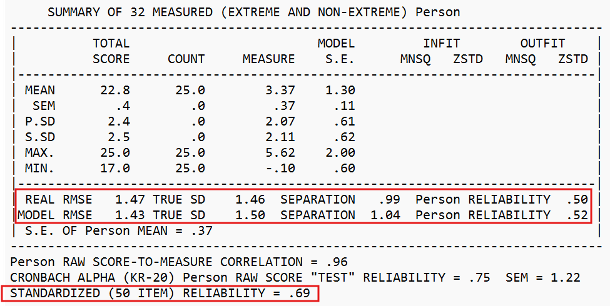
This exploratory study examined the measurement properties of a 25-item multiple-choice test on energy sources administered to 32 tenth-grade students at SMAN 2 Pamekasan, Indonesia. Rasch analysis using Ministep 5.11.0 assessed item and person fit, reliability, person–item targeting, response patterns, and differential item functioning (DIF) by residential area. Items 2, 4, and 20 showed misfit and require content-based review. Cronbach’s alpha was 0.75, while item reliability (0.52–0.53) and person reliability (0.50–0.52) were low. The mean person measure (3.37 logits) exceeded the mean item measure (−1.03 logits), and 13 students achieved maximum scores, indicating a ceiling effect and inadequate targeting for higher-ability students. Although several DIF contrasts were large, reported p-values exceeded 0.05; the small, unequal groups do not establish item fairness. These preliminary findings support item revision, more challenging items, and validation with larger samples.
References
[1] C. C. Laranjeiras, "Physics education as initiation to science: epistemological integrity," Phys. Educ., vol. 61, no. 2, p. 025502, Apr. 2026, doi: https://doi.org/10.1088/1361-6552/ae4ceb
[2] S. Fitriana, T. Hardianti, and S. Syahwin, "The Profile of Scientific Literacy and Self-Concept in Learning Physics," J. Ilm. Pendidik. Fis., vol. 7, no. 1, p. 22, Feb. 2023, doi: https://doi.org/10.20527/jipf.v7i1.7025
[3] J. A. Rafiah and I. A. Miyaqi, "Analyze the Students' Conceptual Understanding of Elasticity and Hooke's Law Using the Rasch Model," Impuls. J. Res. Innov. Phys. Educ., vol. 5, no. 1, pp. 69-83, Oct. 2025, doi: https://doi.org/10.14421/impulse.2025.51-06
[4] K. L. Seeratan, K. W. McElhaney, J. Mislevy, R. McGhee Jr, D. Conger, and M. C. Long, "Measuring Students' Ability to Engage in Scientific Inquiry: A New Instrument to Assess Data Analysis, Explanation, and Argumentation," Educ. Assess., vol. 25, no. 2, pp. 112-135, Apr. 2020, doi: https://doi.org/10.1080/10627197.2020.1756253
[5] R. Qadar, M. Syam, and M. A. Mahdiannur, "Analyzing high school physics teachers' understanding of cognitive process and knowledge dimensions in assessment design using the revised Bloom's taxonomy," Discov. Educ., vol. 4, no. 1, p. 387, Oct. 2025, doi: https://doi.org/10.1007/s44217-025-00807-w
[6] K. Khusaini, N. Azizah, P. Suwasono, C. I. Yogihati, and A. D. Andriani, "Rasch Model Application: Identification of Students' Conceptual Understanding of Static Fluid," J. Pendidik. Fis. Indones., vol. 21, no. 1, pp. 54-68, Jun. 2025, doi: https://doi.org/10.15294/jpfi.v21i1.15023
[7] F. Rasyid, E. Istiyono, and C. W. Gunawan, "Developing and analyzing items of a physics conceptual understanding test on wave topics for high school students using the Rasch Model," REID (Research Eval. Educ., vol. 11, no. 1, pp. 1-16, Jun. 2025, doi: https://doi.org/10.21831/reid.v11i1.75575
[8] I. M. Ridwan, I. Kaniawati, A. Suhandi, T. R. Ramalis, R. Rizal, and E. Sujarwanto, "Tes Kemampuan Pemecahan Masalah pada Tema Perubahan Iklim: Analisis Rasch Model," DIFFRACTION, vol. 5, no. 1, pp. 37-46, Jul. 2023, doi: https://doi.org/10.37058/diffraction.v5i1.7738
[9] L. Zhang, X. Liu, and H. Feng, "Development and validation of an instrument for assessing scientific literacy from junior to senior high school," Discip. Interdiscip. Sci. Educ. Res., vol. 5, no. 1, p. 21, Dec. 2023, doi: https://doi.org/10.1186/s43031-023-00093-2
[10] F. K. Khatmani, W. Liliawati, and H. Imansyah, "Analisis pemahaman konsep fisika siswa smp pada materi suhu dan kalor menggunakan tes isomorfik : Rasch model," WaPFi (Wahana Pendidik. Fis., vol. 9, no. 1, pp. 11-18, Feb. 2024, doi: https://doi.org/10.17509/wapfi.v9i1.52655
[11] I. H. Bimastari, M. Yusup, and K. Kistiono, "The Measuring Energy Literacy: Validation of Knowledge, Attitude, and Behavior Instruments Using the Rasch Model," Integr. Sci. Educ. J., vol. 6, no. 3, pp. 153-162, Aug. 2025, doi: https://doi.org/10.37251/isej.v6i3.2025
[12] T. H. Fiskawarni, R. Rahmawati, W. Widiasih, and R. Saad, "The Design and Validation of the Four Tier Test Instrument for Energy Literacy Using the Rasch Model Analysis," JIPF (Jurnal Ilmu Pendidik. Fis., vol. 9, no. 1, p. 74, Feb. 2024, doi: https://doi.org/10.26737/jipf.v9i1.4717
[13] A. Samsudin et al., "Development of DIGaKiT: identifying students' alternative conceptions by Rasch analysis model," J. Educ. Learn., vol. 18, no. 1, pp. 128-139, Feb. 2024, doi: https://doi.org/10.11591/edulearn.v18i1.20970
[14] M. Bohori, W. Liliawati, I. R. Suwarma, and S. S. Ringo, "The Rasch Analysis of Students' Characteristics in Physics Concept Understanding Improvement through Challenge-Based Learning," J. Penelit. Pengemb. Pendidik. Fis., vol. 8, no. 2, pp. 207-216, Dec. 2022, doi: https://doi.org/10.21009/1.08203
[15] M. D. B. Şenol, K. Özmen, and Ö. F. Özdemir, "Associations between High School Students' Physics-Related Personal Epistemology, Sense of Belonging, and Physics Achievement," Sci. Educ., Mar. 2026, doi: https://doi.org/10.1007/s11191-026-00724-w
[16] A. Žakelj, T. Štemberger, and A. Klančar, "An Empirical Study on Basic and Conceptual Knowledge, Procedural Knowledge and Problem Solving among Primary School Students," Int. J. Instr., vol. 18, no. 4, pp. 627-650, Oct. 2025, doi: https://doi.org/10.29333/iji.2025.18434a
[17] L. A. R. Laliyo, J. S. Tangio, B. Sumintono, M. Jahja, and C. Panigooro, "Analytic Approach of Response Pattern of Diagnostic Test Items In Evaluating Students' Conceptual Understanding of Characteristics of Particle of Matter," J. Balt. Sci. Educ., vol. 19, no. 5, pp. 824-841, Oct. 2020, doi: https://doi.org/10.33225/jbse/20.19.824
[18] M. Tavakol and R. Dennick, "Making sense of Cronbach's alpha," Int. J. Med. Educ., vol. 2, pp. 53-55, Jun. 2011, doi: https://doi.org/10.5116/ijme.4dfb.8dfd
[19] S. Soeharto and B. Csapó, "Assessing Indonesian student inductive reasoning: Rasch analysis," Think. Ski. Creat., vol. 46, p. 101132, Dec. 2022, doi: https://doi.org/10.1016/j.tsc.2022.101132
[20] M. Wilson, S. Bathia, L. Morell, P. Gochyyev, B. W. Koo, and R. Smith, "Seeking a better balance between efficiency and interpretability: Comparing the likert response format with the Guttman response format.," Psychol. Methods, vol. 28, no. 6, pp. 1358-1373, Dec. 2023, doi: https://doi.org/10.1037/met0000462
[21] M. Henninger, R. Debelak, and C. Strobl, "A New Stopping Criterion for Rasch Trees Based on the Mantel-Haenszel Effect Size Measure for Differential Item Functioning," Educ. Psychol. Meas., vol. 83, no. 1, pp. 181-212, Feb. 2023, doi: https://doi.org/10.1177/00131644221077135
[22] F. Virijai et al., "Ceiling Effects in Satisfaction-Based Survey Items: A Psychometric Diagnostic Study of Instructional Facilitation Measures Among Indonesian Pre-Service Science Teachers," F1000Research, vol. 15, p. 1477, Sep. 2026, doi: https://doi.org/10.12688/f1000research.187984.1
[23] F. Wijayanto, I. G. Bucur, K. Mul, P. Groot, B. G. M. van Engelen, and T. Heskes, "Semi-automated Rasch analysis with differential item functioning," Behav. Res. Methods, vol. 55, no. 6, pp. 3129-3148, Sep. 2022, doi: https://doi.org/10.3758/s13428-022-01947-9
[24] A. Zahl‐Thanem, "Understanding Rural Stayers: The Influence of Definitions and Methods," Sociol. Ruralis, vol. 65, no. 2, Apr. 2025, doi: https://doi.org/10.1111/soru.12506
Published
Issue
Section
License
Copyright (c) 2026 Maysarotul Sholehah, Maimon Sumo

This work is licensed under a Creative Commons Attribution-NonCommercial 4.0 International License.