An analysis of physics teachers’ perspectives on collaborative assessment in physics learning
DOI:
https://doi.org/10.12928/jrkpf.v13i2.2250Keywords:
Assessment Rubric, Assessment Transparency, Peer Assessment, ResponsibilityAbstract
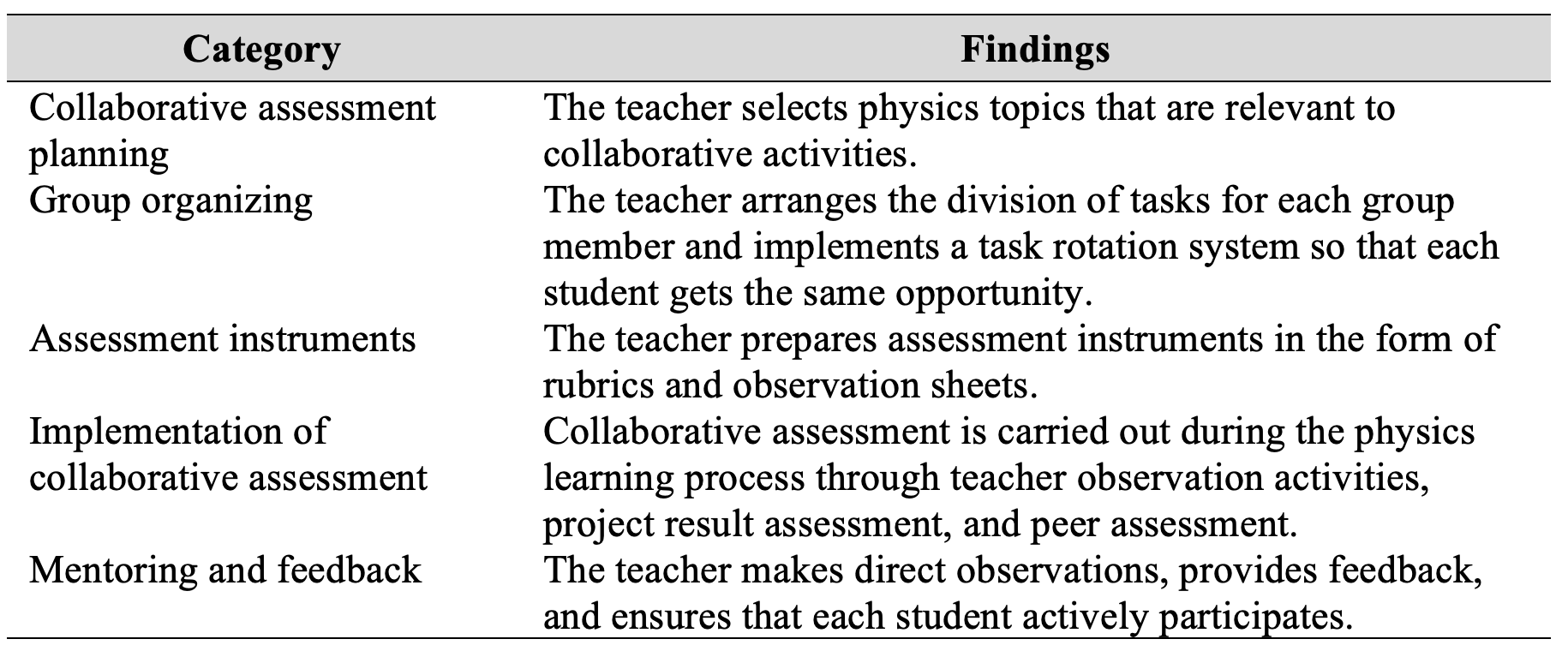
This study aims to analyze collaborative assessment practices in physics learning from the perspective of teachers regarding aspects of fairness, participation, and accountability. This study uses a qualitative approach with a case study method. The subjects in this study are physics teachers who have been teaching for 10 to 16 years and have implemented collaborative assessment in physics learning. This study uses interviews as a data collection technique. This study uses the Miles and Huberman interactive analysis model. Researchers use source triangulation to ensure objectivity, credibility, and validity of the data. The findings indicate that fairness is supported by the use of assessment rubrics, student participation is associated with their understanding of physics concepts, and individual accountability is linked to the distribution of tasks within groups. Implementing collaborative assessment involves several challenges, including students’ limited self awareness, unequal contributions among group members, concerns about student honesty, and time constraints. Strategies to overcome these challenges include division of tasks, alternation of tasks, transparency of assessments, and assignment of related tasks.
References
[1] B. Thornhill-Miller et al., "Creativity, Critical Thinking, Communication, and Collaboration: Assessment, Certification, and Promotion of 21st Century Skills for the Future of Work and Education," J. Intell., vol. 11, no. 3, p. 54, Mar. 2023, doi: https://doi.org/10.3390/jintelligence11030054
[2] A. Markula and M. Aksela, "The key characteristics of project-based learning: how teachers implement projects in K-12 science education," Discip. Interdiscip. Sci. Educ. Res., vol. 4, no. 1, p. 2, Dec. 2022, doi: https://doi.org/10.1186/s43031-021-00042-x
[3] D. Desnita, Y. Darvina, A. Hirahmah, and M. Dhanil, "Effectiveness of Integrated E-Modules Combining Cooperative Learning and Videos in Enhancing Physics Teaching Skills of Pre-Service Teachers," Int. J. Learn. Teach. Educ. Res., vol. 24, no. 9, pp. 192-210, Sep. 2025, doi: https://doi.org/10.26803/ijlter.24.9.10
[4] C. Wang, L. Song, and J. Jiang, "The impact of project-based learning on university physics education: enhancing cognitive skills and core competencies," Front. Psychol., vol. 16, Sep. 2025, doi: https://doi.org/10.3389/fpsyg.2025.1495105
[5] N. HS, N. Nurlista, and M. Hidayat, "Penggunaan Asesmen Autentik di SMA Negeri 1 Sarolangun pada Mata Pelajaran Fisika: Investigasi Pembelajaran Online," Relativ. J. Ris. Inov. Pembelajaran Fis., vol. 5, no. 1, p. 36, Apr. 2022, doi: https://doi.org/10.29103/relativitas.v5i1.6829
[6] E. Tuna Pusa and S. Dinçer, "A Meta-synthesis Study on the Use of e-assessment Tools in Education," Sage Open, vol. 15, no. 3, Jul. 2025, doi: https://doi.org/10.1177/21582440251360495
[7] A. A. Zamista, "Asesmen Online sebagai Asesmen Alternatif dalam Pembelajaran Era Digital: Penelitian Systematic Literature Review," Insa. J. Pemikir. Altern. Kependidikan, vol. 27, no. 2, pp. 108-119, Oct. 2022, doi: https://doi.org/10.24090/insania.v27i2.6756
[8] K. Nadiyyah, R. Aprianti, Zakirman, P. Pandiangan, Widiasih, and D. Sukmayadi, "Digitalisasi Pembelajaran: Studi Evaluasi Pelatihan Guru dalam Merancang Asesmen Digital," Int. J. Community Serv. Learn., vol. 9, no. 3, pp. 497-508, Aug. 2025, doi: https://doi.org/10.23887/ijcsl.v9i3.92984
[9] S. Permatasari et al., "Asesmen Digital berbasis Kahoot dalam Evaluasi Pembelajaran," JIIP - J. Ilm. Ilmu Pendidik., vol. 6, no. 4, pp. 2710-2714, Apr. 2023, doi: https://doi.org/10.54371/jiip.v6i4.1737
[10] S. Nikolic et al., "Laboratory learning objectives: ranking objectives across the cognitive, psychomotor and affective domains within engineering," Eur. J. Eng. Educ., vol. 49, no. 3, pp. 454-473, May 2024, doi: https://doi.org/10.1080/03043797.2023.2248042
[11] A. Ab Rahim, N. K. Mun, A. Saparon, A. F. N. Abdul Rahman, and N. Buniyamin, "Measuring the Learning Effectiveness in the Cognitive, Affective, and Psychomotor (CAP) Domains in Electrical Engineering Laboratory Courses Using Online Delivery Mode: Universiti Teknologi MARA," Pertanika J. Sci. Technol., vol. 31, no. 4, May 2023, doi: https://doi.org/10.47836/pjst.31.4.12
[12] S. Susilawati, "Evaluasi Penggunaan Teknik Penilaian Non-Tes dalam Mengukur Perkembangan Ranah Afektif dan Psikomotorik Siswa dalam Pembelajaran IPA di SDN 24 Kendari," MISOOL J. Pendidik. Dasar, vol. 5, no. 2, pp. 44-55, Dec. 2023, doi: https://doi.org/10.47945/misool.v5i2.1903
[13] A. Werth, K. Oliver, C. G. West, and H. J. Lewandowski, "Assessing student engagement with teamwork in an online, large-enrollment course-based undergraduate research experience in physics," Phys. Rev. Phys. Educ. Res., vol. 18, no. 2, p. 020128, Oct. 2022, doi: https://doi.org/10.1103/PhysRevPhysEducRes.18.020128
[14] R. Zhang, J. Shi, and J. Zhang, "Research on the Quality of Collaboration in Project-Based Learning Based on Group Awareness," Sustainability, vol. 15, no. 15, p. 11901, Aug. 2023, doi: https://doi.org/10.3390/su151511901
[15] J. Kilpeläinen-Pettersson, P. Koskinen, A. Lehtinen, and T. Mäntylä, "Cooperative Learning in Higher Education Physics - A Systematic Literature Review," Int. J. Sci. Math. Educ., vol. 23, no. 7, pp. 2707-2729, Oct. 2025, doi: https://doi.org/10.1007/s10763-024-10538-3
[16] F. Baskoro, T. Wrahatnolo, L. Anifah, and A. I. Agung, "The Influence of Critical Thinking, Collaborative Skills on Learning Outcomes of Sensor and Actuator Competency of Electrical Engineering Collegers in Indonesia," J. Eng. Educ. Transform., vol. 40, no. 1, pp. 80-88, Sep. 2026, doi: https://doi.org/10.16920/jeet/2026/v40i1/26135
[17] Norhasyimah Hamzah, Normah Zakaria, Arihasnida Ariffin, and Siti Nur Kamariah Rubani, "The Effectiveness of Collaborative Learning in Improving Higher Level Thinking Skills and Reflective Skills," J. Adv. Res. Appl. Sci. Eng. Technol., vol. 42, no. 1, pp. 191-198, Mar. 2024, doi: https://doi.org/10.37934/araset.42.1.191198
[18] P. Priyambodo, P. Paidi, I. Wilujeng, and A. Widowati, "Ethno-ECLIPSE learning model: The bridge between collaboration and critical thinking skills," J. Educ. Learn., vol. 17, no. 4, pp. 575-588, Nov. 2023, doi: https://doi.org/10.11591/edulearn.v17i4.20876
[19] S. He, X. Shi, T.-H. Choi, and J. Zhai, "How do students'roles in collaborative learning affect collaborative problem-solving competency? A systematic review of research," Think. Ski. Creat., vol. 50, p. 101423, Dec. 2023, doi: https://doi.org/10.1016/j.tsc.2023.101423
[20] F. F. B. Pals, J. L. J. Tolboom, and C. J. M. Suhre, "Development of a formative assessment instrument to determine students' need for corrective actions in physics: Identifying students' functional level of understanding," Think. Ski. Creat., vol. 50, p. 101387, Dec. 2023, doi: https://doi.org/10.1016/j.tsc.2023.101387
[21] V. Viyanti, U. Rosidin, and R. E. Shintya, "Collaborative and Problem Solving Instruments in Project-Based Physics Learning," Indones. J. Sci. Math. Educ., vol. 5, no. 1, pp. 96-108, Mar. 2022, doi: https://doi.org/10.24042/ijsme.v5i1.11636
[22] S. Peng, S. Komatsuzaki, and R. Sen, "Temporal equal and active participation in synchronous collaborative learning: Antecedents and effect for learning," PLoS One, vol. 20, no. 3, p. e0318122, Mar. 2025, doi: https://doi.org/10.1371/journal.pone.0318122
[23] M. White and B. L. Maher, "How might rubric-based observations better support teacher learning and development?," Educ. Res., vol. 66, no. 1, pp. 86-101, Jan. 2024, doi: https://doi.org/10.1080/00131881.2024.2304542
[24] B. K. Prahani et al., "The effectiveness of collaborative problem based physics learning (CPBPL) model to improve student's self-confidence on physics learning," J. Phys. Conf. Ser., vol. 997, p. 012008, Mar. 2018, doi: https://doi.org/10.1088/1742-6596/997/1/012008
[25] H. Meijer, R. Hoekstra, J. Brouwer, and J.-W. Strijbos, "Unfolding collaborative learning assessment literacy: a reflection on current assessment methods in higher education," Assess. Eval. High. Educ., vol. 45, no. 8, pp. 1222-1240, Nov. 2020, doi: https://doi.org/10.1080/02602938.2020.1729696
Published
Issue
Section
License
Copyright (c) 2026 Dewi Nurfita, Ismiyati Ismiyati, Sarwi Sarwi

This work is licensed under a Creative Commons Attribution-NonCommercial 4.0 International License.