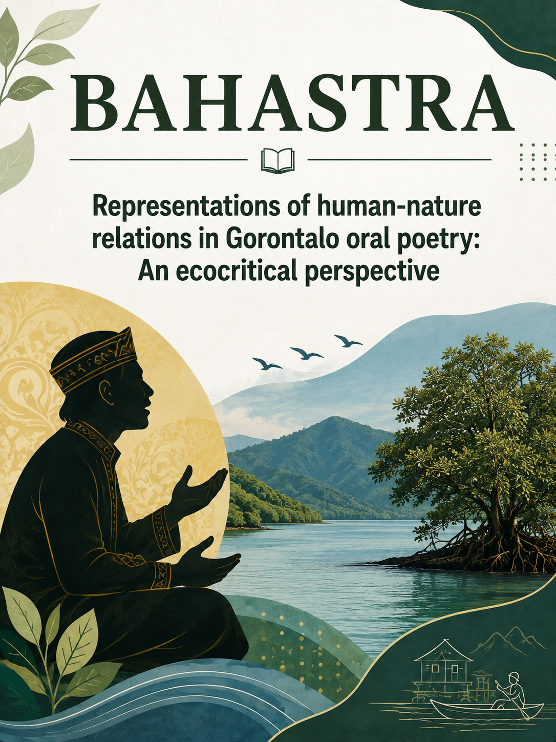
Representations of human-nature relations in Gorontalo oral poetry: An ecocritical perspective
DOI:
https://doi.org/10.26555/bs.v46i2.2267Keywords:
Ecocriticism, Gorontalo , Human–Nature , Interconnectedness , Oral PoetryAbstract
Gorontalo oral poetry preserves ecological experience through culturally situated, communal, and intergenerational forms of expression. However, previous studies have primarily examined its linguistic structures, social functions, and cultural preservation, leaving its ecological philosophy and oral modes of transmission underexplored. This study explores four Gorontalo oral poems—Lo Huidu, Pa’ia Hungo Lo Poli, Bulalo Lo Limutu, and Ta Ilotuhata Lo Botu Bulota—using a qualitative descriptive approach and an ecocritical framework. Data obtained through audio recording, interviews, observation, transcription, and translation were analyzed thematically and interpretatively. The findings reveal a distinctive practical-relational ecological worldview organized around three interconnected principles. First, ecological continuity depends on everyday practices of restraint, care, cooperation, and collective restoration. Second, human–nature relationships are neither static nor inherently harmonious: nature sustains material and cultural life, but human conduct can also produce degradation, livelihood vulnerability, and environmental loss. Third, environmental experience becomes collective ecological memory through oral-literary features such as repetition, alternating voices, imperative expressions, narrative escalation, and communal address. These features transform planting, environmental degradation, and weather-related danger into memorable guidance that can be performed and transmitted across generations. The study advances ecocritical scholarship by identifying a culturally specific Gorontalo ecological worldview grounded in reciprocity, responsibility, vulnerability, and responsiveness to environmental change. It also contributes to oral-literature studies by demonstrating that oral poetry is not simply a repository of ecological messages but an active cultural process through which communities remember environmental change, evaluate human conduct, and transmit principles for sustaining ecological and cultural life.
References
Ab Jabar, N., Sukri, S., Daeng Jamal, D. H., Kiffli, S., & Suliman, M. S. (2024). Literature and cultural ecology: The relationship between folklore and environmental sustainability. BIO Web of Conferences, 131, 03007. https://doi.org/10.1051/bioconf/202413103007
Abubakari, H. (2025). Folktales for environmental conservation: From oral traditions to ecological wisdom. African Studies, 84(1–2), 68–87. https://doi.org/10.1080/00020184.2025.2523518
___________. (2026). African indigenous knowledge systems: Environmental stewardship expressed through folktales. Folklore, 137(1), 137–160. https://doi.org/10.1080/0015587X.2025.2592462
Aldyan, A., Putri, K. A., Aldyan, R. A., & Alasttal, A. (2024). Local wisdom-based environmental management policy in Indonesia: Challenges and implementation. Journal of Law, Environmental, and Justice, 2(3). https://doi.org/10.62264/jlej.v2i3.100
Assumi, S. E. (2026). Sacred landscapes and embodied law: Sumi oral traditions as environmental epistemology. Journal of Environmental Studies and Sciences, 1–13. https://doi.org/10.1007/s13412-025-01087-4
Baga, M., Jahja, M., Sakakibara, M., & Kasamatsu, H. (2024). Cultural fluctuation of lake communities by the Shrinkage of Lake Limboto, Indonesia. Sustainability, 16(2), 704. https://doi.org/10.3390/su16020704
Bagtayan, Z. A. (2021). Cerita rakyat Gorontalo Janjia Lo U Duluwo. Ideas: Jurnal Pendidikan, Sosial, dan Budaya, 7(4), 331–338. https://doi.org/10.32884/ideas.v7i4.564
Bate, J. (2015). Romantic ecology (Routledge revivals): Wordsworth and the environmental tradition. Routledge.
Bouti, S., Ntelu, A., Muziatun, M., Budiarti, E., Ari, A., & Dondo, D. (2025). Orthographic representation of long vowels in Gorontalo: A sociolinguistic perspective on tradition and technology. The International Journal of Communication and Linguistic Studies, 23(3), 1–22. https://doi.org/10.18848/2327-7882/CGP/v23i03/1-22
Braun, V., & Clarke, V. (2006). Using thematic analysis in psychology. Qualitative Research in Psychology, 3(2), 77–101. https://doi.org/10.1191/1478088706qp063oa
Clark, T. (2011). Post-humanism and the ‗end of nature? In the cambridge introduction to literature and the environment. Cambridge University Press.
Creswell, J. W., & Poth, C. N. (2017). Qualitative inquiry and research design: Choosing among five approaches. SAGE Publications.
Davis, R. D. (2024). Ecological consciousness. In Elgar Encyclopedia of Interdisciplinarity and Transdisciplinarity (pp. 196–200). Edward Elgar Publishing. https://doi.org/10.4337/9781035317967.ch43
Desai, F. P., Desai, P. S., Desai, N. K., & Tai, R. A. (2024). Affirmations of ecosystem: The ecotopian bio-network in vedic eco-narratives. Revista de Gestão Social e Ambiental, 18(3), e04825. https://doi.org/10.24857/rgsa.v18n3-094
Djou, D. N. (2019). Dialog peminangan dalam bahasa Gorontalo. Kantor Bahasa Provinsi Gorontalo.
Djou, D. N., & Ntelu, A. (2022). Kontribusi ungkapan figuratif dalam bahasa adat terhadap perilaku sosial masyarakat di provinsi Gorontalo. Journal of Anthropolinguistics, 3(1), 27–39. https://anthropolinguistics.ipmi.or.id/index.php/joa/article/view/19
Djou, D. N., Ntelu, A., & Hinta, E. (2023). Analysis of code-mixing in marriage proposals among Gorontalo people in Indonesia. Eurasian Journal of Applied Linguistics, 9(1), 48–58. https://doi.org/10.32601/ejal.901005
Fabry, G. (2024). Perspectiva ecofeminista y poesía del Cono Sur (Liliana Lukin, Liliana Ancalao y Emilia Pequeño Roessler). Monteagudo, (29), 55–75. https://doi.org/10.6018/monteagudo.601461
Fierro-Concha, M., Concha, M., & Ibarra, E. (2026). Mnemonics and denunciation in Mapuche ecopoetry: Elicura Chihuailaf, Leonel Lienlaf, and Lorenzo Aillapán. Metáfora Revista de Literatura y Análisis, 8(16), 61–79. https://doi.org/10.36286/mrlad.v3i6.258
Finnegan, R. (2012). Oral literature in Africa. Open Book Publishers. https://doi.org/10.11647/OBP.0025
Garrard, G. (2011). Ecocriticism. Routledge. https://doi.org/10.4324/9780203806838
Hassanin, S. M., Eleleidy, M. A., & Al Bayomy, E. M. (2025). Ecocritical perspectives on the healing of nature: A study of covid-19 poetry. World Journal of English Language, 15(7), 389. https://doi.org/10.5430/wjel.v15n7p389
Hilmi, H. S., Andayani, & Wardani, N. E. (2024). Human and nature relations in Hooykaas Christiaan’s Enige Sasakse Volksvertelsels (Lombok): An ecocritical study. Research Journal in Advanced Humanities, 5(1). https://doi.org/10.58256/5k4q1x70
Hinta, E. (2021). Structure of Lohidu’s verbal poetry and values local wisdom in the Gorontalo’s community. Proceeding International Conference on Literature, 314–323.
Hinta, E., Ntelu, A., Djou, D., & Zulkipli, N. (2022). Paanthungi, puisi lisan Gorontalo sebagai media pemertahanan bahasa daerah. JENTERA: Jurnal Kajian Sastra, 11(1), 165. https://doi.org/10.26499/jentera.v11i1.4874
Indriyanto, K. (2024). Reimagining nature in selected Hawaiian literature: An indigenous ecological perspective. Crossroads. A Journal of English Studies, (44(1)), 21–38. https://doi.org/10.15290/CR.2024.44.1.02
Jose, V. R., & Rahul, S. (2026). Ecological wisdom in oral traditions. Comparative Legilinguistics, 65, 1–20. https://doi.org/10.14746/cl.2026.65.1
Kosgei, J. (2021). Indigenous knowledge and marine conservation in oral poems from the Kenyan coast. Wasafiri, 36(2), 71–78. https://doi.org/10.1080/02690055.2021.1879498
Lamusu, S. A. (2020). Kearifan lokal dalam sastra lisan Tuja’i pada upacara adat pinangan masyarakat Gorontalo. LITERA, 19(3), 505–520. https://doi.org/10.21831/ltr.v19i3.32400
Lantowa, J., & Dunggio, M. (2021). Morphologi cerita rakyat Gorontalo Perang Panipi: Kajian naratologi Vladimir Propp. Jurnal Ilmiah Sarasvati: Bahasa, Sastra, dan Pengajarannya, 3(2), 136–150. https://journal.uwks.ac.id/sarasvati/article/view/1741
Le Duc, A. (2025). Vietnamese traditional narratives as ecological parables promoting an ecological ethos. Studia Ecologiae et Bioethicae, 23(3), 19–33. https://doi.org/10.21697/seb.5859
Loder, R. E. (2025). Environmental ethics. In Elgar Concise Encyclopedia of Animal Law (pp. 128–131). Edward Elgar Publishing. https://doi.org/10.4337/9781803923673.00040
Miard, P. (2017). Ecological knowledge. In The International Encyclopedia of Primatology (pp. 1–2). Wiley. https://doi.org/10.1002/9781119179313.wbprim0330
Nasution, I., Marsella, E., Widayati, D., & Lubis, R. (2025). Folklore myths and environmental conservation in Karo regency. Multidisciplinary Reviews, 9(6), 2026250. https://doi.org/10.31893/multirev.2026250
Ntelu, A., & Djou, D. N. (2017). The language family relation of local languages in Gorontalo province (A lexicostatistic study). Journal of Arts and Humanities, 6(11), 48–59. https://doi.org/https://doi.org/10.18533/journal.v6i11.1285
Pete, S. H. (2020). Seliš ontological perspectives of environmental sustainability from oral traditions. Current Opinion in Environmental Sustainability, 43, 71–76. https://doi.org/10.1016/j.cosust.2020.03.003
Putri, N. Q. H., Andayani, A., & Wardani, N. E. (2023). Representation of cultural values in Tempuutn Senarikng of Dayak Benuaq and Tunjung tribes. HTS Teologiese Studies/Theological Studies, 79(1), 8091. https://doi.org/10.4102/hts.v79i1.8091
Setiyoningsih, T., Sumarwati, & Andayani. (2026). Pilgrimage, folklore, and ecological ethics: Symbolic conservation practices in Dieng’s sacred landscape, Indonesia. Geojournal of Tourism and Geosites, 64(1), 217–226. https://doi.org/10.30892/gtg.64119-1670
Soulioti, D. (2022). Ecocritical insights: Contemporary concerns about forest ecosystems in a greek picturebook. Children’s Literature in Education, 53(4), 454–467. https://doi.org/10.1007/s10583-021-09451-y
Spradley, J. P. (2016). Participant observation. Waveland Press.
Sultoni, A., Suwandi, S., Andayani, & Sumarwati. (2023). Representation of ecological wisdom in Banyumas folklore: An ecocritical study. Theory and Practice in Language Studies, 13(12), 3141–3148. https://doi.org/10.17507/tpls.1312.11
Suwandi, S., Ulya, C., Wardhani, N. E., Kurniawan, H., & Ristiyani. (2025). Human-environmental relations as manifested in Central Java folklore of Indonesia. Theory and Practice in Language Studies, 15(7), 2366–2376. https://doi.org/10.17507/tpls.1507.29
Tuloli, N. (2023). Peragaman sastra lisan dan deskripsi pantun Gorontalo. In M. Baga (Ed.), Revitalisasi pantun Gorontalo dan pantun Nusantara (pp. 1–28). PT Insan Cendekia Mandiri Group.
Wahyuni, D., Suwondo, T., Satiyoko, Y., Zamzuri, A., Saptawuryandari, N., & Taum, Y. Y. (2025). The sea as a representation of ecological knowledge: Case study of ‘Suti Solo do Bina Bane’ Tale on Rote island, Indonesia. Journal of Marine and Island Cultures, 14(2), 167–188. https://doi.org/10.21463/jmic.2025.14.2.10
Yaacob, M. (2024). Alam dalam antologi cakerawala Islam nusantara: Satu analisis takmilah. Islamiyyat, 46(1), 83–97. https://doi.org/10.17576/islamiyyat-2024-4601-07
Additional Files
Published
Issue
Section
License
Copyright (c) 2026 Zilfa Achmad Bagtayan, Yunus Dama, Agrariawan Tamsil, Jafar Lantowa

This work is licensed under a Creative Commons Attribution-ShareAlike 4.0 International License.
1.jpg)