Designing website and AI-based Indonesian teaching materials integrated with arts and cultural values
DOI:
https://doi.org/10.26555/bs.v46i2.2217Keywords:
Artificial Intelligence, Arts, Culture, Teaching materials , WebsiteAbstract
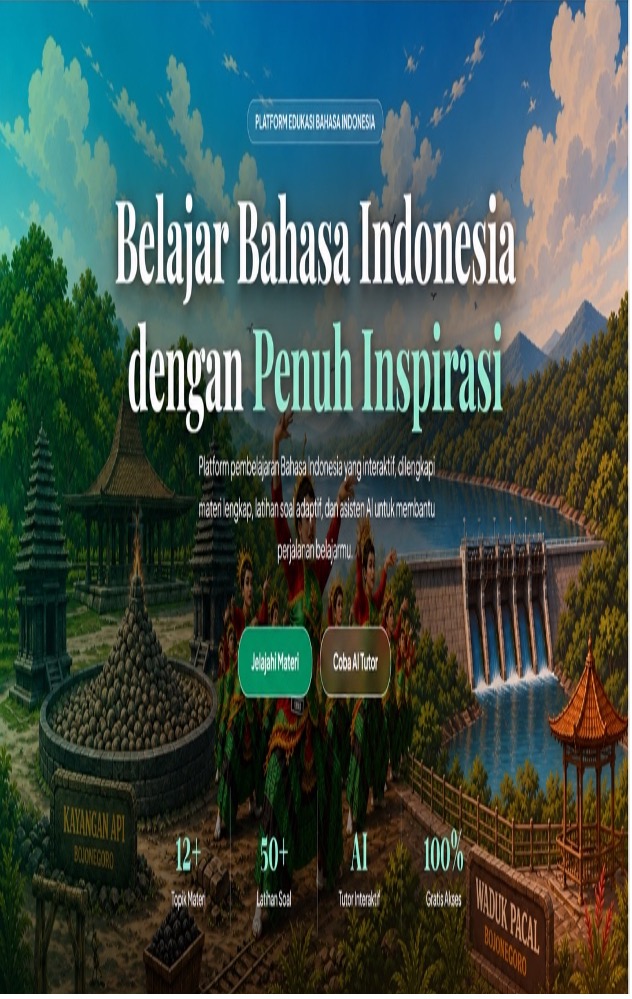
Developing Indonesian language teaching materials that address 21st century demands has become a necessity. This study aims to design AI-integrated and web-based Indonesian teaching materials that are integrated with art and cultural values. It focuses on student interaction with AI as cultural interpreter and the embedding of cultural values within learning activities. This study implements ADDIE design. The primary novelty of this research lies in the formulation of a tripartite integration framework that simultaneously unifies three core components within a single learning product. The research subjects were 200 junior high school students. Data was collected through student needs assessment questionnaires, expert validation questionnaires, and learning achievement tests. The needs analysis revealed a high demand for interactive digital teaching materials among students, with the aspects of digital teaching materials (4,15) and learning technology (4,10) ranking as the highest priorities. Expert validation results indicated that material and media feasibility achieved scores of 90,8% and 88,4%, both categorized as “highly feasible.” The N-Gain test results demonstrated that the experimental class attained an average score of 0,60 (moderate category), with 60% of students falling into the high category, whereas the control class only achieved 0,28 (low category). Pedagogical implication of these findings is the need of learning model which integrates technology and culture to create meaningful, contextual and responsive learning experience. Therefore, AI-integrated and web-based Indonesian teaching materials integrated with art and cultural values are declared highly feasible and effective for use at junior high school level. This study offers three significant contributions: (1) a theoretical contribution in form of the tripartite integration framework, (2) a practical contribution through a ready-to-implement teaching material product, and (3) a policy contribution as a reference for developing an Indonesian language curriculum that is adaptive to the digital era while simultaneously preserving local culture.
References
Agung, M., Budiarty, N. A., & Sunra, L. (2025). Indonesian EFL teachers' strategies for integrating character values and local culture: A review of implementation and learning outcomes. IDEAS: Journal on English Language Teaching and Learning, Linguistics, and Literature, 13(2), 8028-8048. https://ejournal.iainpalopo.ac.id/index.php/ideas/article/view/9021
Astiti, K. A., Yanti, B. A. S., Suryaningsih, N. M. A., Poerwati, C. E., Zahara, L., & Wijaya, I. K. W. B. (2024). Teori psikologi konstruktivisme. Nilacakra.
Astuti, A. P., Aziz, A., Sumarti, S. S., & Bharati, D. A. L. (2019, June). Preparing 21st century teachers: Implementation of 4C character’s pre-service teacher through teaching practice. Journal of Physics: Conference Series, 1233 (1), 012109. https://doi.org/10.1088/1742-6596/1233/1/012109
Chan, C. S. C. (2018). Sustainability of indigenous folk tales, music, and cultural heritage through innovation. Journal of Cultural Heritage Management and Sustainable Development, 8(3), 342-361. https://doi.org/10.1108/JCHMSD-06-2017-0044
Chisunum, J. I., & Nwadiokwu, C. (2024). Enhancing student engagement through practical production and utilization of instructional materials in an educational technology class: A multifaceted approach. NIU Journal of Educational Research, 10(2), 81-89. https://doi.org/10.58709/niujed.v10i2.2002
Dartini, N. P. D. S., Syahputra, A., Zahara, L., Wijaksono, A., & Gombo, M. (2025). Integrating local wisdom values into educational management: A literature review on character development aspects. Indonesian Journal of Educational Inquiry, 2(1), 42-51. https://ejournal2.undiksha.ac.id/index.php/IJEI/article/view/5100
Doering, A., Veletsianos, G., Scharber, C., & Miller, C. (2009). Using the technological, pedagogical, and content knowledge framework to design online learning environments and professional development. Journal of educational computing research, 41(3), 319-346. https://doi.org/10.2190/EC.41.3.d
Firdaus, S. (2025). Indonesian and world folklore from a critical literacy perspective: A comparative analysis of cultural values and social identity. Austronesian: Journal of Language Science & Literature, 4(2), 135-151. https://doi.org/10.59011/austronesian.4.2.2025.135-151
Fisher, M., & Baird, D. E. (2006). Making mLearning work: Utilizing mobile technology for active exploration, collaboration, assessment, and reflection in higher education. Journal of Educational Technology Systems, 35(1), 3-30. https://doi.org/10.2190/4T10-RX04-113N-8858
Fitrawati, F., Syarif, H., Zaim, M., & Perrodin, D. D. (2023). The perceptions of tertiary students and lecturers regarding CLIL-based critical reading material employing interactive multimedia. Indonesian Journal of Applied Linguistics, 12(3), 598-611. https://doi.org/10.17509/ijal.v12i3.36838
Fitria, T. N. (2021, December). Artificial intelligence (AI) in education: Using AI tools for teaching and learning process. In Prosiding seminar nasional & call for paper STIE AAS, 4(1), 134-147. https://prosiding.stie-aas.ac.id/index.php/prosenas/article/view/106
Fitria, T. N. (2025). Culture-based teaching: Integrating Indonesian culture in English language teaching (ELT). International Journal of Sustainable English Language, Education, and Science, 2(2), 63-76. https://doi.org/10.71131/xbqdn589
Fitriadi, F., Sinaga, R. M., & Muhammad, R. R. (2024). A literature review on the cultural perspective study in elementary school education in Indonesia. Journal of Innovation in Educational and Cultural Research, 5(1), 51-61. https://doi.org/10.46843/jiecr.v5i1.848
Gan, B., Menkhoff, T., & Smith, R. (2015). Enhancing students’ learning process through interactive digital media: New opportunities for collaborative learning. Computers in Human Behavior, 51, 652-663. https://doi.org/10.1016/j.chb.2014.12.048
Hasani, H. (2025). The role of Indonesian language teachers in era 5.0: Technology-based learning innovations and artificial intelligence. Alinea: Jurnal Bahasa, Sastra, dan Pengajaran, 5(1), 121-135. https://doi.org/10.58218/alinea.v5i1.1251
Hasibuan, R., Parta, I. B. M. W., Sholihah, H. I. A., & Damayanto, A. (2023). Transformation of Indonesian language learning with artificial intelligence applications: The era of the independent curriculum for learning in universities in Indonesia. Indonesian Journal of Education (INJOE), 2(2), 341-363. https://felifa.net/index.php/INJOE/article/view/154
Ho, S. H., & Shih, Y. T. (2023). Enhance cultural competence and creative abilities through innovation education of traditional techniques. DS 123: Proceedings of the International Conference on Engineering and Product Design Education (E&PDE 2023). https://doi.org/10.35199/EPDE.2023.26
Huang, L. T., Chiu, C. A., Sung, K., & Farn, C. K. (2011). A comparative study on the flow experience in web-based and text-based interaction environments. Cyberpsychology, Behavior, and social networking, 14(1-2), 3-11. https://doi.org/10.1089/cyber.2009.0256
Jayadi, K., Yatim, H., Sahnir, N., Djirong, A., & Abduh, A. (2024). The integration of local cultural arts in the context of teaching materials on the implementation of the merdeka belajar curriculum. Journal of Education Research and Evaluation, 8(2), 404-413. https://doi.org/10.23887/jere.v8i2.78359
Karomah, L., & Masyuri, M. (2024, December). Cultural resilience in the era of globalization: Maintaining heritage and local wisdom for future generations. Proceeding of International Conference on Education, Society and Humanity, 2(2), 1635-1641. https://ejournal.unuja.ac.id/index.php/icesh/article/view/8147
Khatimah, H. (2025). Digital pedagogical innovations in English language education: A systematic literature review. LIER: Language Inquiry & Exploration Review, 2(1), 44-56. https://doi.org/10.71435/639193
Kolluru, V., Mungara, S., & Chintakunta, A. N. (2018). Adaptive learning systems: Harnessing AI for customized educational experiences. International Journal of Computational Science and Information Technology, 6(3), 10-5121. https://doi.org/10.5121/ijcsity.2018.6302
Kosimov, R. A. (2025). The role of cultural heritage objects in developing moral and ethical education of individuals. Mental Enlightenment Scientific-Methodological Journal, 6(08), 589-596. https://mentaljournal-jspu.uz/index.php/mesmj/article/view/1163
Kovalchuk, V., Reva, S., Volch, I., Shcherbyna, S., Mykhailyshyn, H., & Lychova, T. (2025, June). Artificial intelligence as an effective tool for personalized learning in modern education. Environment. Technology. Resources. Proceedings of the International Scientific and Practical Conference, 3, 187-194. https://doi.org/10.17770/etr2025vol3.8534
Laili, M. (2017). Integrating character education and local wisdom in developing English teaching material. Education and Human Development Journal, 2(2). https://doi.org/10.33086/ehdj.v2i2.1383
Lee, A. Y. (2016). Media education in the school 2.0 era: Teaching media literacy through laptop computers and iPads. Global Media and China, 1(4), 435-449. https://doi.org/10.1177/2059436416667129
Li, G. (2023). E-learning intelligence model with artificial intelligence to improve learning performance of students. Journal of Computer Allied Intelligence (JCAI, ISSN: 2584-2676), 1(1), 14-26. https://doi.org/10.69996/jcai.2023002
Li, Q., Lau, R. W., Shih, T. K., & Li, F. W. (2008). Technology supports for distributed and collaborative learning over the internet. ACM Transactions on Internet Technology (TOIT), 8(2), 1-24. https://doi.org/10.1145/1323651.1323656
Malarsih, M., Haryono, S., & Widodo, W. (2025). Local culture–based dance learning with the integration of students’ creativity, motor skills, and social sensitivity. Catharsis, 14(2), 147-154. https://doi.org/10.15294/catharsis.v14i2.18824
McGrath, I. (2016). Materials evaluation and design for language teaching. Edinburgh University Press.
Miqawati, A. H., Wijayanti, F., & Purnama, A. I. (2024). Integrating local culture in English language teaching: Enhancing authentic materials and cultural awareness. Journal of English in Academic and Professional Communication, 10(2), 100-106. https://doi.org/10.25047/jeapco.v10i2.5096
Ottu, M. D., Yundayani, A., & Djahimo, S. E. (2024). The use of local wisdom-based instructional materials in english language teaching for junior high school students in Timor Tengah Selatan Regency. SOSCIED, 7(2), 360-372. https://doi.org/10.32531/jsoscied.v7i2.804
Silverajah, V. G., & Govindaraj, A. (2017, December). The use of digitized self-learning resources to enhance students' independent learning. Proceedings of the 9th International Conference on Education Technology and Computers, 131-135. https://doi.org/10.1145/3175536.3175544
Subiyantoro, S., & Fadhilah, S. S. (2020). A study on teachers’ perceptions towards cultural arts subject using wayang kulit purwa to students of junior high school in Solo Raya. International Journal of Pedagogy and Teacher Education, 4(2), 138-153. https://doi.org/10.20961/ijpte.v4i2.44145
Sugiyono. (2017). Metode penelitian bisnis: Pendekatan kuantitatif, kualitatif, kombinasi, dan R&D (Edisi ke-3). Alfabeta.
Susanti, E., Hikmat, A., & Tarmini, W. (2025). Needs analysis fo the development of web-based teaching materials in scientific writing skills instruction for eleventh-grade vocational high school students. BAHASTRA, 45(2), 222-231. https://doi.org/10.26555/bs.v45i2.1407
Tohani, E., & Aulia, I. (2022). Effects of 21st century learning on the development of critical thinking, creativity, communication, and collaboration skills. Journal of Nonformal Education, 8(1), 46-53. https://doi.org/10.15294/jne.v8i1.33334
Tondeur, J., Van Braak, J., Ertmer, P. A., & Ottenbreit-Leftwich, A. (2017). Understanding the relationship between teachers’ pedagogical beliefs and technology use in education: A systematic review of qualitative evidence. Educational technology research and development, 65(3), 555-575. https://doi.org/10.1007/s11423-016-9481-2
Trissetianto, A. C., Muhlis, M., & Priyambodo, A. (2026). Design and implementation of an augmented reality multimedia framework for enhanced collaborative learning in higher education environments using real time interaction techniques. Digital Multimedia and Visualization Technology, 1(1), 01-12. https://doi.org/10.66472/dimuvi.v1i1.45
Vlasenko, K. V., Volkov, S. V., Lovianova, I. V., Sitak, I. V., Chumak, O. O., & Bohdanova, N. H. (2023). Exploring usability principles for educational online courses: a case study on an open platform for online education. Educational Technology Quarterly, (2), 173-187. https://doi.org/10.55056/etq.602
Vonti, L. H., Rosyid, A., Indriyani, I., & Muchtar, A. K. (2025). Cultural responsiveness and digital tools in literacy instruction: Insight from Indonesian High School teachers. English Review: Journal of English Education, 13(1), 145-154. https://doi.org/10.25134/erjee.v13i1.11195
Wangkamhan, Y., & Nachaisin, K. (2024). Integrating local wisdom into the Thai curriculum: Enhancing student engagement and cultural awareness. Journal of Buddhist Education and Research (JBER), 10(3), 173-183. https://so06.tci-thaijo.org/index.php/jber/article/view/282446
Woo, J. H., & Choi, H. (2021). Systematic review for AI-based language learning tools. arXiv preprint arXiv:2111.04455. https://doi.org/10.48550/arXiv.2111.04455
Zainuddin, Z. (2025). The merdeka curriculum as a reflection of national identity: Dynamics of character education based on local wisdom in South Sumatra. Studies in Humanities and Education, 6(2), 28-44. https://doi.org/10.48185/she.v6i2.1696
Additional Files
Published
Issue
Section
License
Copyright (c) 2026 Zuhad Zuhad, Carrine Irawan Kumalasari, Cahyo Hasanudin, Aji Krisna Bayu, Liga Alhaqi Audi Putra Nusantara

This work is licensed under a Creative Commons Attribution-ShareAlike 4.0 International License.
1.jpg)