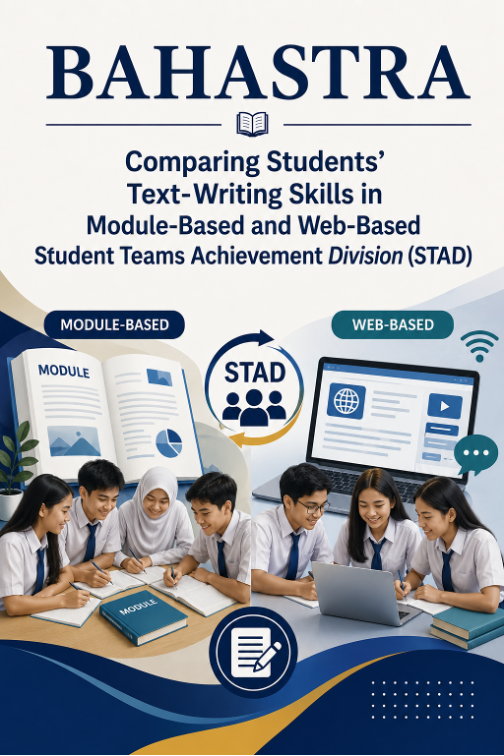
A Comparing Students’ Text-Writing Skills in Module-Based and Web-Based Student Teams Achievement Division (STAD)
DOI:
https://doi.org/10.26555/bs.v46i2.2151Keywords:
Kurikulum Merdeka , Module-Based Learning, STAD , Text-Writing Skills , Web-Based LearningAbstract
Writing instruction in Indonesian language classes faces two related challenges: students' persistent difficulty in organizing ideas, text structures, and linguistic features, and the curricular shift toward Kurikulum Merdeka, which emphasizes logical, critical, creative, and publication-oriented writing in print and digital media. Previous studies on STAD mostly tested the model as a cooperative strategy, while fewer studies compared how different media shape STAD implementation in genre-based writing. This study addresses that gap by comparing module-based and web-based STAD for tenth-grade students' text-writing skills. A quantitative quasi-experimental comparison was conducted using 70 complete posttest scripts from two Grade X classes at SMA Negeri 3 Padang. The module-based group and the web-based group wrote observation report, exposition, and anecdote texts. The texts were assessed through an analytic rubric covering content development, generic structure, and linguistic features. The data were analyzed using descriptive statistics, Welch's t-test, Mann-Whitney U test, and Cohen's d. The module-based group obtained an overall mean of 76.06 (SD = 6.46), while the web-based group reached 80.85 (SD = 5.61). The difference was significant, t (66.69) = 3.31, p = .001, d = .79. Web-based STAD showed the largest advantage in observation reports and anecdotes, while the difference in exposition texts was smaller. These findings indicate that instructional media are not neutral in cooperative writing instruction. Web-based STAD strengthens interaction, access to examples, and revision feedback, whereas modules provide procedural scaffolding. The study contributes empirical evidence on media-sensitive STAD implementation for text-based Indonesian language learning.
References
Arikunto, S. (2014). Prosedur penelitian: Suatu pendekatan praktik. Rineka Cipta.
Badan Standar, Kurikulum, dan Asesmen Pendidikan. (2024). Keputusan Kepala Badan Standar, Kurikulum, dan Asesmen Pendidikan Nomor 032/H/KR/2024 Tentang Capaian Pembelajaran pada Pendidikan Anak Usia Dini, Jenjang Pendidikan Dasar, dan Jenjang Pendidikan Menengah pada Kurikulum Merdeka. Kementerian Pendidikan, Kebudayaan, Riset, dan Teknologi.
Badger, R., & White, G. (2000). A process genre approach to teaching writing. ELT Journal, 54(2), 153-160. https://doi.org/10.1093/elt/54.2.153
Bandura, A. (1997). Self-efficacy: The exercise of control. W. H. Freeman.
Cohen, J. (1988). Statistical power analysis for the behavioral sciences (2nd ed.). Lawrence Erlbaum Associates.
Dalman. (2016). Keterampilan menulis. Rajagrafindo Persada.
Deci, E. L., & Ryan, R. M. (2000). The “what” and “why” of goal pursuits: Human needs and the self-determination of behavior. Psychological Inquiry, 11(4), 227-268. https://doi.org/10.1207/S15327965PLI1104_01
Dillenbourg, P. (1999). What do you mean by collaborative learning? In P. Dillenbourg (Ed.), Collaborative learning: Cognitive and computational approaches (pp. 1-19). Elsevier.
Elola, I., & Oskoz, A. (2010). Collaborative writing: Fostering foreign language and writing conventions development. Language Learning & Technology, 14(3), 51-71. https://doi.org/10.64152/10125/44226
Flower, L., & Hayes, J. R. (1981). A cognitive process theory of writing. College Composition and Communication, 32(4), 365-387. https://doi.org/10.2307/356600
Gillies, R. M. (2016). Cooperative learning: Review of research and practice. Australian Journal of Teacher Education, 41(3), 39-54. https://doi.org/10.14221/ajte.2016v41n3.3
Graham, C. R. (2006). Blended learning systems: Definition, current trends, and future directions. In C. J. Bonk & C. R. Graham (Eds.), The handbook of blended learning: Global perspectives, local designs (pp. 3-21). Pfeiffer.
Graham, S. (2018). A revised writer(s)-within-community model of writing. Educational Psychologist, 53(4), 258-279. https://doi.org/10.1080/00461520.2018.1481406
Graham, S., & Perin, D. (2007). Writing next: Effective strategies to improve writing of adolescents in middle and high schools. Alliance for Excellent Education.
Hattie, J., & Timperley, H. (2007). The power of feedback. Review of Educational Research, 77(1), 81-112. https://doi.org/10.3102/003465430298487
Helaluddin, Nurhayati, Nadya, N. L., Ismail, G., Guntur, M., & Fransori, A. (2023). The use of collaborative strategies to improve students' writing ability and self-efficacy: A mixed method study. European Journal of Educational Research, 12(1), 265-280. https://doi.org/10.12973/eu-jer.12.1.265
Hyland, K. (2003). Second language writing. Cambridge University Press. https://doi.org/10.1017/CBO9780511667251
Johnson, D. W., & Johnson, R. T. (2009). An educational psychology success story: Social interdependence theory and cooperative learning. Educational Researcher, 38(5), 365-379. https://doi.org/10.3102/0013189X09339057
Jonsson, A., & Svingby, G. (2007). The use of scoring rubrics: Reliability, validity and educational consequences. Educational Research Review, 2(2), 130-144. https://doi.org/10.1016/j.edurev.2007.05.002
Karnedi, K. (2025). Effectiveness of developing a STAD model integrated into group work projects to enhance students' writing skills. Baileo: Jurnal Sosial Humaniora, 2(2), 225-241. https://doi.org/10.30598/baileofisipvol2iss2pp225-241
Kementerian Pendidikan, Kebudayaan, Riset, dan Teknologi. (2024). Peraturan Menteri Pendidikan, Kebudayaan, Riset, dan Teknologi Nomor 12 Tahun 2024 tentang Kurikulum pada Pendidikan Anak Usia Dini, Jenjang Pendidikan Dasar, dan Jenjang Pendidikan Menengah.
Kirschner, P. A., Sweller, J., & Clark, R. E. (2006). Why minimal guidance during instruction does not work: An analysis of the failure of constructivist, discovery, problem-based, experiential, and inquiry-based teaching. Educational Psychologist, 41(2), 75-86. https://doi.org/10.1207/s15326985ep4102_1
Lawanto, O. (2001). Pembelajaran berbasis web sebagai metoda komplemen kegiatan pendidikan. Jurnal Pendidikan dan Kebudayaan, 7(9), 44-58.
Lu, X., & Kim, S. (2021). A systematic review of collaborative writing implementation in K-12 second language classrooms. TEFLIN Journal, 32(1), 50-71. https://doi.org/10.15639/teflinjournal.v32i1/50-71
Lukmawardani, N. I., & Badriyah, I. M. (2022). Genre based approach to improve students’ writing ability of tenth graders of senior high school. English Edu: Journal of English Teaching and Learning, 1(1), 9-17. https://doi.org/10.18860/jetl.v1i1.1622
Lv, X., Ren, W., & Xie, Y. (2021). The effects of online feedback on ESL/EFL writing: A meta-analysis. Frontiers in Psychology, 12, 643261. https://doi.org/10.3389/fpsyg.2021.643261
Mantra, I. B. N., Maba, W., & Widiastuti, I. A. M. S. (2025). Utilizing cooperative learning as an effective method to improve students' writing skills. International Journal of Multidisciplinary Approach Research and Science, 3(2), 458-471. https://doi.org/10.59653/ijmars.v3i02.1520
Martin, J. R., & Rose, D. (2008). Genre relations: Mapping culture. Equinox.
Means, B., Toyama, Y., Murphy, R., & Baki, M. (2013). The effectiveness of online and blended learning: A meta-analysis of the empirical literature. Teachers College Record, 115(3), 1-47. https://doi.org/10.1177/016146811311500307
Nisja, I. (2018). Kesesuaian buku teks Bahasa Indonesia dengan Kurikulum 2013. Jurnal Penelitian Pendidikan Bahasa dan Sastra Indonesia, 1(1), 162-172.
OECD. (2023). PISA 2022 results (Volume I): The state of learning and equity in education. OECD Publishing. https://doi.org/10.1787/53f23881-en
Resmi, T., Tansliova, L., & Maysaroh, E. (2020). Pengaruh model pembelajaran STAD terhadap kemampuan menulis teks laporan hasil observasi. JIPIS, 29(2), 107-111.
Rusman. (2011). Model-model pembelajaran: Mengembangkan profesionalisme guru. Raja Grafindo Persada.
Sadler, D. R. (1989). Formative assessment and the design of instructional systems. Instructional Science, 18(2), 119-144. https://doi.org/10.1007/BF00117714
Santyasa, I. W. (2009). Metode penelitian pengembangan dan teori pengembangan modul. Universitas Pendidikan Ganesha.
Shadish, W. R., Cook, T. D., & Campbell, D. T. (2002). Experimental and quasi-experimental designs for generalized causal inference. Houghton Mifflin.
Shoimin, A. (2016). 68 model pembelajaran inovatif dalam Kurikulum 2013. Ar-Ruzz Media.
Slavin, R. E. (2014). Cooperative learning and academic achievement: Why does groupwork work? Anales de Psicologia, 30(3), 785-791. https://doi.org/10.6018/analesps.30.3.201201
Slavin, R. E. (2015). Cooperative learning: Theory, research, and practice (2nd ed.). Allyn & Bacon.
Storch, N. (2013). Collaborative writing in L2 classrooms. Multilingual Matters. https://doi.org/10.21832/9781847699954
Sugiyono. (2015). Metode penelitian kuantitatif, kualitatif, dan R&D. Alfabeta.
Tafonao, R. S. H., Halawa, N., Bu'ulolo, Y., & Ndruru, M. (2025). Penerapan model STAD dalam meningkatkan kemampuan menulis surat dinas. J-Simbol, 13(2), 739-747. https://doi.org/10.23960/simbol.v13i2.1005
Tarigan, H. G. (2008). Menulis sebagai suatu keterampilan berbahasa. Angkasa.
Vygotsky, L. S. (1978). Mind in society: The development of higher psychological processes. Harvard University Press.
Warschauer, M. (2007). Technology and writing. In C. Davison & J. Cummins (Eds.), International handbook of English language teaching (pp. 907-912). Springer. https://doi.org/10.1007/978-0-387-46301-8_60
Wood, D., Bruner, J. S., & Ross, G. (1976). The role of tutoring in problem solving. Journal of Child Psychology and Psychiatry, 17(2), 89-100. https://doi.org/10.1111/j.1469-7610.1976.tb00381.x
Yoandita, P. E. (2019). Students' difficulties in writing. Journal of English Education, 7(1), 45-52. https://doi.org/10.35194/jj.v7i1.534
Yu, S., & Lee, I. (2016). Peer feedback in second language writing (2005-2014). Language Teaching, 49(4), 461-493. https://doi.org/10.1017/S0261444816000161
Yusuf, Q., Jusoh, Z., & Yusuf, Y. Q. (2019). Cooperative learning strategies to enhance writing skills among students. International Journal of Instruction, 12(1), 1399-1412. https://doi.org/10.29333/iji.2019.12189a
Additional Files
Published
Issue
Section
License
Copyright (c) 2026 Indriani Nisja, Lira Hayu Afdetis Mana

This work is licensed under a Creative Commons Attribution-ShareAlike 4.0 International License.
1.jpg)