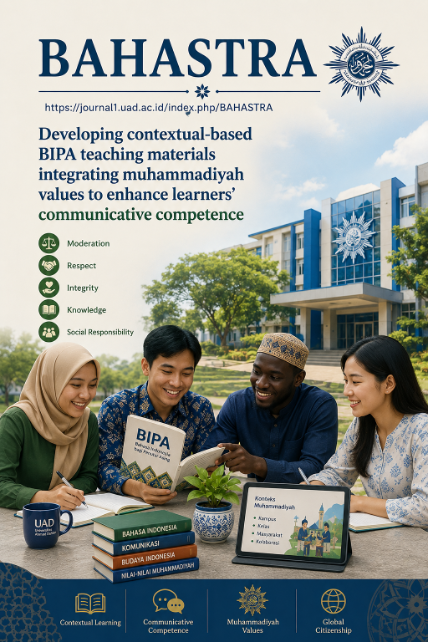
Developing contextual-based BIPA teaching materials integrating muhammadiyah values to enhance learners’ communicative competence
DOI:
https://doi.org/10.26555/bs.v46i2.2141Keywords:
BIPA , Communicative Competence , Contextual Learning , Instructional Materials Development , Muhammadiyah UniversitiesAbstract
This study aims to develop and evaluate contextual-based Indonesian language teaching materials for foreign speakers (BIPA) within the Muhammadiyah university setting. Addressing the limitations of existing culture-based materials, the study proposes an institution-based approach that integrates Muhammadiyah values, academic practices, socio-religious perspectives, and authentic campus communication contexts into instructional design. A mixed-method research design was employed within a research and development (R&D) framework guided by the ADDIE model. The study involved 15 BIPA learners, 2 instructors, and 3 experts. The needs analysis revealed that learners required instructional materials integrating linguistic, communicative, academic, socio-cultural, and institutional dimensions, with institutional context emerging as the most important component. The developed materials were validated by experts and were rated highly appropriate due to their alignment with learners’ communicative needs, authentic learning situations, and integration of institutional cultural values. The effectiveness test demonstrated a statistically significant improvement in learners’ communicative competence between the pre-test and post-test, with a large effect size indicating substantial learning gains. The findings suggest that the integration of authentic campus interactions and Muhammadiyah-based contextual content can enhance learners’ ability to communicate effectively in academic and social environments. This study contributes to BIPA pedagogy by extending contextualization beyond local cultural representation toward an institution-based framework that integrates cognitive, cultural, and contextual dimensions. The findings provide a practical model for developing context-sensitive BIPA materials in Islamic higher education institutions and other educational settings with distinctive institutional identities.
References
Ahmed, S. T. S. (2023). From communicative competence to communication proficiency: A theoretical study. Acuity: Journal of English Language Pedagogy, Literature, and Culture, 8(1), 13–22. https://jurnal.unai.edu/acuity/article/view/2739
Aiken, L. R. (1985). Three coefficiencts for analyzing the reliability and validity of ratings. Educational and Psychological Measurement, 45, 131–142. https://doi.org/10.1177/0013164485451012
Akyıldız, T. S., Çelik, V., & Ahmed, K. H. (2021). Intercultural communicative competence: Why is it significant and how can it be enhanced in EFL settings? Yaşadıkça Eğitim, 35(2), 793–803. https://doi.org/10.33308/26674874.2021352314
Amin, M., & Malik, A. (2024). The role of AIK education in increasing student diversity Muhammadiyah University. Edukasia: Jurnal Penelitian Pendidikan Islam, 19(2), 249–265. https://doi.org/10.21043/edukasia.v19i2.27166
Andriyanto, O. D., Suhartono, Nurhadi, D., Rohaedi, D. W., Hardika, M., & Chuchai, N. (2025). Cultural immersion in BIPA learning: Innovative strategy for developing speaking skills through local wisdom. Educational Process: International Journal, 17, 1–18. https://doi.org/10.22521/edupij.2025.17.354
Arisnawati, N., Rahmatiah, R., & Yulianti, A. I. (2022). BIPA learning design based on buginese culture. ETDC: Indonesian Journal of Research and Educational Review, 1(4), 459–470. https://doi.org/10.51574/ijrer.v1i4.447
Aristia, E. S., Siswantara, E., & Ismiati, I. (2025). Developing CCU instructional materials integrated with local cultures in improving EFL learners’ communicative competences. Journal of Languages and Language Teaching, 13(2), 863–875. https://doi.org/10.33394/jollt.v13i2.13082
As, I. S., & Marleni. (2023). A correlation between linguistic competence and speaking performance of the intermediate students. Journal of English Study Programme, 6(2), 397–406. https://doi.org/10.31851/esteem.v6i2.12336
Associate, G. P. N. (2025). The role of sociolinguistic competence in developing intercultural communication skills in translator education. International Journal of Pedagogics, 05(163), 163–164. https://doi.org/10.37547/ijp/Volume05Issue09-41
Barry, A., & Azani, M. Z. (2026). Reconstructing madrasah identity through Al-Ghazali’s epistemology in contemporary education. Edukasi Islami: Jurnal Pendidikan Islam, 15(01), 19–36.
Best, J. W., Kahn, I. J. V, & Jha, A. K. (2017). Research in education (10th ed.). Perason.
Brainee, H. J. (2024). Investigating the impact of cultural awareness on language learners’ motivation and proficiency. Journal of Gender, Culture and Society, 4(1), 29–38. https://doi.org/10.32996/jgcs.2024.4.1.4
Branch, R. M. (2010). Instructional design: The ADDIE approach. Instructional Design: The ADDIE Approach. Springer US. https://doi.org/10.1007/978-0-387-09506-6
Burhanuddin, W. (2023). The role of sociolinguistics competence in shaping EFL learners’ communicative engagement. JRIP: Jurnal Riset dan Inovasi Pembelajaran, 3(3), 352–368. https://doi.org/10.51574/jrip.v3i3.3872
Byrne, D. (2022). A worked example of Braun and Clarke ’ s approach to reflexive thematic analysis. Quality & Quantity, 56(3), 1391–1412. https://doi.org/10.1007/s11135-021-01182-y
Creswell, J. W. (2018). Research design: Qualitative, quantitative, and mixed methods approaches (Fifth). SAGE.
Diadara, N. (2026). Javanese wisdom: Life-cycle batik as BIPA teaching material with portfolio writing models. IJORER: International Journal of Recent Educational Research, 7(2), 754–772. https://doi.org/10.46245/ijorer.v7i2.1247
Diana, L., Arum, D. P., Susanto, G., & Angoluan, K. C. (2025). Analysis of the needs for the development of Indonesian culture and storytelling based on BIPA animation video teaching materials. International Journal of Social Learning (IJSL), 5(3), 627–646. https://doi.org/10.47134/ijsl.v5i3.450
Dörnyei, Z., & Dewaele, J. (2023). Questionnaires in second language research (3rd Editio). Routledge. https://doi.org/10.4324/9781003331926-2
Echavez, C. J. L. (2024). Shapeshifting in social spaces: Sociolinguistic competence of multilingual learner. Kajian Linguistik dan Sastra, 9(2), 202–218. https://doi.org/10.23917/kls.v9i2.6606
Eustaqio, M. T. L. (2022). An analysis of the communicative competence level of students: A case of nursing students in a state university in Nothern Philippines. International Journal of Linguistics, Literature, and Translation, 0299(1980), 42–49. https://doi.org/10.32996/ijllt.2022.5.4.6
Faisal. (2025). Communicative competence: Its implications for English-as-a- foreign-language teachers in Indonesia. Varidika, 37(1), 14–29. https://journals2.ums.ac.id/varidika/article/view/8226
Fasco, S. P., Asiimwe, S., Ssekabira, G., & Tushabe, J. A. (2024). Enhancing student engagement and learning outcomes: Effective strategies in institutional pedagogy. International Journal of Multidisciplinary Research and Growth Evaluation, 5(2005), 758–767. https://www.researchgate.net/publication/382848686
Guetterman, T. C., Clark, V. L. P., & Molina-Azorin, J. F. (2024). Terminology and mixed methods research: A Persistent challenge. Journal of Mixed Methods Research, 18(1), 9–13. https://doi.org/10.1177/15586898231217855
Guetterman, T. C., & Manojlovich, M. (2024). Grand rounds in methodology: Designing for integration in mixed methods research. Research and Reporting Methodology, 0, 1–9. https://doi.org/10.1136/bmjqs-2023-016112
Herawati, H., Hikmat, A., & Mulyono, H. (2025). Development of transcultural multimedia teaching materials for BIPA learners based on interpretative, interpersonal, and presentational communication models. EDUKASIA: Jurnal Pendidikan dan Pembelajaran, 6, 681–692. https://doi.org/10.62775/edukasia.v6i2.1441
Hermansya, M. Y., Suyatno, & Yuniseffendri. (2022). Presentation of Indonesian cultural elements in BIPA teaching materials published by the ministry of education and culture. Jurnal DISASTRI (Pendidikan Bahasa dan Sastra Indonesia), 4(3), 68–79. https://doi.org/10.33752/disastri.v4i3.3714
Hossain, K. I. (2024). Reviewing the role of culture in English language learning: Challenges and opportunities for educators. Social Sciences and Humanities Open, 9(December 2023), 100781. https://doi.org/10.1016/j.ssaho.2023.100781
Husnayaini, I., & Indrawati. (2025). Development of Indonesian language teaching materials for foreign speakers (BIPA) based on the culture of Bangka Belitung in the English education study program at IAIN Syaikh Abdurrahman Siddik Bangka Belitung. Lire Journal (Journal of Linguistics and Literature), 9(3), 202–217. https://doi.org/10.33019/lire.v9i3.390
Ilyana, N., Tajuddin, I., Abas, U., Aziz, K. A., Nor, R., Nor, H., & Izni, N. A. (2025). Content validity assessment using Aiken’ s V: Knowledge integration model for blockchain in higher learning institutions. (IJACSA) International Journal of Advanced Computer Science and Applications, 16(6), 601–608. https://doi.org/10.14569/IJACSA.2025.0160659
Iskandar, I., Patak, A. A., & Azis, A. (2020). The development of culturally-embedded materials in the teaching of Indonesian for foreign speakers (BIPA) at Universitas Negeri Makassar. Proceeding of The International Conference on Science and Advanced Technology (ICSAT), 90–98.
Kabir, S. M. A. (2021). Book review book title: Thematic analysis: A practical guide. Pasaa Paritat Journal, 39(December 2024), 142–145. https://doi.org/10.58837/CHULA.PPJ.39.8
Kang, W. Y. C. (2024). The development and validation of English communicative competence model for high school students in Korea. English Teaching, 79(1), 3–24. https://doi.org/10.15858/engtea.79.1.202403.3
Kim, D. (2020). Learning language, learning culture: Teaching language to the whole student. ECNU Review of Education, 3(3), 519–541. https://doi.org/10.1177/2096531120936693
Kong, Y. (2021). The Role of experiential learning on students’ motivation and classroom engagement. Frontiers in Psychology, 12(October), 10–13. https://doi.org/10.3389/fpsyg.2021.771272
Kugai, K. (2023). The essence of communicative competence. Philology and Journalism, 22(12), 256–257. https://doi.org/10.36074/logos-22.12.2023.067
Kurniasih, D., Andayani, & Setiawan, B. (2022). Urgency of understanding Indonesian culture for BIPA students at Sebelas Maret University. International Conference of Humanities and Social Science (ICHSS), 125–140.
Macalister, J., & Nation, I. S. P. (2020). Language curriculum design (Second Edi). Taylor & Francis. https://doi.org/10.4324/9780429203763
Mahmoud, P., & Ahmed, A. L. I. (2021). Impact of unpretending and using figurative language on improving learners’ communicative competence. European Academic Research, 9(6), 3242–3252.
Mebert, L., Barnes, R., Dalley, J., Gawarecki, L., Ghazi-Nezami, F., Shafer, G., Slater, J., & Yezbick, E. (2020). Fostering student engagement through a real-world, collaborative project across disciplines and institutions. Higher Education Pedagogies, 5(1), 30–51. https://doi.org/10.1080/23752696.2020.1750306
Megawati, M., Sulisworo, D., & Sayuti, M. (2025). Development of a character instrument based on Al-Islam and kemuhammadiyahan values for muhammadiyah higher education students: A systematic literature review. Jurnal Konseling dan Pendidikan, 13(3), 715–728. https://doi.org/10.29210/1182900
Mishan, F., & Timmis, I. (2015). Materials development for TESOL series (J. C. and F. Farr (ed.)). Edinburgh University Press Ltd. https://doi.org/10.1515/9780748691371
Murzaki, L. A. (2025). Cultivating academic integrity through Islamic ethical foundations in scholarship. Academia Open, 10(2), 1–11. https://doi.org/10.21070/acopen.10.2025.12726
Nailissaadah, L., & Triastuti, A. (2023). International journal of multicultural and multireligious understanding representation of communicative competence in an English language textbook. International Journal of Multicultural and Multireligious Understanding, 10(12), 64–75. https://doi.org/10.18415/ijmmu.v10i12.5212
Naim, M., & Istanto. (2025). Ethics of Islamic education in the 21st century: Sociological perspectives in muhammadiyah review. International Summit on Science Technology and Humanity, 415–424. https://proceedings.ums.ac.id/iseth/article/view/6836
Nashir, H. (2024). Islam berkemajuan. https://Muhammadiyah.or.Id/2022/10/Islam-Berkemajuan/
Noviyanti, D. S. (2024). Intercultural communicative competence based learning model for teaching EFL in Islamic higher education in 21st century. Conference on English Language Teaching, 4(1 SE-Articles), 108–121.
Nurmayanti, N. (2025). Developing communicative competence through task-based language teaching. JELT Journal of English Education, Teaching, and Literature, 03(02), 1–8. https://doi.org/10.65787/jelt.v3i2.624
Oktora, M., & Khairina, Y. (2023). Developing digital teaching materials based on North Sumatra local culture for beginners level of BIPA. UNICSSH 2022, 211–216. https://doi.org/10.2991/978-2-494069-35-0_26
Penuel, W. R., Henson, K., Bracey, Z. B., Vick, N., & Rivet, A. (2024). Designing standards-aligned instructional materials that connect to students’ interests and community priorities. The Science Teacher, 91(5), 62–70. https://doi.org/10.1080/00368555.2024.2390547
Permanasari, E. Y., Soebiantoro, S., & Haryanti, N. (2023). Optimizing institutional identity: A strategic approach through religious culture in higher education. Al-Tanzim: Jurnal Manajemen Pendidikan Islam, 7(4), 1290–1303. https://doi.org/10.33650/al-tanzim.v7i4.6821
Purbarani, E., & Muliastuti, L. (2023). Development of bahasa Indonesia for foreign speaker’s learning material based on Indonesian cultures-literatures and 5C integrated. AKSIS: Jurnal Pendidikan Bahasa dan Sastra Indonesia, 7(2), 128–146. https://doi.org/10.21009/AKSIS.070203
Putri, D., Kristanto, B., & Dian, I. (2025). The sociopragmatic competence paradox: Examining the gap between linguistic and interactive skills in EFL academic presentations in science and technology contexts. JETLI: Journal of English Teaching and Linguistic Issues, 04(01), 44–65. https://doi.org/10.58194/jetli.v4i1.2279
Rafli, Z., Amrulloh, M. A., & Zain, B. (2026). Sociolinguistic approach in teaching Arabic: A literature review. ALIF: Journal of Arabic Language and Learning in Focus, 1(1), 23–34. https://doi.org/10.52640/qtn1jq10
Rahmat, W., Tiawati, R. L., Saddhono, K., Septia, E., Hartati, Y. S., Nisja, I., Dwinitia, S., Zulfitriyani, & Mana, L. H. A. (2024). BIPA learning practices of international students in higher education: A phenomenon of language integration based on psychopragmatics approach. Environment and Social Psychology, 9(8), 1–12. https://doi.org/10.59429/esp.v9i8.2733
Robiah, S., Sri Rahayu, N., Widaystuti, R., & Islam Nusantara, U. (2024). A philosophical analysis of the implementation of vision, mission, strategies, and goals of junior high schools to improve education quality. Didaktika: Jurnal Kependidikan, 13(1), 533–544.
Santoso, D. (2024). Islamic education and civilized democracy: Haedar Nashir’s polite communication strategy from a Qur’anic and pragmatic perspective. Nadwa: Jurnal Pendidikan Islam, 18(2), 259–276. https://doi.org/10.21580/nw.2024.18.2.28598
Shaw, L., Grose, J., Kustra, E., Goff, L., Ellis, D., & Borin, P. (2021). Cultivating an institutional culture that values teaching developing a repository of effective practices. To Improve the Academy, 40(1), 131–156. https://doi.org/10.3998/tia.962
Syafruddin, Pratiwi, B., Izzati, A. N., & Sianipar, I. F. (2025). Teaching Indonesian for foreign speakers: A bibliometric analysis. Issues in Language Studies, 14(1), 55–73. https://doi.org/10.33736/ils.7551.2025
Syakur, I., Shodiq, S. F., & Madjid, A. (2024). Strategic leadership in realizing Islamic academic culture in Muhammadiyah Universities: Systematic literature review. Al-Ishlah: Jurnal Pendidikan, 16(4), 5640–5653. https://doi.org/10.35445/alishlah.v16i4.5825
Taguchi, N. (2026). Development of intercultural communicative competence in an. TESOL International Journal, 60(1), 321–348. https://doi.org/10.1002/tesq.70038
Tan, Han, Z. H., Lam, T. T., & Fah, L. Y. (2023). Use of real-world contexts in instructional materials designed by pre-university mathematics teachers. Dinamika Jurnal Ilmiah Pendidikan Dasar, 15(2), 91–101. https://doi.org/10.30595/dinamika.v15i2.18973
Teng, M. F. (2023). Language learning strategies. Cognitive Individual Differences in Second Language Acquisition: Theories, Assessment and Pedagogy, January, 147–173. https://doi.org/10.1515/9781614514749-008
Teng, M. F., Wen, E. Z., & Li, D. (2025). Communicative and task-based language teaching: Where are we now? Language Learning Journal, 53(6), 685–693. https://doi.org/10.1080/09571736.2025.2572673
Tomlinson, B. (2023). Principled blended learning materials for language acquisition. Journal of English Language Teaching Innovations and Materials (Jeltim), 5(1), 1. https://doi.org/10.26418/jeltim.v5i1.60159
Wibowo, A. H., Mohamad, B., Djatmika, & Santosa, R. (2024). Designing and assessing experiential learning pedagogy for an intercultural communicative competence training module: A quasi-experimental study. Frontiers in Education, 9(December), 1–13. https://doi.org/10.3389/feduc.2024.1470209
Wibowo, W. S., Roektiningroem, E., Bastian, N., & Hudda, K. S. (2018). Development of project-based learning science module to improve critical thinking skills of junior high school students. Journal of Science Education Research, 2(2), 71–76. https://doi.org/10.21831/jser.v2i2.22471
Xu, H., Wang, Y., & Ma, J. (2025). A comprehensive review of intercultural communicative competence in EFL education and global business. Cogent Education, 12(1), 1–27. https://doi.org/10.1080/2331186X.2025.2557608
Zhou, R., Samad, A., & Perinpasingam, T. (2024). A systematic review of cross-cultural communicative competence in EFL teaching: insights from China. Humanities and Social Sciences Communications, 11(1), 1–11. https://doi.org/10.1057/s41599-024-04071-5
Additional Files
Published
Issue
Section
License
Copyright (c) 2026 Khaerunnisa Khaerunnisa, Mutiarani Mutiarani, Wika Soviana Devi , Apri Utami Parta Santi , Rina Nuryani , Halimah Halimah, Anzily Rahma Alia , Muraina Kamilu Olanrewaju

This work is licensed under a Creative Commons Attribution-ShareAlike 4.0 International License.
1.jpg)