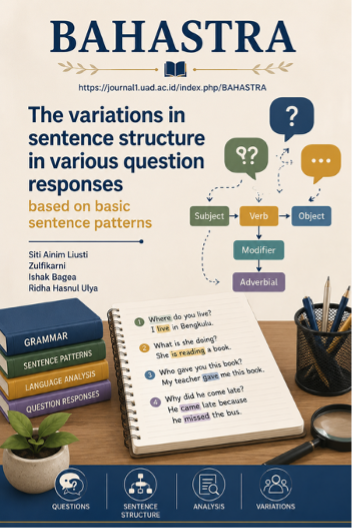
The variations of sentence structure in various question responses based on basic sentence patterns
DOI:
https://doi.org/10.26555/bs.v46i2.2117Keywords:
Basic Sentence Patterns , Sentence , Structure , Question WordsAbstract
Syntactic competence is foundational to children’s literacy development; however, empirical research on how elementary learners construct sentences in response to specific interrogative prompts remains limited in Indonesian linguistic scholarship. Although prior studies have normatively described canonical sentence patterns or assessed general syntactic complexity, few have investigated the structural variations elicited by different question words. This study describes and analyzes the syntactic variations produced by fourth-grade students in response to five Indonesian interrogatives (where, how, who, why, what) and maps these responses onto the six canonical sentence patterns of Indonesian. Using a qualitative descriptive design and content analysis, the study examined students’ written responses to a narrative reading comprehension task. Each answer was parsed for syntactic function and evaluated against the framework of Standard Indonesian Grammar. Trustworthiness was ensured through thick description and inter-analyst triangulation. The findings reveal that each interrogative elicits a distinct range of syntactic realizations: full, elliptical, and compound with why producing the most elaborate, multi-clausal constructions. All observed variations align systematically with the six canonical patterns, indicating that ellipsis functions as a pragmatically motivated strategy rather than a syntactic deficiency. This study enriches the descriptive understanding of Indonesian child syntax and provides a diagnostic tool for elementary language instruction.
References
Afrianto, Sujatna, E. T. S., Darmayanti, N., Ariyani, F., & Cooke-Plagwitz, J. (2020). Clause and predicative constituents in an Austronesian language: Lampung language. Topics in Linguistics, 21(2), 62–79. https://doi.org/10.2478/topling-2020-0010
Alwi, H., Dardjowidjojo. S., Moeliono, A. M., & Lapoliwa, H. (2017). Tata bahasa baku bahasa Indonesia (Edisi Keempat). Balai Pustaka.
Al-Obaydi, L. H., Schams, M., & Köseoğlu, P. (2025). Balancing syntactic complexity and clarity: The role of AI in enhancing academic writing proficiency. Saudi Journal of Language Studies, 5(4), 271–290. https://doi.org/10.1108/SJLS-10-2024-0062
Andayani, A., & Jupriono. D. (2025). Fungsi dan kategori sintaksis kalimat dasar bahasa. Jurnal Kajian Budaya, Bahasa, dan Sastra, 4(4), 35-42. https://doi.org/10.69957/tanda.v4i04.1847
Antari, W. Y., & Satyawati, M. S. (2017). Analisis penggunaan kalimat bahasa Indonesia pada karangan siswa kelas V Sekolah Dasar Negeri 10 Sanur, Denpasar. Jurnal Humanus, 21(1), 46-51.
Bahari, A. (2025). Balancing syntactic complexity and clarity: The role of AI in enhancing academic writing proficiency. Saudi Journal of Language Studies, 5(4), 271-290. https://doi.org/10.1108/SJLS-10-2024-0062
Basaria, I., & Dardanila, D. (2025). Clause structure and topicalization in Nias language: A typological analysis. Theory and Practice in Language Studies, 15(12), 3974–3983. https://doi.org/10.17507/tpls.1512.17
Buckalew, G., Ramirez, A. G., & Schneider, J. M. (2024). Maternal question use relates to syntactic skills in 5- to 7-year-old children. Journal of Speech, Language, and Hearing Research, 67(12), 4734–4747. https://doi.org/10.1044/2024_JSLHR-23-00426
Biondo, N., Ivanova, M. V., Pracar, A. L, Baldo, J., & Dronkers, N. F. (2024). Mapping sentence comprehension and syntactic complexity: Evidence from 131 stroke survivors. Brain Communications, 6(6), fcae379. https://doi.org/10.1093/braincomms/fcae379
Chaer, A. (2014). Linguistik umum. Rineka Cipta.
Furey, J., Bourget, J. L., & Reno, E. A. (2021). Explicit instruction in sentence combining for struggling writers: A practice guide. US Departement Of Education, Office of Special Education.
Guba, E. G., & Lincoln, Y. S. (1994). Competing paradigms in qualitative research. Handbook of Qualitative Research, 2(163-194), 105.
Han, C. H., & Romero, M. (2004). The syntax of whether/Q... or questions: Ellipsis combined with movement. Natural Language & Linguistic Theory, 22(3), 527-564. https://doi.org/10.1023/B:NALA.0000027674.87552.71
Herpindo, A. W., Wijayanti, I. S., Shalima, I., & Ngestrini, R. (2022). Kategori, fungsi, dan peran sintaksis bahasa Indonesia dengan PoS Tangging berbasis rule dan probability. KEMBARA: Jurnal Keilmuan Bahasa Sastra, dan Pengajarannya, 8(1), 51-65. https://doi.org/10.22219/kembara.v8i1.18602
Karomani, K. (2009). Ulama, jawara, dan umaro: Studi tentang elite lokal di Banten. Sosiohumaniora, 11(2), 168. https://doi.org/10.24198/sosiohumaniora.v11i2.5417
Lemen, H. C. P., Lieven, E. V. M, & Theakston, A. L. (2024). The influence of pragmatic funcion on children’s comprehension of complex because-and if-sentences. Frontiers in Language Sciences, 3, 1420237. https://doi.org/10.3389/flang.2024.1420237
Liusti, S. A. (2016). Analisis kalimat berdasarkan pola kalimat dasar dan kalkulus predikat. Adabiyyāt: Jurnal Bahasa dan Sastra, 15(2), 157-175. https://doi.org/10.14421/ajbs.2016.15203
Liusti, S. A., & Ratna, E. (2020). Variations of sentence structure in 5th grade students’ essays in Padang: Perspective of basic sentence patterns. 1st Progress in Social Science, Humanities, and Education Research Symposium (PSSHERS 2019), 126-128. Atlantis Press. https://doi.org/10.2991/assehr.k.200824.031
___________. (2021). Sentence structure in the essays of grade IV students in elementary schools in Padang. 4th International Conference on Language, Literature, and Education (ICLLE-4 2021), 257-260. Atlantis Press.
Liusti, S. A., Anggraini, D., Henanggil, M. D. F., & Ulya, R. H. (2024). Minangkabau women’s resistance: A critical discourse analysis of Sara Mills. Pascasarjana ISBI Bandung Conference Series.
Malik, A., Afnita, A., Ulya, R. H., & Triana, H. (2026). Analisis struktur dan kebahasaan teks laporan hasil observasi siswa kelas X MAN 4 Tanah Datar. Jurnal Manajemen Pendidikan, 14(1), 409-411. https://doi.org/10.33751/jmp.v14i1.74
Mansur, A., & Nisa, L. A. (2022). Analisis sintaksis kalimat deklaratif dan kalimat interogatif dalam film Incredible Love tahun 2021. Jurnal Peneroka: Kajian Ilmu Pendidikan Bahasa dan Sastra Indonesia, 2(1), 48-66 https://doi.org/10.30739/peneroka.v2i1.1365
Marjokorpi, J., & van Rijt, J. (2025). Grammatical understanding predicts reading comprehension in secondary-level students: Insights from a Finnish national survey. Language and education, 39(4), 924-943. https://doi.org/10.1080/09500782.2024.2376280
Markhamah, & Sabardila, A. (2014). Analisis kesalahan karakteristik bentuk pasif. Jagad Abjad.
Mukram, P. T. (2024). Ragam kalimat interogatif pada antologi cerpen “Alona Ingin Menjadi Serangga” karya Mashdar Zainal berdasarkan frasa pengisi setiap fungsi sintaksis. Prosodi, 18(2), 236–251. https://doi.org/10.21107/prosodi.v18i2.23634
Munirah, M., & Hardian, H. (2016). Pengaruh kemampuan kosakata dan struktur kalimat terhadap kemampuan menulis paragraf siswa SMA. Jurnal Pendidikan Bahasa dan Sastra, 16(1), 78-87. https://doi.org/10.17509/bs_jpbsp.v16i1.3064
Naini, I., & Ulya, R. H. (2025). Reasoning patterns and sentence construction errors in students’ scholarly articles: A content analysis of academic writing in Padang City. Al-Ishlah: Jurnal Pendidikan, 17(2), 2786-2796. https://doi.org/10.35445/alishlah.v17i2.7447
Noveria, E., Ulya, R. H., & Sukma, R. (2026). Integrating project-based learning with authentic news video production: A qualitative case study on news text literacy development in Indonesia's Merdeka Curriculum. BAHASTRA, 46(1), 81-91.
Nurhadi. (2010). Membaca cepat dan efektif: Teori dan latihan. Sinar Baru Algensindo.
Pancarrani, B., Ghazali, A. S., Nurchasanah. (2018). Kompleksitas kalimat bahasa Indonesia siswa kelas IV—VI sekolah dasar. Jurnal Pendidikan: Teori, Penelitian, dan Pengembangan, 3(9), 1216-1227. https://www.neliti.com/publications/483962
Pancarrani, B., & Mukhlas, M. (2025). Kompleksitas struktur kalimat bahasa Indonesia siswa sekolah dasar inklusi. Ghancaran: Jurnal Pendidikan Bahasa dan Sastra Indonesia, 6(2), 266-277. https://doi.org/10.19105/ghancaran.v6i2.13973
Pandean, M. L. M. (2018). Kalimat tanya dalam bahasa Indonesia. Jurnal Kajian Liguistik, 5(3), 75-88. https://doi.org/10.35796/kaling.5.3.2018.25030
Pradestania, K. A., Umami, S. A., & Sumarlam. (2022). Analisis sintaksis: Fungsi, kategori, dan peran pada karangan siswa kelas V SD dan XI SMA. Prosiding Seminar Nasional Linguistik dan Sastra (SEMANTIKS), 4.
Putrayasa, I. B., & Ramendra, D. P. (2021). Syntactic study based on character education values essays of fourth grade elementary school student in Bali Province. International Journal of Linguistics, Literature and Culture, 7(5), 396-404. https://www.neliti.com/publications/411519
Putrayasa. (2019). Tata kalimat bahasa Indonesia sekolah dasar. Refika Aditama.
Ramadhani, N. F., Hamzah, R. A., & Arief, R. (2025). Struktur kebahasaan bahasa Indonesia sebagai rujukan penggunaan bahasa (Sintaksis). Kande, 6(1), 14-24. https://doi.org/10.29103/jk.v6i1.21412
Rahmanto, S. N. (2017). Pelepasan fungsi sintaksis dalam kalimat majemuk bahasa Indonesia. Jurnal Bahasa dan Sastra Indonesia, 1-6.
Ramlan, M. (2005). Ilmu bahasa Indonesia: Sintaksis. CV Karyono.
Suhandano. (2020). Clause and predicative constituents in an Austronesian language: Lampung language. Topics in Linguitics, 21(2), 62-79. https://doi.org/10.2478/topling-2020-0010
Supriyadi. (2014). Sintaksis bahasa Indonesia. Universitas Negeri Gorontalo Press.
Supriyadi, Mayasari, D., & Djumadil, S. M. S. (2023). Fungsi, peran, dan kategori sintaksis bahasa Indonesia dalam kalimat. Jurnal Pendidikan Dasar dan Sosial Humaniora, 2(7), 725-740.
Sutrisno, A., & Denistia, K. (2024). The use of English relative clauses by Indonesia authors: A case study in business, engineering, and science journal articles. Journal of Language and Literature, 24(2), 510-522. https://doi.org/10.24071/joll.v24i2.9097
Syaripuddin, R., & Rahman, F. (2019). The comparative study of Indonesian students writing ability on Indonesian language and English language. The Asian EFL Journal, 26(6.2), 1-20.
Tikhonova, E., Mezentseva, D., & Kasatkin, P. (2024). Text redundancy in academic writing: A systematic scoping review. Journal of Language and Education, 10(3), 128-160. https://doi.org/10.17323/jle.2024.23747
Thompson, S. A., & Ono, T. (2025). What do speakers do with predicate nominal construction? Discourse & society. https://doi.org/10.1177/14614456251362412
Toba, R., Noor, W. N., & Sanu, L. O. (2019). The current issues of Indonesian EFL students’ writing skills: ability, problem, and reason in writing comparison and contrast essay. Dinamika Ilmu, 19(1), 57–73. https://doi.org/10.21093/di.v19i1.1506
Ulya, R. H. (2024). Transformasi makrolinguistik bahasa Indonesia dalam gamitan media digital: Analisis wacana kritis pada platform media sosial. Jurnal Ilmiah Langue and Parole, 8(1), 91-99. https://doi.org/10.36057/jilp.v8i1.717
Verhaar, J. W. M. (2010). Asas-asas linguistik umum. Gadjah Mada University Press.
Wu, X., Mauranen, A., & Lei, L. (2019). Syntactic complexity in English as a lingua franca academic writing. Journal of English for Academic Purposes, 42, 100798. https://doi.org/10.1016/j.jeap.2019.100798
Yohana, F. R., & Mulyadi, M. (2025). clause struktur and topicalization in Nias language: A typological analysis. Theory and Praktice in Language Studies, 15(12), 3974-3983. https://doi.org/10.17507/tpls.1512.17
Additional Files
Published
Issue
Section
License
Copyright (c) 2026 Siti Ainim Liusti; Zulfikarni Zulfikarni, Ishak Bagea; Ridha Hasnul Ulya

This work is licensed under a Creative Commons Attribution-ShareAlike 4.0 International License.
1.jpg)