The interplay of social media exposure and language attitudes in shaping students' academic writing skills
DOI:
https://doi.org/10.26555/bs.v46i2.2088Keywords:
Academic Writing , Attitudes , Digital Literacy, Exposure Language , Social MediaAbstract
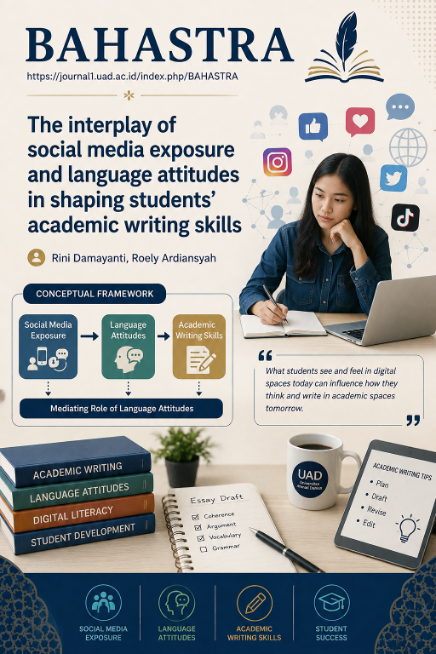
This study explores how social media exposure shapes students’ ambivalent language attitudes and influences their academic writing. In the digital era, students are continuously exposed to informal linguistic environments characterized by abbreviations, code-mixing, slang, and non-standard sentence structures. Using a qualitative descriptive-analytical design, this study involved 30 undergraduate students at a university in Surabaya, Indonesia. Data were collected through in-depth interviews, analysis of academic writing samples, and non-participant observations of students’ digital language practices. The findings identify ambivalent language attitudes as the study’s principal contribution. Students recognized the importance of standard Indonesian for academic writing while feeling more comfortable using informal digital language in everyday communication. This tension appeared in their writing through informal vocabulary, fragmented sentences, limited paragraph development, and weak cohesion. However, students with stronger metacognitive awareness, deliberate code-switching, systematic revision, and greater exposure to academic texts were better able to regulate their writing. These findings suggest that language attitudes constitute the key mechanism linking social media exposure and academic writing quality. Writing instruction should therefore promote register awareness and self-regulated writing strategies to help students navigate effectively between digital and academic language.
References
Alhajjaj, H., Shredam, A. M., Al-Halalat, K. I., & Tarawneh, H. (2025). Social media and its impact on university students: An analytical study. Educational Process: International Journal, 18(1). https://doi.org/10.22521/edupij.2025.18.492
Alneyadi, S., Abulibdeh, E., & Wardat, Y. (2023). The impact of digital environment vs. traditional method on literacy skills: Reading and writing of Emirati fourth graders. Sustainability, 15(4), 3418. https://doi.org/10.3390/su15043418
Asare, I. A., Plahar, J. D. K., Pantah, A., & Adansi, J. E. (2022). Effects of social media on students’ writing: The case study of Mount Mary College of Education. International Journal of Social Science Education Communication and Economics (SINOMICS Journal), 1(2), 45–74. https://doi.org/10.54443/sj.v1i2.7
Černý, M. (2025). Conceptualisation of digital wellbeing associated with generative artificial intelligence from the perspective of university students. European Journal of Investigation in Health, Psychology, and Education, 15(10), 197. https://doi.org/10.3390/ejihpe15100197
Chairunisa, H., & Hasibuan, H. S. (2024). The impact of digital literacy on Indonesian language development. Education Achievement: Journal of Science and Research, 5(2). https://doi.org/10.51178/jsr.v5i2.1850
Chen, J. Y., & Liu, T. T. (2025). Intertwining social, affective, and digital dynamics: A masspersonal communication model to analyze home language maintenance. Frontiers in Psychology, 16, 1639079. https://doi.org/10.3389/fpsyg.2025.1639079
Demneri, E. (2024). Students' difficulties in writing in English language. Proceedings of the International Conference on Modern Research in Education, Teaching and Learning, 3(1), 35–41. https://doi.org/10.33422/icmetl.v3i1.290
Di Marco, N., Loru, E., Bonetti, A., Serra, A. O. G., Cinelli, M., & Quattrociocchi, W. (2024). Patterns of linguistic simplification on social media platforms over time. Proceedings of the National Academy of Sciences of the United States of America, 121(50), e2412105121. https://doi.org/10.1073/pnas.2412105121
Dinihari, Y., & Musringudin, M. (2026). The role of digital literacy and Indonesian language proficiency among university students in using social media. IJORER: International Journal of Recent Educational Research, 7(1), 382–399. https://doi.org/10.46245/ijorer.v7i1.1185
Eragamreddy, N. M., Alrezqy, A., & Joseph, R. (2024). Digital tools and writing education: A thematic analysis of technology’s role in writing skills development. Arab World English Journal, 16(3), 3–25. https://doi.org/10.24093/awej/vol16no3.1
Fanani, A., Maisarah, M., & Masrur, M. (2025). Contextualizing artificial intelligence for English language learning in faith-based schools: A qualitative inquiry. Multidisciplinary Science Journal, 8(6), 2026380. https://doi.org/10.31893/multiscience.2026380
Fang, F., Meng, Y., Tang, L., & Cui, Y. (2025). The impact of informal digital learning of English (IDLE) on EFL learners' engagement: Mediating roles of flow, online self-efficacy, and behavioral intention. Behavioral Sciences, 15(7), 851. https://doi.org/10.3390/bs15070851
Gabi, C. (2022). Academic writing. Altralogue Publishing.
Gárgoles, P., & Ambás, G. (2023). The power of consumers on social media: A case study of Balenciaga’s crisis communication. Fashion communication in the digital age, 3–13. https://doi.org/10.1007/978-3-031-38541-4_1
Hamade, M. A., Ismail, N. A., & Mohamed, S. N. A. (2024). The role of language proficiency in academic success for international students: A case study approach. International Journal of Studies in International Education, 1(1), 14–19. https://doi.org/10.62951/ijsie.v1i1.107
Hamsiah, A., Bakri, M., Muhammadiah, M., & Rizal, A. (2026). Exploring academic writing competence through four emerging constructs: Digital self-efficacy, genre awareness, collaborative writing, and reflective revision in Indonesian contexts. SAGE Open, 16(1), 21582440261423575. https://doi.org/10.1177/21582440261423575
Hurbik, K., Khan, M. N., & Khan, M. A. (2025). Language change in the digital age: A linguistics analysis of online communication. Social Sciences & Humanity Research Review, 3(4), 1866-1875. https://doi.org/10.63468/sshrr.252
Kim, C., Preston, K., Jr., Braga, A., & Fankhauser, S. C. (2023). Increasing student confidence in writing: Integrating authentic manuscript writing into an online 8-week research program. Journal of Microbiology & Biology Education, 24(1), e00199-22. https://doi.org/10.1128/jmbe.00199-22
Kim, Y. G., Yang, D., Reyes, M., & Connor, C. (2021). Writing instruction improves students' writing skills differentially depending on focal instruction and children: A meta-analysis for primary grade students. Educational Research Review, 34, 100408. https://doi.org/10.1016/j.edurev.2021.100408
Klimova, B., & Pikhart, M. (2019). Cognitive and applied linguistics aspects of using social media: The impact of the use of Facebook on developing writing skills in learning English as a foreign language. European Journal of Investigation in Health, Psychology and Education, 10(1), 110–118. https://doi.org/10.3390/ejihpe10010010
Kulsum, U., Kartini, A., Loekman, A., & Hasanah, N. (2024). Language attitudes of teacher students towards Indonesian. Journal of Electrical Systems, 20(5s), 564–569. https://doi.org/10.52783/jes.2272
Lakhal, M. (2021). Social media use and its effects on writing ability among Moroccan university EFL students. International Journal of English Literature and Social Sciences, 6(3), 132–143. https://doi.org/10.22161/ijels.63.21
Lee, Y.-J., Davis, R. O., & Lee, S. O. (2024). University students' perceptions of artificial intelligence-based tools for English writing courses. Online Journal of Communication and Media Technologies, 14(1), 202412. https://doi.org/10.30935/ojcmt/14195
Liu, H., Li, T., Zheng, H., Li, Y., & Fan, J. (2025). Exploring the relationship between students' language learning curiosity and academic achievement: The mediating role of foreign language anxiety. Behavioral Sciences, 15(8), 1133. https://doi.org/10.3390/bs15081133
Li, M., & Zhang, M. (2023). Collaborative writing in L2 classrooms: A research agenda. Language Teaching, 56(1), 1–17. https://doi.org/10.1017/S0261444821000318
Majumder, R. (2024). Impact of practical applications on undergraduate English language instruction. International Journal of Applied and Scientific Research, 2(1). https://doi.org/10.59890/ijasr.v2i1.1226
Muawanah, U., Marini, A., & Sarifah, I. (2024). The interconnection between digital literacy, artificial intelligence, and the use of e-learning applications in enhancing the sustainability of regional languages: Evidence from Indonesia. Social Sciences & Humanities Open, 10, 101169. https://doi.org/10.1016/j.ssaho.2024.101169
Naslund, J. A., Bondre, A., Torous, J., & Aschbrenner, K. A. (2020). Social media and mental health: Benefits, risks, and opportunities for research and practice. Journal of Technology in Behavioral Science, 5(3), 245–257. https://doi.org/10.1007/s41347-020-00134-x
Ningrum, R. W., Hamamah, H., Sahiruddin, S., & Rohmah, Z. (2023). Academic writing difficulties for Indonesian students in pursuing postgraduate studies abroad. Premise Journal of English Education, 12(1), 5271. https://doi.org/10.24127/pj.v12i1.5271
Pan, L., ul Haq, S., & Nadeem, M. (2024). The impact of digital competence and personal innovativeness on the learning behavior of students: Exploring the moderating role of digitalization in higher education quality. SAGE Open. Advance online publication. https://doi.org/10.1177/2158244024126591
Panjaitan, L. L., & Patria, A. N. (2024). Social media and language evolution: The impact of digital communication on language change. International Journal of Linguistics, Literature and Translation, 7(12), 53-57. https://doi.org/10.32996/ijllt
Putra, I. G. A. C. S., & Tustiawati, I. A. M. (2024). Language attitudes and practices in multilingual setting: A case study of university students in Bali. Lingua Cultura, 18(1), 89–96. https://doi.org/10.21512/lc.v18i1.11506
Ramadhan, R. A., Rahim, A., Darmanto, D., & Paris, A. S. (2024). Enhancing academic writing through digital tools: A systematic review. Journal of Language and Literature Studies, 4(4), 707–770. https://doi.org/10.36312/jolls.v4i4.2342
Sari, M. R., & Mahendra, Y. (2025). The use of digital media to improve reading skills in Indonesian language learning in elementary schools: A literature review. Journal for Lesson and Learning Studies, 8(2), 232–242. https://doi.org/10.23887/jlls.v8i2.92970
Sari, G. I., Winasis, S., Pratiwi, I., Nuryanto, U. W., & Basrowi. (2024). Strengthening digital literacy in Indonesia: Collaboration, innovation, and sustainability education. Social Sciences & Humanities Open, 10, 101100. https://doi.org/10.1016/j.ssaho.2024.101100
Sarwar, M., Ramzan, R. M., Memon, R., & Rehman, Z. (2025). The linguistic impact of social media: A thematic analysis of language change in the digital age. Journal of Applied Linguistics and TESOL (JALT), 8(4), 925–936. https://doi.org/10.63878/jalt1427
Sulyati, E., & Kuswara, K. (2025). Leveraging digital literacy for Indonesian language learning: Strategies to enhance high school students' writing skills–Opportunities and obstacles. Al-Ishlah: Jurnal Pendidikan, 17(2), 3066-3075. https://doi.org/10.35445/alishlah.v17i2.5727
Suryanto, A. F., Wajdi, M., Sahoo, P. K., & Wu, Q. (2025). The impact of artificial intelligence on logic skills, critical thinking, and student creativity. Journal of Language Literature Social and Cultural Studies, 3(3), 283–299. https://doi.org/10.58881/jllscs.v3i3.407
Timotheou, S., Miliou, O., Dimitriadis, Y., Sobrino, S. V., Giannoutsou, N., Cachia, R., Monés, A. M., & Ioannou, A. (2023). Impacts of digital technologies on education and factors influencing schools' digital capacity and transformation: A literature review. Education and Information Technologies, 28(6), 6695–6726. https://doi.org/10.1007/s10639-022-11431-8
Yu, J., Bekerian, D. A., & Osback, C. (2024). Navigating the digital landscape: Challenges and barriers to effective information use on the Internet. Encyclopedia, 4(4), 1665–1680. https://doi.org/10.3390/encyclopedia4040109
Additional Files
Published
Issue
Section
License
Copyright (c) 2026 Rini Damayanti, Roely Ardiansyah

This work is licensed under a Creative Commons Attribution-ShareAlike 4.0 International License.
1.jpg)