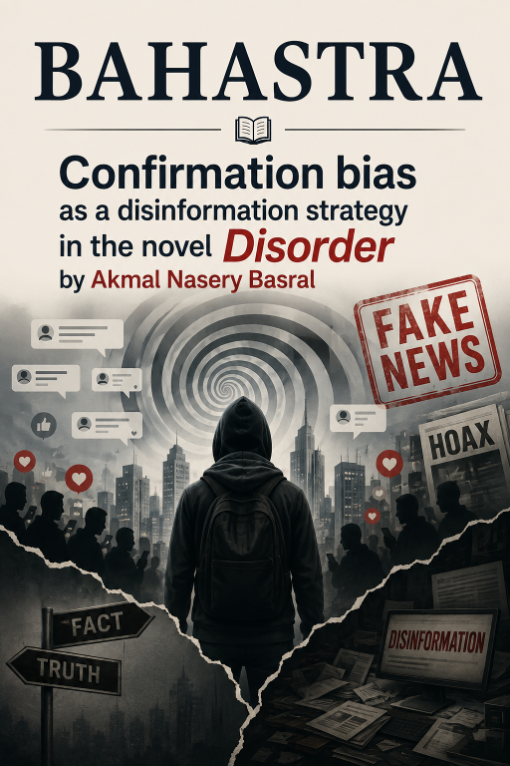
Confirmation bias as a disinformation strategy in the novel Disorder by Akmal Nasery Basral
DOI:
https://doi.org/10.26555/bs.v46i2.2087Keywords:
Confirmation Bias, Disinformation, Disorder NovelAbstract
This study analyzes confirmation bias as a disinformation strategy in Disorder, a novel by Akmal Nasery Basral. The novel portrays how information aligned with pre-existing beliefs is more readily accepted than contradictory evidence, particularly in situations involving social, political, and health-related uncertainty. Literary works provide an important space for examining disinformation because they not only represent social reality but also reveal how meaning, ideology, and public opinion are constructed. This study employed a qualitative descriptive method using a sociology of literature approach, with the researcher as the primary instrument for data collection and analysis. The data consisted of monologues and dialogues that indicate forms of confirmation bias functioning as disinformation strategies. Data were collected through close textual observation and analyzed through data reduction, data display, and conclusion drawing. The findings show that confirmation bias in Disorder functions not merely as a psychological tendency of the characters but as a disinformation strategy constructed through narrative, dialogue, characterization, and plot conflict. This strategy reinforces subjective viewpoints and constructs manipulative realities, including the symbolic representation of food as an expression of piety and the stereotyping of ethnic Chinese people as the source of the pandemic. These representations reflect communication practices through which selective information reinforces existing beliefs and shapes public opinion. This study extends disinformation research beyond media studies into literary studies by demonstrating how the novel functions as a space for representation, social criticism, and reflection on the mechanisms of public opinion formation and the dissemination of disinformation in the post-truth era.
References
Appel, M., & Richter, T. (2007). Persuasive effects of fictional narratives increase over time. Media Psychology, 10(1), 113-134. https://doi.org/10.1080/15213260701301194
Balkan, E., & Ülgen, S. (2023). A primer on misinformation, malinformation, and disinformation. EDAM. https://edam.org.tr/uploads/yukleme_resim/Report-Disinformation-Malinformation-Misinformation.pdf
Broda, E., & Strömbäck, J. (2024). Misinformation, disinformation, and fake news: Lessons from an interdisciplinary, systematic literature review. Annals of the International Communication Association, 48(2), 139-166. https://doi.org/10.1080/23808985.2024.2323736
Berthet, V., Teovanović, P., & de Gardelle, V. (2024). A common factor underlying individual differences in confirmation bias. Scientific Reports, 14(1), 27795. https://doi.org/10.1038/s41598-024-78053-7
Boer, K. M. (2020). Media, komunikasi, dan informasi di masa pandemi covid-19. MBridge Press.
Basral, A. N. (2020). Disorder. PT Bentang Pustaka.
Boonprakong, N., Pareek, S., Tag, B., Goncalves, J., & Dingler, T. (2024). Assessing susceptibility factors of confirmation bias in news feed reading. https://doi.org/10.2139/ssrn.4797710
Boukes, M., Aalbers, L., & Andersen, K. (2022). Political fact or political fiction? The agenda-setting impact of the political fiction series Borgen on the public and news media. Communications, 47(1), 50-72. https://doi.org/10.1515/commun-2019-0161
Bafadhal, O. M., & Santoso, A. D. (2020). Memetakan pesan hoaks berita covid-19 di Indonesia lintas kategori, sumber, dan jenis disinformasi. Bricolage: Jurnal Magister Ilmu Komunikasi, 6(02), 235-249. https://journal.ubm.ac.id/index.php/bricolage/article/viewFile/2148/1842
Damono, S. D. (1979). Sosiologi sastra: Sebuah pengantar singkat. Pusat Pembinaan dan Pengembangan Bahasa.
Endraswara, S. (2013). Metodologi penelitian sastra. CAPS.
Fajri, C., Farihanto, M. N., Tawar, Kusuma, A., Rahman, A. R., Putri, K. S. M., Dewi, A. F. K., Sholehin, M., & Faradilah, M. (2022). Manajemen informasi dan komunikasi risiko covid-19 (Studi di Daerah Istimewa Yogyakarta). Penerbit Galuh Patria.
Fatmawati, E. (2020). Kompetensi literasi digital dalam menangkal infodemi. MAFINDO.
Hussain, M., & Soomro, T. R. (2023). Social media: An exploratory study of information, misinformation, disinformation, and malinformation. Appl. Comput. Syst., 28(1), 13-20. https://doi.org/10.2478/acss-2023-0002
Hoewe, J., & Sherrill, L. A. (2019). The influence of female lead characters in political TV shows: Links to political engagement. Journal of Broadcasting & Electronic Media, 63(1), 59-76. https://doi.org/10.1080/08838151.2019.1570782
Imaroh, Z., Hamzani, A. I., & Aryani, F. D. (2023). Pertanggungjawaban pidana penyebaran berita hoax di media sosial. PT Nasya Expanding Management.
Ikhsan, M., Khairunniza, Z., & Sofia, R. (2021). Misinformasi, tantangan pandemi di era digital. AVERROUS: Jurnal Kedokteran dan Kesehatan Malikussaleh, 7(2), 62-72. https://doi.org/10.29103/averrous.v7i2.5432
Jones, M. D., & McBeth, M. K. (2010). A narrative policy framework: Clear enough to be wrong? Policy Studies Journal, 38(2), 329-353. https://doi.org/10.1111/j.1541-0072.2010.00364.x
Kurniati. (2021). Hoax perspektif hukum Islam. Alauddin University Press.
Kietzmann, J., Lee, L. W., McCarthy, I. P., & Kietzmann, T. C. (2020). Deepfakes: Trick or treat? Business Horizons, 63(2), 135–146. https://doi.org/10.1016/j.bushor.2019.11.006
Lim, W. M. (2023). Fact or fake? The search for truth in an infodemic of disinformation, misinformation, and malinformation with deepfake and fake news. Journal of Strategic Marketing, 1-37. https://doi.org/10.1080/0965254X.2023.2253805
Li, Y., & Xie, Y. (2020). Is a picture worth a thousand words? An empirical study of image content and social media engagement. Journal of Marketing Research, 57(1), 1–19. https://doi.org/10.1177/0022243719881113
Lamprou, E., Antonopoulos, N., Anomeritou, I., & Apostolou, C. (2021). Characteristics of fake news and misinformation in Greece: The rise of new crowdsourcing-based journalistic fact-checking models. Journalism and Media, 2(3), 417–439. https://doi.org/10.3390/journalmedia2030025
Liebes, T., & Katz, E. (1986). Patterns of involvement in television fiction: A comparative analysis. European journal of communication, 1(2), 151-171. https://doi.org/10.1177/0267323186001002004
Launa, L. (2020). Banjir infodemi: Viralitas akurasi berita virologi dalam fenomena coronavirus disease. The Source: Jurnal Ilmu Komunikasi, 2(2), 1-21. https://jurnal.usahid.ac.id/thesource/article/view/305/273
Meel, P., & Vishwakarma, D. K. (2020). Fake news, rumor, information pollution in social media and web: A contemporary survey of state-of-the-arts, challenges, and opportunities. Expert Systems with Applications, 153, 112986. https://doi.org/10.1016/j.eswa.2019.112986
Miles, M. B., & Huberman, A. M. (1994). Analisis data kualitatif. Penerbit Universitas Indonesia.
Moleong, L. J. (2018). Metodologi penelitian kualitatif. Remaja Rosdakarya.
Modgil, S., Singh, R. K., Gupta, S., & Dennehy, D. (2024). A confirmation bias view on social media induced polarisation during covid-19. Information Systems Frontiers, 26(2), 417-441. https://doi.org/10.1007/s10796-021-10222-9
McDowell, K. (2024). Storytelling and/as Misinformation: Storytelling dynamics and narrative structures for three cases of COVID-19 viral misinformation. Cambridge Studies on Governing Knowledge Commons. https://doi.org/10.1017/9781009255165.002
Mutz, D. C., & Nir, L. (2010). Not necessarily the news: Does fictional television influence real-world policy preferences? Mass Communication and Society, 13(2), 196-217. https://doi.org/10.1080/15205430902813856
Nabila, M. H., & Djokoto, N. K. (2025). Narratives that build nations: Storytelling as a strategic tool against disinformation in the United States. Journal of Education and Sociology, 4(10), 29-37.
Oswald, M. E., & Grosjean, S. (2004). Confirmation bias. In Cognitive illusions: A handbook on fallacies and biases in thinking, judgement, and memory (ed. Pohl, R. F.) 79–96. Psychology Press.
Peters, C. (2015). Evaluating journalism through popular culture: HBO’s The Newsroom and public reflections on the state of the news media. Media, Culture, & Society, 37(4), 602-619. https://doi.org/10.1177/0163443714566902
Peters, U. (2022). What is the function of confirmation bias? Erkenntnis, 87(3), 1351-1376. https://doi.org/10.1007/s10670-020-00252-1
Pratama, H. S. (2019). Buku panduan berpikir kritis menghadapi berita palsu (Hoaks) di media sosial. International NGO Forum on Indonesian Development (INFID).
Purwanto, A., Anom, A. K., Sasmito, A. , Ningtyas, I., Wedhaswary, I. D., Mardjianto, L. D. (2021). Periksa fakta melawan infodemi. Aliansi Jurnalis Independen.
Rollwage, M., Loosen, A., Hauser, T. U., Moran, R., Dolan, R. J., & Fleming, S. M. (2020). Confidence drives a neural confirmation bias. Nature communications, 11(1), 2634. https://doi.org/10.1038/s41467-020-16278-6
Rodhan, N. (2020). A neurophilosophy of fake news, disinformation and digital citizenship. Blog of the American Philosophical Association.
Suzuki, M., & Yamamoto, Y. (2021). Characterizing the influence of confirmation bias on web search behavior. Frontiers in psychology, 12, 771948. https://doi.org/10.3389/fpsyg.2021.771948
Simarmata, J., Iqbal, M., Hasibuan, M. S., Limbong, T., & Albra, W. (2019). Hoaks dan media sosial: Saring sebelum sharing. Penerbit Yayasan Kita Menulis.
Saryono, D. (2021). Sastra, memori, dan wabah pandemi. Borobudur Writers & Cultural Festival.
Setyawan, D., Ra’is, D. U., & Rohman, A. (2021). Peran komunikasi publik dalam menanggapi gelombang disinformasi covid-19. Publisia: Jurnal Ilmu Administrasi Publik, 6(2), 165-175. https://doi.org/10.26905/pjiap.v6i2.6436
Setyawati, K. A. (2022). Ethnography of communication: The analysis of Dell Hymes’ speaking model in the communication among the infertility husband and wife. Linguistics Initiative, 2(1), 59-69. https://doi.org/10.53696/27753719.2131
Slater, M. D., & Rouner, D. (2002). Entertainment—education and elaboration likelihood: Understanding the processing of narrative persuasion. Communication Theory, 12(2), 173-191. https://doi.org/10.1111/j.1468-2885.2002.tb00265.x
Trianton, T. (2019). Sastra, Hoax, dan kritik yang HOTS. Seminar Nasional bertajuk “Haoks, Literasi Sastra, dan Kedewasaan Berpolitik” yang dihelat oleh HISKI Komisariat Banyumas. https://doi.org/10.31227/osf.io/95k43
Tolosana, R., Vera-Rodriguez, R., Fierrez, J., Morales, A., & Ortega-Garcia, J. (2020). Deepfakes and beyond: A survey of face manipulation and fake detection. Information Fusion, 64, 131–148. https://doi.org/10.1016/j.inffus.2020.06.014
Tandoc, E. C. (2021). Fake news. In The Routledge companion to media disinformation and populism (pp. 110-117). Routledge. https://doi.org/10.4324/9781003004431-12
Vidal-Perez, J., Dolan, R. J., & Moran, R. (2025). Disinformation elicits learning biases. eLife, 14. https://doi.org/10.7554/eLife.106073
Van Zoonen, L. (2007). Audience reactions to Hollywood politics. Media, Culture & Society, 29(4), 531-547. https://doi.org/10.1177/0163443707076188
White, A. (2022). Overcoming ‘confirmation bias’ and the persistence of conspiratorial types of thinking. Continuum, 36(3), 364-376. https://doi.org/10.1080/10304312.2021.1992352
Wellek, R., & Warren, A. (1994). Teori Kesusastraan. Diterjemahkan dalam Bahasa Indonesia oleh Melani Budianta. Gramedia.
Additional Files
Published
Issue
Section
License
Copyright (c) 2026 Eka Nova Ali Vardani, Alfi Khoiru An Nisa, Yeni Mardiana Devanti

This work is licensed under a Creative Commons Attribution-ShareAlike 4.0 International License.
1.jpg)