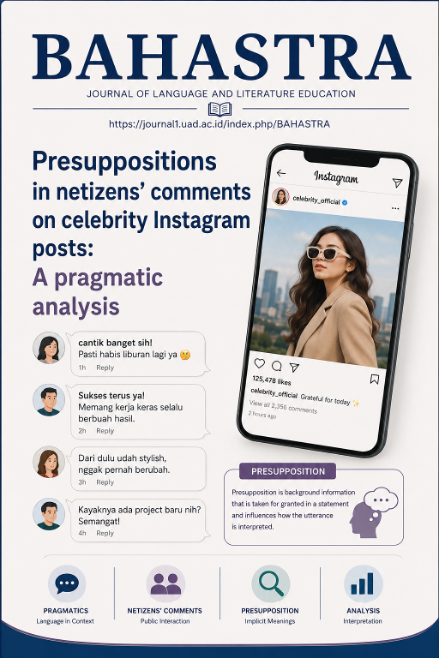
Presuppositions in netizens’ comments on celebrity Instagram posts: A pragmatic analysis
DOI:
https://doi.org/10.26555/bs.v46i2.2025Keywords:
Comments , Instagram , Netizens , PresuppositionsAbstract
This study examines the types and functions of presuppositions in netizens' comments on celebrity Instagram posts. The data were collected from comments posted on the Instagram account @Ollaramlan between May and June 2025. Using qualitative content analysis, the study analyzed 51 presuppositional utterances selected through purposive sampling. The analysis identified four types of presupposition: existential, lexical, factive, and structural. Existential presupposition was the most frequent type (49.02%), followed by lexical presupposition (47.06%), while factive and structural presuppositions each occurred only once. Beyond identifying these types, the findings reveal that presuppositions function as linguistic resources for expressing judgment, appreciation, and affect. They also reflect shared cultural attitudes toward religion, beauty, authenticity, and family responsibility. These findings suggest that presuppositions enable commenters to communicate evaluations indirectly by presenting assumptions as shared knowledge, making them an important pragmatic resource in social media interaction.
References
Arafat, G. Y. (2018). Membongkar isi pesan dan media dengan content analysis. Alhadharah: Jurnal Ilmu Dakwah, 17(33), 32–48. https://doi.org/10.18592/alhadharah.v17i33.2370
Beaver, D., & Stanley, J. (2025). The politics of language. Princeton University Press.
Berliana, D., Harahap, E. P., & Yusra, H. (2024). Analisis praanggapan dalam novel Yang Telah Lama Pergi karya Tere Liye. Jurnal Ilmiah Dikdaya, 14(1), 104–113. https://doi.org/10.33087/dikdaya.v14i1.610
Bou-Franch, P., & Blitvich, P. G. C. (2014). Conflict management in massive polylogues: A case study from YouTube. Journal of Pragmatics, 73, 19-36. https://doi.org/10.1016/j.pragma.2014.05.001
Chaer, A. (2010). Pragmatik bahasa Indonesia. Rineka Cipta.
Creswell, J. W., & Poth, C. N. (2018). Qualitative inquiry and research design: Choosing among five approaches (4th ed.). SAGE Publications.
Erni, E., Herwandi, H., & Sari, I. (2019). Praanggapan dalam tuturan dialog bahasa persidangan di Pengadilan Negeri Kelas IA Pekanbaru. GERAM (Gerakan Aktif Menulis), 7(2). https://doi.org/10.25299/geram.2019.vol7(2).3911
Fairclough, N. (2015). Language and power (3rd ed.). Routledge.
Harahap, J. H. (2017). An analysis of pragmatic presuppositions in editorial texts [Unpublished undergraduate thesis]. Universitas Sumatera Utara.
Harahap, S. M., & Amri, Y. K. (2023). Presuppositions in Buddykuofficial Instagram comments about Teddy Minahasa. LingLit Journal: Scientific Journal for Linguistics and Literature, 4(1), 19–31. https://doi.org/10.33258/linglit.v4i1.857
Hood, S. (2010). Appraising research: Evaluation in academic writing. Palgrave Macmillan. https://doi.org/10.1057/9780230274662
Huang, Y. (2014). Pragmatics (2nd ed.). Oxford University Press.
Jati, E. P., Sumarlam, S., & Djatmika, D. (2017). Presupposition and implicature in Indonesia Lawak Klub. Proceedings of the International Seminar on Language Maintenance and Shift (LAMAS 7), 197–203.
Levinson, S. C. (1983). Pragmatics. Cambridge University Press. https://doi.org/10.1017/CBO9780511813313
Lincoln, Y. S., & Guba, E. G. (1985). Naturalistic inquiry. SAGE Publications. https://doi.org/10.1016/0147-1767(85)90062-8
Krippendorff, K. (2018). Content analysis: An introduction to its methodology (4th ed.). SAGE Publications. https://doi.org/10.4135/9781071878781
Martin, J. R., & White, P. R. R. (2005). The language of evaluation: Appraisal in English. Palgrave Macmillan.
Meyer, C. F. (1987). Language, context, and text: Aspects of language in a social-semiotic perspective. https://doi.org/10.2307/3586740
Miles, M. B., Huberman, A. M., & Saldaña, J. (2014). Qualitative data analysis: A methods sourcebook (3rd ed.). SAGE Publications.
Moldovan, A. (2023). Persuasive presuppositions. Journal of Pragmatics, 211, 96–104. https://doi.org/10.1016/j.pragma.2023.04.004
Nasarudin, N., Yulisna, R., Sartika, R., Sari, A. W., Satini, R., Anggraini, D., & Febriana, N. (2024). Pragmatik. Yayasan Tri Edukasi Ilmiah.
Nopiyanti, N., & Mutia, F. (2022). Analisis praanggapan wacana iklan produk kecantikan Wardah. Jurnal Pendidikan Bahasa dan Sastra Indonesia, 6(2), 150–156. https://doi.org/10.30743/bahastra.v6i2.4671
Nurfalupi, R. (2018). Pragmatik: Teori dan aplikasi. Refika Aditama.
Nuramila. (2020). Tindak tutur dalam media sosial: Kajian pragmatik. Yayasan Pendidikan dan Sosial Indonesia Maju. https://doi.org/10.31237/osf.io/zah35
Pasaribu, R., Situmorang, A., & Hutapea, D. (2023). Factive and lexical presuppositions in public responses to the Teddy Minahasa case. Indonesian Journal of English Language Teaching, 18(2), 211–224.
Putrayasa, I. B. (2014). Pragmatik. Graha Ilmu.
Sari, L. I., Retnowaty, R., & Musdolifah, A. (2018). Presupposition in food stall advertising banners. Jurnal Basataka, 1(1), 37–44. https://doi.org/10.36277/basataka.v1i1.13
Sari, F. E. S. T. B. T. (2022). Metode analisis dalam media sosial. Jurnal Ilmu Komputer, Ekonomi, dan Manajemen, 2(1), 923–926.
Sbisà, M. (2021). Presupposition and implicature: Varieties of implicit meaning in explicitation practices. Journal of Pragmatics, 182, 176-188. https://doi.org/10.1016/j.pragma.2021.05.027
Selsia, N. W., Pratiwi, W. D., & Triyadi, S. (2024). Presupposition analysis in Lapor Pak. Jurnal Ilmiah Wahana Pendidikan, 10(3), 528–542.
Setiawan, D., Salem, L., & Syahrani, A. (2018). Presuppositions in novel dialogue. Jurnal Pendidikan dan Pembelajaran Khatulistiwa, 7(9).
Stalnaker, R. (2002). Common ground. Linguistics and Philosophy, 25(5–6), 701–721. https://doi.org/10.1023/A:1020867916902
Susanti, S., Abadi, M. I., & Yanuarsih, S. (2025). Analisis tiga jenis praanggapan dalam dua episode talk show Lapor Pak di trans 7. DEIKTIS: Jurnal Pendidikan Bahasa dan Sastra, 5(3), 2060-2074. https://doi.org/10.53769/deiktis.v5i3.1906
Thoma, D., Becker, K., & Kißler, A. (2023). Presuppositions are more persuasive than assertions. Applied Psycholinguistics, 44(5), 816–843. https://doi.org/10.1017/S0142716423000292
Tonhauser, J., Beaver, D., Roberts, C., & Simons, M. (2013). Toward a taxonomy of projective meaning. Language, 89(3), 491–544. https://doi.org/10.1353/lan.2013.0001
Wahid, N. A., Lestari, D., & Ramadhan, Y. (2025). Existential presuppositions in Instagram meme comments. Indonesian Journal of Applied Linguistics, 15(1), 55–68.
Wulandari, R. (2020). Presuppositions in Indonesian online discourse. Indonesian Journal of Applied Linguistics, 10(2), 340–352.
Yule, G. (2014). The study of language (5th ed.). Cambridge University Press.
Yus, F. (2011). Cyberpragmatics: Internet-mediated communication in context. John Benjamins. https://doi.org/10.1075/pbns.213
Zappavigna, M. (2011). Ambient affiliation: A linguistic perspective on twitter. New Media & Society, 13(5), 788–806. https://doi.org/10.1177/1461444810385097
Zappavigna, M. (2018). Searchable talk: Hashtags and social media metadiscourse. Bloomsbury Academic.
Additional Files
Published
Issue
Section
License
Copyright (c) 2026 Redo Andi Marta, Elan Halid, Fitri Handayani

This work is licensed under a Creative Commons Attribution-ShareAlike 4.0 International License.
1.jpg)