The value of multiculturalism in Indonesian language textbooks as an internalization of inclusive education in the AI technology era
DOI:
https://doi.org/10.26555/bs.v46i2.1759Keywords:
Artificial Intelligence , Inclusive Education , Textbooks , The Value of MulticulturalismAbstract
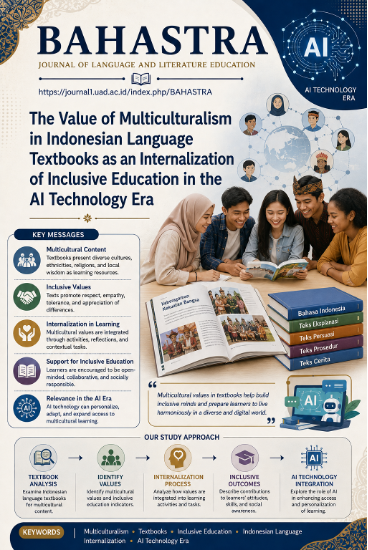
Multicultural education at the senior high school level plays a crucial role in fostering tolerant student characters, promoting respect for diversity, and creating inclusive learning environments. This study aimed to explore the multicultural values within Grade XI Indonesian language textbooks as a form of internalizing inclusive education in the era of artificial intelligence (AI) technology. Utilizing a descriptive qualitative method, this study analysed multicultural values as the research object, with Grade XI Indonesian language textbooks serving as the research subject. Data were gathered using the scrutinizing and note-taking techniques, while the data analysis process involved data collection, data reduction, data display, and conclusion drawing. The results revealed that the Grade XI Indonesian language textbooks incorporated several multicultural values, including justice, tolerance, equality, and democracy. These values were embedded across three dimensions—knowledge, skills, and attitudes—and were represented through reading texts, exercises, and student reflective activities. These findings confirm that Indonesian language textbooks serve as a strategic medium for internalizing inclusive education. In the AI era, these multicultural values can be implemented more effectively through personalized and inclusive learning. Ultimately, the integration of value-rich textbooks and AI technology supports the creation of an equitable, inclusive education system oriented toward the well-being of all students.
References
Abacioglu, C. S., Epskamp, S., Fischer, A. H., & Volman, M. (2023). Effects of multicultural education on student engagement in low- and high-concentration classrooms: the mediating role of student relationships. Learning Environments Research, 26(3), 951–975. https://doi.org/10.1007/s10984-023-09462-0
Abdollah A., & Mohsen J. (2020). A study and explanation of the theory of general justice in the view of st. Journal of Philosophical Theological Research.
Acar, M., & Sivis, O. (2023). But the poor needed it more: Children’s judgments on procedural justice to allocate resources between two candidates equal in merit, different in need. Journal of Experimental Child Psychology, 232, 105679. https://doi.org/10.1016/j.jecp.2023.105679
Assefa, E. A. (2026). AI and the digital divide in ensuring educational access and multicultural inclusivity. Journal of Information, Communication, and Ethics in Society, 24(2), 298–316. https://doi.org/10.1108/JICES-05-2025-0125
Azwar, I. (2024). Pembelajaran inklusif: Menuju kesetaraan pembelajaran. Edupedia Publisher.
Baihaqi, M., & Sugiarmin, M. (2006). Pendidikan inklusif. UPI Press.
Banks, J. A. (1993). Multicultural education: Historical development, dimensions, and practice. Review of Research in Education, 19, 3–49. https://doi.org/10.2307/1167339
Banks, J. A., & Banks, C. A. M. (2021). Multicultural education: Issues and perspectives (10th ed.). Wiley.
Barir, M. (2014). Kesetaraan dan kelas sosial dalam perspektif Al-Quran. Jurnal Studi Ilmu-Ilmu Al-Quran dan Hadist, 15(1), 61-92. https://doi.org/10.14421/qh.2014.1501-04
Dahl, R. A. (2001). On democracy. Yale University Press. https://doi.org/10.1016/B0-08-043076-7/01131-1
Datta, G. (2021). Conceptualisation of social justice model as an advanced framework of inclusive education tracing the trajectory. Journal of Indian Education, 46(4), 110–122. https://ejournals.ncert.gov.in/index.php/jie/article/view/2853
Dewey, J. (2024). Democracy and education: An introduction to the philosophy of education (N. Tampio, Ed.). Columbia University Press. https://doi.org/10.7312/dewe21010
Díaz-León, K., Palacios-Serna, L. I., & Borrego-Rosas, C. E. (2024). Inclusive education: From theoretical considerations to social praxis. 4(8), 152–168.
Dwi, M., & Alif, A. N. (2024). Transformative impact of ai on multicultural education: A qualitative thematic analysis. Edelweiss Applied Science and Technology, 8(5), 113–118. https://doi.org/10.55214/25768484.v8i5.1667
Egan-Simon, D. (2022). Active agents of change: A conceptual framework for social justice-orientated citizenship education. Citizenship, Social, and Economics Education, 1(2), 297-310. https://doi.org/10.1177/27526461221089350
Elias, A., & Mansouri, F. (2023). Towards a critical transformative approach to inclusive intercultural education. Journal of Multicultural Discourses, 18(1), 4–21. https://doi.org/10.1080/17447143.2023.2211568
Elliott, R., & Kim, B. La. (2025). Overcoming barriers: The potential of AI digital textbooks in multicultural middle school education. Multicultural Education Review, 17(1), 19–41. https://doi.org/10.1080/2005615X.2025.2467765
Graf, E., Stempfer, L., Muis, K. R., & Goetz, T. (2024). Classroom emotions in civic education: A multilevel approach to antecedents and effects. Learning and Instruction, 90, 101869. https://doi.org/10.1016/j.learninstruc.2023.101869
Herdania, K. (2025). Paradigma budaya patriarki di Indonesia dalam perspektif sosial dan demografi. Jurnal Ilmu Sosial dan Budaya, 10(1), 90–101. https://doi.org/10.23887/jiis.v11i1.85429
Hwang, G.-J., Xie, H., Wah, B. W., & Gašević, D. (2020). Vision, challenges, roles, and research issues of artificial intelligence in education. Computers and Education: Artificial Intelligence, 1, 100001. https://doi.org/10.1016/j.caeai.2020.100001
Lyiscott, J., De Los Ríos, C. V., & Clark, C. H. (2023). Case studies of effective learning climates for civic reasoning and discussion. The ANNALS of the American Academy of Political and Social Science, 705(1), 138–155. https://doi.org/10.1177/00027162231178627
Marwati, H., & Waskitaningtyas, K. (2021). Cerdas cergas cerdas cergas SMA/SMK kelas XI. Pusat Perbukuan Badan Standar, Kurikulum, dan Asesmen Pendidikan Kementerian Pendidikan, Kebudayaan, Riset, dan Teknologi. https://buku.kemdikbud.go.id
Molle, C. (2018). Food insecurity: Where social injustice meets environmental exploitation. In L. Dominelli, B. R. Nikku, & H. B. Ku (Eds.), Routledge. https://doi.org/10.4324/9781315183213
Mukti, A. P. Y., Wicaksana, M. F., & Pardyatmoko, P. (2025). Model pembelajaran literasi kritis dalam pembelajaran Bahasa Indonesia: Studi kasus di sekolah menengah kejuruan. Bahasa: Jurnal Keilmuan Pendidikan Bahasa dan Sastra Indonesia, 7(2), 483–490. https://doi.org/10.26499/bahasa.v7i2.1531
Nadhiroh, U., & Ahmadi, A. (2024). Pendidikan inklusif: Membangun lingkungan pembelajaran yang mendukung kesetaraan dan kearifan budaya. Jurnal Ilmu Budaya, 8(1), 11–22. https://doi.org/10.30872/jbssb.v8i1.14072
Nafi’ah, A. L., & Masyhuda, H. M. (2021). Nilai-nilai pendidikan multikultural dalam buku teks di sekolah dasar kelas atas. ESTETIK: Jurnal Bahasa Indonesia, 4(1), 65–86. https://doi.org/10.29240/estetik.v4i1.2391
Ng, D. T. K., Leung, J. K. L., Chu, S. K. W., & Qiao, M. S. (2021). Conceptualizing AI literacy: An exploratory review. Computers and Education: Artificial Intelligence, 2, 100041. https://doi.org/10.1016/J.CAEAI.2021.100041
Ningtyas, D. W., Agung, D. A. G., & Khakim, M. N. L. (2023). Analisis wacana nilai pendidikan multikultural dalam buku teks Sejarah Indonesia kelas XI sekolah menengah atas kurikulum merdeka. Jurnal Pendidikan, 2(12), 1189–1204. https://doi.org/10.17977/um063v2i122022p1189-1204
Nurnaningsih, M., & Salehudin, M. (2025). Transformasi pendidikan anak usia dini melalui media AI: Sebuah pendekatan inklusif. Indonesian Journal of Early Childhood: Jurnal Dunia Anak Usia Dini, 7(1), 156-165. https://doi.org/10.35473/ijec.v7i1.3615
OECD. (2023). PISA 2022 Results Factsheets Indonesia. OECD.
Panuntun, S., & Aziz, A. (2023). Pendidikan multikulturalisme dan prospeknya di Indonesia. Syntax Idea, 5(8), 1046–1058. https://doi.org/10.46799/syntax-idea.v5i8.2474
Perkins, K. A., & Rodriguez, R. A. (2021). Lead self first: Leadership and social justice self-actualization from within the system. In Becoming a Diversity Leader on Campus (pp. 80–102). Routledge. https://doi.org/10.4324/9781003008521-7
Pozas, M., Trujillo, C. J. G., & Letzel-Alt, V. (2023). Mexican school students’ perceptions of inclusion: A brief report on students’ social inclusion, emotional well-being, and academic self-concept at school. Frontiers in Education, 8, 1069193. https://doi.org/10.3389/feduc.2023.1069193
Pytanza, D. S., Rakhmawati, R., & Nurhadi, N. (2022). Implementasi pendidikan inklusif dalam pembelajaran sekolah dasar. Jurnal Pendidikan Dasar Nusantara, 8(1), 33–44. https://doi.org/10.29407/jpdn.v8i1.16685
Ramanta, R., & Samsuri. (2020). Analisis nilai-nilai multikultural dalam buku teks Pendidikan Pancasila dan Kewarganegaraan di SMA.
Rodiyana, R., Maftuh, B., Sapriya, S., Syaodih, E., Yanto, A., & Sofyan, D. (2023). Toleransi dalam perbedaan pendapat melalui model pembelajaran inkuiri berbasis nilai. Jurnal Educatio FKIP UNMA, 9(3), 1260–1269. https://doi.org/10.31949/educatio.v9i3.4945
Rosepti, P. (2022). Cultivating children’s social awareness in the multicultural and diverse community: A perspective from empathetic teaching. Edueksos: Jurnal Pendidikan Sosial & Ekonomi, 11(2). https://doi.org/10.24235/edueksos.v11i2.11210
Saporno, R. N. (2025). Students’ biases and accommodation in inclusive education: Understanding barriers and promoting equity in the classroom. Environment and Social Psychology, 10(3), 3196. https://doi.org/10.59429/esp.v10i3.3196
Setyowati, F. (2015). Implementasi nilai-nilai demokrasi pada sekolah inklusi di SMP Tumbuh Yogyakarta. Spektrum Analisis Kebijakan Pendidikan, 4(2), 147–157. https://doi.org/10.21831/sakp.v4i2.1435
Simmons, C. A. (2025). Social justice and qualitative research. In Issues of Equity (pp. 97–101). Routledge. https://doi.org/10.4324/9781003560128-22
Sivaci, S., & Hakkoymaz, S. (2026). AI-TPACK in teacher education: Investigating the role of AI-TPACK in multicultural teaching competencies and intercultural sensitivity of teacher candidates. European Journal of Teacher Education, 1–19. https://doi.org/10.1080/02619768.2026.2614703
Sofiyatunnisa, J., & Susanto, G. (2025). Berpikir kritis-kreatif sebagai dimensi profil pelajar pancasila pada buku Bahasa Indonesia kelas VII kurikulum merdeka. Jurnal Pembelajaran Sastra, 4(2), 67–88. https://doi.org/10.51543/hiskimalang.v4i02.76
Sohrabi, H. (2019). A durkheimian critique of contemporary multiculturalism. Ethnic and Racial Studies, 1–22. https://doi.org/10.1080/01419870.2019.1585898
Sudrajat, D., Meisarah, F., Anggraini, D., Kutai, U., & Tenggarong, K. (2025). Analysis of multicultural education values in thematic textbooks for primary schools: A literature review. International Journal of Teaching and Learning (INJOTEL), 2(11).
Sya’bani, M. Q., & Kholidya, C. F. (2023). Internalisasi nilai demokrasi melalui kegiatan proyek penguatan profil pelajar pancasila guna menangkal 49 radikalisme di kalangan remaja (Studi kasus di SMKN 1 Kemlagi). Prosiding Seminar Nasional Fakultas Ilmu Pendidikan Universitas Negeri Surabaya.
Syahputra, D., Bangun, M. B., & Handayani, S. M. (2021). Budaya patriarki dan ketidaksetaraan gender dalam pendidikan di Desa Bontoraja, Kabupaten Bulukumba. Jurnal Sustainable, 6(2), 606–616.
Tilaar, H. A. R. (2017). Multikulturalisme: Tantangan global masa depan dalam transformasi pendidikan nasional. Grasindo.
Umar, M. A., & Nurrohman, W. (2024). Multicultural education to develop tolerance of santri. Multicultural Islamic Education Review, 2(2), 97–106. https://doi.org/10.23917/mier.v2i2.4661
UNESCO. (2019). Behind the numbers: Ending school violence and bullying. UNESCO. https://doi.org/10.54675/TRVR4270
UNESCO. (2023). Guidance for generative AI in education and research. UNESCO. https://doi.org/10.54675/EWZM9535
Ward, F., Cho, J., Jung, J. K., Tognocchi, C., Beadles, T., & Cheon, J. (2025). ChatGPT for the intellectual soul: A Deweyan perspective on AI-based multicultural classroom praxis. Multicultural Education Review, 17(1), 1–18. https://doi.org/10.1080/2005615X.2025.2467759
Widasmara, S. (2012). Aspek multikultural dalam buku teks Bahasa Indonesia untuk SMP. Universitas Negeri Yogyakarta.
Widiatmaka, P., & Hidayat, M. Y. (2022). Pendidikan multikultural dan pembangunan karakter toleransi. JIPSINDO (Jurnal Pendidikan Ilmu Pengetahuan Sosial Indonesia), 9(2), 119–133. https://doi.org/10.21831/jipsindo.v9i2.48526
Widjaja, G., Abadi, S. A., & Matthew, M. (2025). Embedding the values of justice, equality and acceptance of differences in students: A literature review of inclusive education strategies in Indonesia. International Journal of Teaching and Learning (INJOTEL), 2(11). https://injoqast.net/index.php/INJOTEL/article/view/340
Winataputra, U. S. (2016). Pendidikan kewarganegaraan dalam perspektif pendidikan demokrasi. Civic-Culture: Jurnal Ilmu Pendidikan PKN dan Sosial Budaya, 10(1), 1–15.
Zamroni. (2011). Pendidikan demokrasi pada masyarakat multikultural. Surya Saranan Grafika.
Additional Files
Published
Issue
Section
License
Copyright (c) 2026 Sakinah Isna Firmani, Diah Rahma Cahya Agustyowati , Fathul Hidayati, Ruli Nur Safitri

This work is licensed under a Creative Commons Attribution-ShareAlike 4.0 International License.
1.jpg)