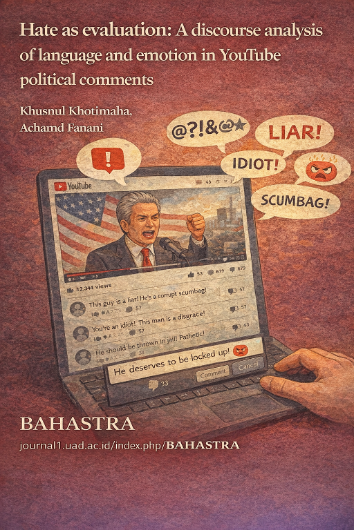
Hate as evaluation: A discourse analysis of language and emotion in Youtube political comments
DOI:
https://doi.org/10.26555/bs.v46i1.1781Keywords:
Appraisal Theory , Digital Discourse , Hate Speech , Moral JudgmentAbstract
This study examines the linguistic and psychological dynamics of hate speech in Indonesian political discourse on YouTube by analyzing user comments on a CNN Indonesia talk show discussing Gibran Rakabuming Raka. Using a qualitative approach grounded in appraisal-based discourse analysis, the study analyzes 1,534 comments to explore how evaluative language constructs moral conflict in online political communication. The findings reveal that hate speech is predominantly expressed through negative judgment, which accounts for 45% of the data, followed by contractive engagement strategies that restrict dialogue (44%) and intensified graduation that amplifies emotional force (12%). These linguistic patterns indicate that political disagreement is frequently framed as moral condemnation rather than rational debate. The study further demonstrates that such evaluative strategies are closely linked to psychological processes, including moral conviction, group identity signaling, and emotional contagion, which collectively intensify polarization in digital spaces. By integrating linguistic analysis with psychological perspectives, this research highlights hate speech as a form of moralized discourse that escalates affective conflict. The study concludes by recommending digital literacy interventions that extend beyond content moderation to address underlying evaluative and emotional processes, with the aim of fostering empathy, critical reflection, and more constructive online political engagement.References
Abdullah, H., Kunhao, Z., & Ma'rof, A. A. (2024). The role of moral disengagement, anonymity perception, online disinhibition, and empathy in predicting cyberbullying perpetration among Chinese young adults. International Journal of Academic Research in Business and Social Sciences, 14(12), 2178–2195. https://doi.org/10.6007/IJARBSS/v14-i12/24048
Adinugroho, I., Kristiani, P., & Nurrachman, N. (2023). Understanding aggression in digital environment: Relationship between shame and guilt and cyber aggression in online social network. Psikohumaniora: Jurnal Penelitian Psikologi, 8(2), 215-228. https://doi.org/10.21580/pjpp.v8i2.14827
Afrina, C., Zulaikha, S. R., & Jumila, J. (2024). The low level of digital literacy in Indonesia: An analysis of online media content. Record and Library Journal, 10(2), 374–387. https://doi.org/10.20473/rlj.V10-I2.2024.374-387
Akbar, M. F., Akram, M., & Fiddienika, A. (2024). Fenomena ketidaksopanan berbahasa Indonesia pada saat bermain game online. Jurnal Loyalitas Sosial: Journal of Community Service in Humanities and Social Sciences, 6(2), 85–99. https://doi.org/10.32493/JLS.v6i2.p85-99
Ariestandy, D., Adidharma, W., & Isdendi, R. R. (2024). Transformation of political participation in the digital age: The role of social media in shaping public opinion and mass mobilization. Jurnal Ekonomi Teknologi dan Bisnis (JETBIS), 3(9), 1738–1745. https://doi.org/10.57185/jetbis.v3i9.145
Bandura, A. (1999). Social cognitive theory of personality. In L. A. Pervin & O. P. John (Eds.), Handbook of personality: Theory and research (2nd ed.). Guilford Press.
Bobro, N. (2024, August). Conditions for enhancing students’ information and intellectual activity in the digital environment. In Theoretical and empirical scientific research: Concept and trends. https://doi.org/10.36074/logos-16.08.2024.045
Bruneau, E. G., Kteily, N. S., & Laustsen, L. (2017). The unique effects of blatant dehumanization on attitudes and behavior towards Muslim refugees during the European 'refugee crisis' across four countries. European Journal of Social Psychology, 48(5), 645–662. https://doi.org/10.1002/ejsp.2357
Calderón, F. H., Balani, N., Taylor, J., & Peignon, M. (2021). Linguistic patterns for code word resilient hate speech identification. Sensors, 21(23), 7859. https://doi.org/10.3390/s21237859
Chen, Y., Lu, J., Walker, D. I., Ma, W., Glenn, A. L., & Han, H. (2025). Perceived stress and society-wide moral judgment. European Journal of Investigation in Health, Psychology and Education, 15(6), 106. https://doi.org/10.3390/ejihpe15060106
Civila, S., Romero-Rodríguez, L. M., & Civila, A. (2020). The demonization of Islam through social media: A case study of #StopIslam on Instagram. Publications, 8(4), 1–19. https://doi.org/10.3390/publications8040052
Courtenay, T., & Baraitser, P. (2021). Online contraceptive discussion forums: A qualitative study to explore information provision. BMJ Sexual & Reproductive Health, 47(3), e5. https://doi.org/10.1136/bmjsrh-2020-200719
Dam, L., & Jensen, H. D. (2024). Everyday positivity: An appraisal analysis of online identity in food blogs. First Monday, 29(6). https://doi.org/10.5210/fm.v29i6.13225
Doré, B. P., & Morris, R. (2018). Linguistic synchrony predicts the immediate and lasting impact of text-based emotional support. Psychological Science, 29(10), 1716–1729. https://doi.org/10.1177/0956797618779971
Gallacher, J. D., & Bright, J. (2021, February). Hate contagion: Measuring the spread and trajectory of hate on social media. OSF Preprints. https://doi.org/10.31234/osf.io/b9qhd
Hackenburg, K., Brady, W. J., & Tsakiris, M. (2023). Mapping moral language on U.S. presidential primary campaigns reveals rhetorical networks of political division and unity. PNAS Nexus, 2(6), 189. https://doi.org/10.1093/pnasnexus/pgad189
Haq, Z., & Rahyono, F. X. (2025). Exploring negative judgment language in Indonesian conversational language on Facebook: An appraisal analysis. Indonesian Journal of EFL and Linguistics, 10(1). https://doi.org/10.21462/ijefl.v10i1.879
Haslam, N. (2006). Dehumanization: An integrative review. Personality and Social Psychology Review, 10(3), 252–264. https://doi.org/10.1207/s15327957pspr1003_4
Houran, J., Dagnall, N., Sapkota, R. P., & Lange, R. (2025). The spread of mind: Psychological contagion in theory and critique. Frontiers in Psychology, 16, 1631927. https://doi.org/10.3389/fpsyg.2025.1631927
Houtven, V. E., Acquah, S. B., Obermaier, M., & Saleem, M. (2024). ‘You got my back?’ Severity and counter-speech in online hate speech toward minority groups. Media Psychology, 27(4), 1–32. https://doi.org/10.1080/15213269.2023.2298684
Jamilah, F., & Wahyuni, P. (2020). Ujaran kebencian dalam kolom komentar YouTube pada tahun politik pemilihan presiden 2019. Silampari Bisa: Jurnal Penelitian Pendidikan Bahasa Indonesia, Daerah, dan Asing, 3(2), 325–341. https://doi.org/10.31540/silamparibisa.v3i2.1109
Kane, A., Van Swol, L. M., & Sarmiento-Lawrence, I. G. (2023). Emotional contagion in online groups as a function of valence and status. Computers in Human Behavior, 139, 107543. https://doi.org/10.1016/j.chb.2022.107543
Kazmi, S., Mohd Noor, S. N. F., Nur Indah, R., & Jaes, L. (2021). Attitude realization in news reports: An interpretation through an appraisal analysis. Indonesian Journal of Applied Linguistics, 11(1), 191–200. https://doi.org/10.17509/ijal.v11i1.34622
Khotimah, K. (2024). Analisis Sistem Appraisal Pada Pemberitaan Konflik Israel-Palestina Di Media Kompas.Com dan CNN Indonesia. Jurnal Kandai. 20(2), 229-245. https://ojs.badanbahasa.kemendikdasmen.go.id/jurnal/index.php/kandai/article/view/7025
Križan, A., & Barbič, A. (2023). Appraisal analysis and AI chatbots: Do we even need humans? ELOPE: English Language Overseas Perspectives and Enquiries, 22(1), 35–52. https://doi.org/10.4312/elope.22.1.35-52
Kruglanski, A. W., Ellenberg, M., Szumowska, E., & Bushman, B. J. (2023). Frustration-aggression hypothesis reconsidered: The role of significance quest. Aggressive Behavior, 49(1), 3–13. https://doi.org/10.1002/ab.22092
Leuprecht, C., Skillicorn, D. B., & Kernot, D. (2025). Linguistic models of abusive language. Dynamics of Asymmetric Conflict, 18(2), 158–174. https://doi.org/10.1080/17467586.2024.2407922
Luo, M., Hsu, T. W., Park, J. S., & Hancock, J. T. (2020). Emotional amplification during live-streaming: Evidence from comments during and after news events. Proceedings of the ACM on Human-Computer Interaction, 4(CSCW1), 1–19. https://doi.org/10.1145/3392853
Maalikih, M. D., Sumarwati, & Rakhmawati, A. (2024). Degrading sarcasm in verbal bullying: A speech act study on junior high school students in Surakarta, Indonesia. Proceeding of The International Conference of Innovation, Science, Technology, Education, Children, and Health, 4(2), 267–277. https://icistech.org/index.php/icistech
Martin, J. R., & White, P. R. R. (2005). The language of evaluation. Palgrave Macmillan.
Reichelmann, A., Hawdon, J., Costello, M., & Ryan, J. (2020). Hate knows no boundaries: Online hate in six nations. Deviant Behavior, 42(9), 1–12. https://doi.org/10.1080/01639625.2020.1722337
Rollwage, M., & Fleming, S. M. (2021). Confirmation bias is adaptive when coupled with efficient metacognition. Philosophical Transactions of the Royal Society B: Biological Sciences, 376(1822), 20200131. https://doi.org/10.1098/rstb.2020.0131
Serrano-Puche, J., Hashom, H., Mustafa, W. A., Mohammed Noor, A., Tambak, S., & Nasir, K. (2021). Digital disinformation and emotions: Exploring the social risks of affective polarization. International Review of Sociology, 31(2). https://doi.org/10.1080/03906701.2021.1947953
Snowden, R., Amad, S., Morley, E., & Butkute, N. (2021). Explicit and implicit self-esteem and aggression: Differential effects of agency and communion. Journal of Interpersonal Violence, 37(11–12), NP10036–NP10059. https://doi.org/10.1177/0886260520985490
Syrjämäki, A., Ilves, M., Olsson, T., & Kiskola, J. (2024). Online disinhibition mediates the relationship between emotion regulation difficulties and uncivil communication. Scientific Reports, 14(1), 30019. https://doi.org/10.1038/s41598-024-81086-7
Tahir, I., & Ramadhan, M. G. F. (2024). Hate speech on social media: Indonesian netizens’ hate comments of presidential talk shows on YouTube. LLT Journal: A Journal on Language and Language Teaching, 27(1), 230–251. https://doi.org/10.24071/llt.v27i1.8180
Walther, J. B. (2022). Social media and online hate. Current Opinion in Psychology, 45, 101298. https://doi.org/10.1016/j.copsyc.2021.12.010
Wang, S. Y. N. (2025). Moral language and political polarisation: An overview. Sociology Compass, 19(5), e70063. https://doi.org/10.1111/soc4.70063
Yoder, K. J., & Decety, J. (2022). Moral conviction and metacognitive ability shape multiple stages of information processing during social decision-making. Cortex, 151, 162–175. https://doi.org/10.1016/j.cortex.2022.03.008
Zhang, J., Xiong, Z., Zheng, H., & Ma, X. (2024). The moral psychological justification of anger: An exploration of self-respect and recognition. Behavioral Sciences, 15(1), 3. https://doi.org/10.3390/bs15010003
Additional Files
Published
Issue
Section
License
Copyright (c) 2025 Khusnul Khotimah, Achamd Fanani

This work is licensed under a Creative Commons Attribution-ShareAlike 4.0 International License.
1.jpg)