Designing a phonological awareness–based early literacy intervention for preschool and early elementary children: An ADDIE analysis and design study
DOI:
https://doi.org/10.26555/bs.v46i2.2364Keywords:
ADDIE Model , Early Literacy , Needs Analysis , Phonological AwarenessAbstract
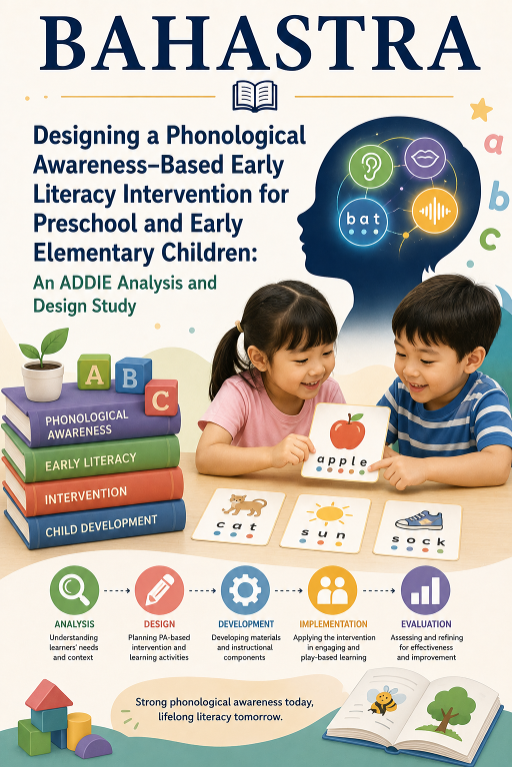
Early literacy skills constitute a fundamental foundation for children's reading and writing development. However, literacy instruction in preschools and early elementary classrooms continues to emphasize letter recognition, while the systematic development of phonological awareness receives limited attention. This study aimed to analyze instructional needs and to design a conceptual prototype of an early literacy intervention model based on a phonological awareness approach. A Research and Development approach using the ADDIE model was adopted; this article reports the Analysis and Design phases only, while the Development, Implementation, and Evaluation phases are planned for subsequent research. The needs analysis combined classroom observations, play-based assessments of children's phonological awareness, semi-structured teacher interviews, and document analysis, involving one kindergarten, one elementary school, 60 children, and 12 teachers in Tasikmalaya City, Indonesia. Most children had difficulty identifying initial sounds, segmenting words of three or more syllables, recognizing rhymes, and manipulating simple phonemes, with the greatest difficulty on voicing contrasts. Teachers equated reading readiness with alphabet recognition and had no instructional resources for phonological awareness. The resulting conceptual prototype rests on five design principles—progressive phonological development, play-based learning, contextualized instruction, practical applicability, and embedded assessment—and specifies learning objectives, instructional syntax, an activity hierarchy, media, and assessment strategies. Because expert validation, practicality testing, and effectiveness testing have not been conducted, the model is presented as a design hypothesis, not as a validated intervention.
References
Adams, M. J. (1990). Beginning to read: Thinking and learning about print. MIT Press.
Anthony, J. L., & Francis, D. J. (2005). Development of phonological awareness. Current Directions in Psychological Science, 14(5), 255–259. https://doi.org/10.1111/j.0963-7214.2005.00376.x
Anthony, J. L., & Lonigan, C. J. (2004). The nature of phonological awareness: Converging evidence from four studies of preschool and early grade school children. Journal of Educational Psychology, 96(1), 43–55. https://doi.org/10.1037/0022-0663.96.1.43
Arianti, N. K. L., & Kristiantari, M. G. R. (2024). Transformasi keterampilan membaca permulaan pada siswa kelas I sekolah dasar melalui permainan media ular tangga. Indonesian Journal of Instruction, 5, 252–261. https://doi.org/10.23887/iji.v5i2.78256
Branch, R. M. (2009). Instructional design: The ADDIE approach. Springer. https://doi.org/10.1007/978-0-387-09506-6
Christianti, M. (2023). Permainan literasi untuk anak-anak. Jurnal Pendidikan Anak, 12(1), 11–22. https://jurnal.uny.ac.id/index.php/jpa/article/view/61137
___________. (2024). Validitas dan reliabilitas asesmen literasi awal (ALIA) untuk anak usia dini. Jurnal Pendidikan Anak, 13(2), 250–264. https://doi.org/10.21831/jpa.v13i2.649
Dzikriya, F. M., & Meilawati, A. (2021). Pemerolehan fonologi bahasa Jawa pada anak usia 2,5 tahun: Kajian psikolinguistik. Jurnal Penelitian Humaniora, 26(2), 67–75. https://doi.org/10.21831/hum.v26i2.44990
Ehri, L. C., Nunes, S. R., Willows, D. M., Schuster, B. V., Yaghoub-Zadeh, Z., & Shanahan, T. (2001). Phonemic awareness instruction helps children learn to read: Evidence from the national reading panel’s meta-analysis. Reading Research Quarterly, 36(3), 250–287. https://doi.org/10.1598/RRQ.36.3.2
Fitriani, R. (2020). Kesadaran fonologis dalam kurikulum PAUD: Sebuah tinjauan. Jurnal Ilmiah Pendidikan, 7(3), 199–208.
Goswami, U. (2008). Phonological development and reading by instruction: How learning to read changes children’s phonological awareness. Child Development Perspectives, 2(1), 38–43.
Goswami, U., & Bryant, P. (2016). Phonological skills and learning to read. Psychology Press. https://doi.org/10.4324/9781315695068
Handayani, L. (2021). Strategi pengajaran kesadaran fonologis untuk guru PAUD. Jurnal Pendidikan Anak, 4(2), 223–232.
Hulme, C., & Snowling, M. J. (2013). The interface between spoken and written language: Developmental disorders. Philosophical Transactions of the Royal Society B, 369(1634), 1–8. https://doi.org/10.1098/rstb.2012.0395
Justice, L. M., & Sofka, A. E. (2010). Engaging children with print: Building early literacy skills through quality read-alouds. Guilford Press.
Laksana, D. N. L., Ita, E., Ngura, E. T., & Saju, C. F. (2023). Instruments for early mapping of preschool numeracy and literacy. Jurnal Pendidikan Anak Usia Dini Undiksha, 11, 362–372. https://doi.org/10.23887/paud.v11i3.66999
Lonigan, C. J., & Shanahan, T. (2009). Developing early literacy: Report of the national early literacy panel. National Institute for Literacy.
Meiyanti, E., Santoso, & Widjanarko, M. (2022). Local wisdom-based market game to improve kindergarten children’s language skills. Journal of Psychology and Instruction, 6(3), 145–154. https://doi.org/10.23887/jpai.v6i3.52675
Melby-Lervåg, M., Lyster, S.-A. H., & Hulme, C. (2012). Phonological skills and their role in learning to read: A meta-analytic review. Psychological Bulletin, 138(2), 322–352. https://doi.org/10.1037/a0026744
Moeliono, A. M., Lapoliwa, H., Alwi, H., Sasangka, S. S. T. W., & Suglyono. (2017). Tata bahasa baku bahasa Indonesia (Keempat). Balai Pustaka.
Mulyani, N. (2021). Peran guru dalam mengembangkan literasi awal anak. Jurnal Pendidikan dan Kebudayaan, 16(4), 567–579.
Nurmeisa, Sunanih, & Taufik, S. Y. (2025). Pengembangan media pembelajaran komaca (Kotak mari membaca) untuk meningkatkan kemampuan membaca permulaan siswa kelas 1 SDN Sambongpari Kota Tasikmalaya. Journal of Health Education Law Information and Humanities, 2(1), 362–378, https://doi.org/10.57235/helium.v2i1.5137
Pancawati, N., Widayati, M., & Nurnaningsih. (2024). Aktualisasi game edukatif digital pada perkembangan kemampuan literasi baca tulis anak usia dini. Journal of Education Action Research, 8(4), 624–635. https://doi.org/10.23887/jear.v8i4.86023
Panel, N. E. L. (2008). Developing early literacy: Report of the national early literacy panel. National Institute for Literacy.
Piasta, S. B., & Wagner, R. K. (2010). Developing early literacy skills: A meta-analysis of alphabet learning and instruction. Reading Research Quarterly, 45(1), 8–38. https://doi.org/10.71049/jdh5n683
Plomp, T., & Nieveen, N. (2013). Educational design research: Part A – an introduction. SLO Netherlands Institute for Curriculum Development.
Prasetyo, A. (2023). Analisis kesiapan guru dalam mengembangkan kemampuan fonologis anak. Jurnal Ilmiah Pendidikan Guru, 8(1), 12–21. https://doi.org/10.71049/jdh5n683
Pratiwi, A. S. (2020). Students’ phonological awareness in PAUD IT Ihya Assunah. Journal of Physics: Conference Series, 1477(4), 42069. https://doi.org/10.1088/1742-6596/1477/4/042069
Pratiwi, A. S., Dewi, R. S., & Lestari, A. T. (2018). Psikoedukasi kesadaran fonologi di pendidikan anak usia dini Kota Tasikmalaya. Early Childhood: Jurnal Pendidikan, 2(2a), 1–7. https://doi.org/10.35568/earlychildhood.v2i2a.284
Pratiwi, A. S., Wijana, I. D. P., & Sutrisno, A. (2023). Proses-proses fonologis anak usia dini. Naturalistic, 8(1), 182–193. https://doi.org/10.35568/naturalistic.v8i1.5182
Pratiwi, A. S., Wijana, I. D. P., Sutrisno, A., Nurhayati, E., & Nurdin, R. R. (2025). Mapping early childhood phonological abilities in PAUD Tasikmalaya: A qualitative descriptive study. Jurnal Bahasa, Sastra, Seni, dan Pengajarannya, 53(1), 55–76. https://doi.org/10.17977/2550-0635.1151
Pratiwi, K. W., Gading, I. K., & Antara, P. A. (2021). Instrumen penilaian kemampuan membaca permulaan pada anak usia dini. Journal for Lesson and Learning Studies, 4(1), 33–38. https://doi.org/10.23887/jlls.v4i1.33574
Putri, R. G., & Hayati, D. (2022). Penerapan metode fonik untuk meningkatkan kemampuan membaca permulaan anak usia dini. Jurnal PAUD Trunojoyo, 9(1), 1–9. https://doi.org/10.61104/jd.v1i1.21
Satyadewi, N. P. A., Ambara, D. P., & Wiarta, I. W. (2024). Interactive Powerpoint-based educational games: Media to stimulate group B children ’ s language skills. Jurnal Pendidikan Anak Usia Dini Undiksha, 12, 155–166. https://doi.org/10.23887/paud.v12i1.75500
Seymour, P. H. K., Aro, M., & Erskine, J. M. (2003). Foundation literacy acquisition in European orthographies. British Journal of Psychology, 94(2), 143–174. https://doi.org/10.1348/000712603321661859
Snow, C. E., Burns, M. S., & Griffin, P. (1998). Preventing reading difficulties in young children. National Academies Press.
Stanovich, K. E. (2000). Progress in understanding reading: Scientific foundations and new frontiers. Guilford Press.
Sulistiyawati, D. Y. R., Utami, W. T. P., & Utaminingtyas, S. (2024). Perspektif guru tentang kemampuan literasi anak usia dini di tahun awal masuk SD. Jurnal Pendidikan Anak, 13(2), 189–200. https://doi.org/10.21831/jpa.v13i2.482
Susanto, H. (2021). Evaluasi kemampuan fonologis anak usia dini di beberapa PAUD di Indonesia. Jurnal Pendidikan Anak Usia Dini, 5(2), 115–124.
Ukrainetz, T. A. (2009). Contextualized skill intervention frameworks in speech-language therapy: Scaffolding phonemic awareness. Language, Speech, and Hearing Services in Schools, 40(1), 36–49. https://doi.org/10.1044/0161-1461(2008/07-0077)
Vellutino, F. R., Scanlon, D. M., Small, S. G., & Fanuele, D. P. (2006). Response to intervention as a vehicle for distinguishing between children with and without reading disabilities. Journal of Learning Disabilities, 39(2), 157–169. https://doi.org/10.1177/00222194060390020401
Wahyuni, S. (2022). Pengaruh pembelajaran berbasis fonologi terhadap kemampuan membaca permulaan. Jurnal Pendidikan Dasar, 10(1), 33–45. https://doi.org/10.46368/jpd.v10i1.489
Whitehurst, G. J., & Lonigan, C. J. (1998). Child development and emergent literacy. Child Development, 69(3), 848–872. https://doi.org/10.1111/j.1467-8624.1998.tb06247.x
Wiedarti, P., Maslakhah, S., Nirwani, I. I., & Musfiroh, T. (2022). Analisis jumlah kata dan frekuensi jenis kata dalam buku elektronik jenjang PAUD terbitan Badan Bahasa 2019. Litera, 21(3), 288–300. https://doi.org/10.21831/ltr.v21i3.53350
Winardi, D. W. S. S., & Widiana, I. W. (2024). KACA: Educational tutorial video-based games to stimulate early childhood language skills. Jurnal Pendidikan Anak Usia Dini Undiksha, 12(1), 138–146. https://doi.org/10.23887/paud.v12i1.74881
Winnuly, Fauziah, P. Y., Triana, R. S., & Susanti, T. (2023). Pengembangan media pembelajaran pop-up storybook interaktif untuk anak usia dini. Jurnal Pendidikan Anak, 12(1), 36–48. https://doi.org/10.61992/tiflun.v1i1.80
Winskel, H., & Widjaja, V. (2007). Phonological awareness, letter knowledge, and literacy development in Indonesian beginner readers and spellers. Applied Psycholinguistics, 28(1), 23–45. https://doi.org/10.1017/S0142716407070026
Wiyani, N. A., & Nuryana, Z. (2023). Management of the emergent literacy program for early childhood at the Birrul Walidain learning house. Jurnal Pendidikan dan Pemberdayaan Masyarakat, 10(1), 1–12. https://doi.org/10.21831/jppm.v10i1.57038
Ziegler, J. C., & Goswami, U. (2005). Reading acquisition, developmental dyslexia, and skilled reading across languages: A psycholinguistic grain size theory. Psychological Bulletin, 131(1), 3–29. https://doi.org/10.1037/0033-2909.131.1.3
Zuchdi, D., Dantes, N., & Sutama. (2021). Strategi pengembangan literasi pada anak usia dini di Indonesia. Cakrawala Pendidikan, 40(2), 333–345.
Additional Files
Published
Issue
Section
License
Copyright (c) 2026 Anggia Suci Pratiwi, Yopa Taufik Saleh, Meiliana Nurfitriani , Karla Mahardika , Novia Nurul Mustami , Adelia Lintang Anjarika , Warti Nurlatifah

This work is licensed under a Creative Commons Attribution-ShareAlike 4.0 International License.