Integration of classroom assessment techniques in authentic assessment for literature learning in higher education: A conceptual literature review
DOI:
https://doi.org/10.26555/bs.v46i2.2221Keywords:
authentic assessment, classroom assessment techniques, Higher Education , Literature Teaching , Practice-Based LearningAbstract
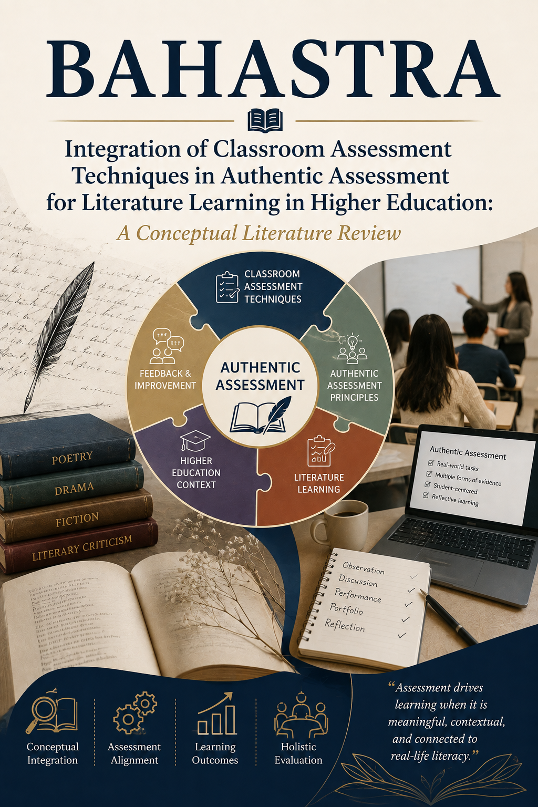
Conventional assessment in university literature courses often prioritises theoretical knowledge while providing limited evidence of students’ interpretive, applicative, performative, research, and reflective competencies. This conceptual literature review investigated how classroom assessment techniques (CAT) could be incorporated into an authentic assessment framework for literature education. A structured search across Scopus, ERIC, ScienceDirect, Google Scholar, and Garuda identified 38 publications for theory-informed thematic analysis. The analysis integrated conceptual definitions, assessment principles, task characteristics, student actions, learning evidence, and relationships among authentic assessment, CAT, and literary competence. Five interrelated competency dimensions emerged: interpretation, application, performance, research, and reflection. Based on these dimensions, the review proposes primary but non-exclusive alignments with five CAT techniques: directed paraphrasing, application cards, human tableau, paper or project prospectuses, and student-generated questions. The resulting framework positions authentic assessment as the overarching approach and CAT as a potential mechanism for eliciting varied evidence of literary competence. Rather than prescribing fixed one-to-one correspondences, the framework recognises that each technique may address multiple competencies and may be adapted to literary genre, learning outcomes, classroom conditions, and assessment purposes. The study contributes a conceptually grounded and context-sensitive model for designing participatory, competency-oriented assessment in university literature education. As the framework derives from literature synthesis rather than classroom implementation, its feasibility, effectiveness, and educational value remain to be established through empirical validation across diverse courses and institutional contexts.
References
Ajjawi, R., Tai, J., Dollinger, M., Dawson, P., Boud, D., & Bearman, M. (2024). From authentic assessment to authenticity in assessment: broadening perspectives. Assessment & Evaluation in Higher Education, 49(4), 499–510. https://doi.org/10.1080/02602938.2023.2271193
Alenezi, M. (2023). Digital learning and digital institution in higher education. Education Sciences, 13(1), 88. https://doi.org/10.3390/educsci13010088
Angelo, T. A., & Cross, K. P. (1993). Classroom assessment techniques: A handbook for college teachers. Jossey-Bass Publishers.
Awajan, N. W. (2023). The effect of implementing technology in formative assessments to ensure student learning in higher education English literature courses after COVID-19. Online Journal of Communication and Media Technologies, 13(2), e202320. https://doi.org/10.30935/ojcmt/13049
Barua, L., & Lockee, B. (2025). Flexible assessment in higher education: A comprehensive review of strategies and implications. TechTrends, 69(2), 301–309. https://doi.org/10.1007/s11528-025-01039-3
Bawi, S. V. (2025). Revitalizing ritual performances for environmental conservation and climate change adaptation: A case study of ecotourism in Khaw Nu M’cung National Park, Myanmar. Forest and Society, 9(1), 48–69. https://doi.org/10.24259/fs.v9i1.33163
Braun, V., & Clarke, V. (2006). Using thematic analysis in psychology. Qualitative Research in Psychology, 3(2), 77–101. https://doi.org/10.1191/1478088706qp063oa
Calafato, R., & Hunstadbråten, S. (2025). Literature in language education: Exploring EFL learners’ literary competence profiles. English Teaching & Learning, 49(3), 537–559. https://doi.org/10.1007/s42321-024-00193-w
Cheung, A., & Lin (Angela), Z. (2024). Preservice teachers’ experience and perceptions of adopting performance‐based assessment in literary texts. TESOL Journal, 15(3), 1. https://doi.org/10.1002/tesj.793
Cuaca, C. (2025). Assessment techniques in literature teaching: A meta-synthesis. Pantao (International Journal of the Humanities and Social Sciences), 4(4), 6078–6084. https://doi.org/10.69651/PIJHSS0404559
Doecke, B. (2024). Reading in the classroom and beyond: Learning from early career English teachers. Changing English, 31(2), 99–116. https://doi.org/10.1080/1358684X.2024.2329686
Dornan, T., Conn, R., Monaghan, H., Kearney, G., Gillespie, H., & Bennett, D. (2019). Experience based learning (ExBL): Clinical teaching for the twenty-first century. Medical Teacher, 41(10), 1098–1105. https://doi.org/10.1080/0142159X.2019.1630730
Fawns, T., Bearman, M., Dawson, P., Nieminen, J. H., Ashford-Rowe, K., Willey, K., Jensen, L. X., Damşa, C., & Press, N. (2025). Authentic assessment: From panacea to criticality. Assessment & Evaluation in Higher Education, 50(3), 396–408. https://doi.org/10.1080/02602938.2024.2404634
González-Salamanca, J. C., Agudelo, O. L., & Salinas, J. (2020). Key competencies, education for sustainable development and strategies for the development of 21st century skills: A systematic literature review. Sustainability, 12(24), 10366. https://doi.org/10.3390/su122410366
Gulikers, J. T. M., Bastiaens, T. J., & Kirschner, P. A. (2004). A five-dimensional framework for authentic assessment. Educational Technology Research and Development, 52(3), 67–86. https://doi.org/10.1007/BF02504676
Hains-Wesson, R., & le Roux, S. (2024). Bridging teacher knowledge and practice: Exploring authentic assessment across educational levels. Education Sciences, 14(8), 894. https://doi.org/10.3390/educsci14080894
Hu, A., Liu, Q., & Daniel, B. (2025). Digital technologies in authentic assessment in higher education: A systematic literature review and narrative synthesis. SAGE Open, 15(3), 21582440251357198. https://doi.org/10.1177/21582440251357198
Jopp, R. (2020). A case study of a technology enhanced learning initiative that supports authentic assessment. Teaching in Higher Education, 25(8), 942–958. https://doi.org/10.1080/13562517.2019.1613637
Karlsson, R. G., & Barahona, M. (2024). Exploring literary competences in EFL preservice teachers’ pedagogical proposals. Cogent Education, 11(1). https://doi.org/10.1080/2331186X.2024.2406140
Karunanayaka, S. P., & Naidu, S. (2021). Impacts of authentic assessment on the development of graduate attributes. Distance Education, 42(2), 231–252. https://doi.org/10.1080/01587919.2021.1920206
Kaya-Capocci, S., O’Leary, M., & Costello, E. (2022). Towards a framework to support the implementation of digital formative assessment in higher education. Education Sciences, 12(11), 823. https://doi.org/10.3390/educsci12110823
Kerman, N. T., Banihashem, S. K., Karami, M., Er, E., van Ginkel, S., & Noroozi, O. (2024). Online peer feedback in higher education: A synthesis of the literature. Education and Information Technologies, 29(1), 763–813. https://doi.org/10.1007/s10639-023-12273-8
Koekemoer, C. (2025). Arts-based assessment for English literary studies. Journal of Literary Studies, 41, 1–21. https://doi.org/10.25159/1753-5387/19874
Kong, S.-C., & Yang, Y. (2024). A human-centered learning and teaching framework using generative artificial intelligence for self-regulated learning development through domain knowledge learning in K–12 settings. IEEE Transactions on Learning Technologies, 17, 1562–1573. https://doi.org/10.1109/TLT.2024.3392830
Levine, S., Trepper, K., Chung, R. H., & Coelho, R. (2021). How feeling supports students’ interpretive discussions about literature. Journal of Literacy Research, 53(4), 491–515. https://doi.org/10.1177/1086296X211052249
Luitel, S. (2022). Classroom assessment practice of higher education: A case of Tribhuvan University. Interdisciplinary Research in Education, 7(1), 49–58. https://doi.org/10.3126/ire.v7i1.47497
Mann, K., Gordon, J., & MacLeod, A. (2009). Reflection and reflective practice in health professions education: A systematic review. Advances in Health Sciences Education, 14(4), 595–621. https://doi.org/10.1007/s10459-007-9090-2
Matsumoto-Royo, K., & Ramírez-Montoya, M. S. (2021). Core practices in practice-based teacher education: A systematic literature review of its teaching and assessment process. Studies in Educational Evaluation, 70, 101047. https://doi.org/10.1016/j.stueduc.2021.101047
McArthur, J. (2023). Rethinking authentic assessment: Work, well-being, and society. Higher Education, 85(1), 85–101. https://doi.org/10.1007/s10734-022-00822-y
Morais, A. A. F. de, & Martins, P. A. R. (2025). The cultural perspective of language and its importance to communication. Revista de Gestão e Secretariado, 16(1), e4648. https://doi.org/10.7769/gesec.v16i1.4648
Neina, Q. A., Nuryatin, A., Supriyanto, RM. T., Mardikantoro, H. B., Qomariyah, U., & Burhanudin, M. (2024). Pedagogical principles as the basis for multiliteracy assessment in literature learning in higher education. Theory and Practice in Language Studies, 14(12), 3996–4007. https://doi.org/10.17507/tpls.1412.35
Parmigiani, D., Nicchia, E., Murgia, E., & Ingersoll, M. (2024). Formative assessment in higher education: An exploratory study within programs for professionals in education. Frontiers in Education, 9, 1366215. https://doi.org/10.3389/feduc.2024.1366215
Pezzi, M. R., Veiga, A., & Fernandes, P. (2025). Assessment in higher education: An overview of the impacts of teaching practices and student percep-tions based on a systematic literature review. Avaliação: Revista Da Avaliação Da Educação Superior (Campinas), 30, e025025. https://doi.org/10.1590/1982-57652024v29id29313125
Quinlan, K. M., Sellei, G., & Fiorucci, W. (2025). Educationally authentic assessment: Reframing authentic assessment in relation to students’ meaningful engagement. Teaching in Higher Education, 30(3), 717–734. https://doi.org/10.1080/13562517.2024.2394042
Rao, N. J., & Banerjee, S. (2023). Classroom assessment in higher education. Higher Education for the Future, 10(1), 11–30. https://doi.org/10.1177/23476311221143231
Rasyid, Y., Satria, D., & Hayati, Y. (2025). Enhancing creative narrative writing skills and multimodal communication competence through a digital storytelling-based project-based learning model. BAHASTRA, 45(2), 232–240. https://doi.org/10.26555/bs.v45i2.1580
Rotthoff, T., Kadmon, M., & Harendza, S. (2021). It does not have to be either or! Assessing competence in medicine should be a continuum between an analytic and a holistic approach. Advances in Health Sciences Education, 26(5), 1659–1673. https://doi.org/10.1007/s10459-021-10043-0
Salinas-Navarro, D. E., Vilalta-Perdomo, E., Michel-Villarreal, R., & Montesinos, L. (2024). Using generative artificial intelligence tools to explain and enhance experiential learning for authentic assessment. Education Sciences, 14(1), 83. https://doi.org/10.3390/educsci14010083
Saputra, D. T., Rahmawati, E. L., & Markhamah, M. (2025). Implementation strategy of multimodal literacy text as a means to optimize literacy in Indonesian language lessons for elementary school students. BAHASTRA, 45(1), 155–164. https://doi.org/10.26555/bs.v45i1.1260
Sokhanvar, Z., Salehi, K., & Sokhanvar, F. (2021). Advantages of authentic assessment for improving the learning experience and employability skills of higher education students: A systematic literature review. Studies in Educational Evaluation, 70, 101030. https://doi.org/10.1016/j.stueduc.2021.101030
Sumarwati, S., Anindyarini, A., Suryanto, E., Hadiyah, H., & Menjamin, S. (2023). Assessment competence in Indonesian language learning of rural primary school teachers. BAHASTRA, 43(2), 198–220. https://doi.org/10.26555/bs.v43i2.510
Sunardi, S., Hermagustiana, I., & Rusmawati, D. (2025). Tension between theory and practice in literature courses at university-based educational institutions: Strategies and approaches. Journal of Language Teaching and Research, 16(2), 666–675. https://doi.org/10.17507/jltr.1602.33
Sutadji, E., Susilo, H., Wibawa, A. P., Jabari, N. A. M., & Rohmad, S. N. (2021). Authentic assessment implementation in natural and social science. Education Sciences, 11(9), 534. https://doi.org/10.3390/educsci11090534
Vlachopoulos, D., & Makri, A. (2024). A systematic literature review on authentic assessment in higher education: Best practices for the development of 21st century skills, and policy considerations. Studies in Educational Evaluation, 83, 101425. https://doi.org/10.1016/j.stueduc.2024.101425
Wang, R. Y., Liu, T., & Dang, H. (2018). Bridging critical institutionalism and fragmented authoritarianism in China: An analysis of centralized water policies and their local implementation in semi‐arid irrigation districts. Regulation & Governance, 12(4), 451–465. https://doi.org/10.1111/rego.12198
Wiggins, G. P. (1998). Educative assessment: Designing assessments to inform and improve student performance. Jossey-Bass.
Ziadi, A. (2025). The aesthetic judgements of metaphors in understanding literary texts. Humanities and Social Sciences Communications, 12(1), 190. https://doi.org/10.1057/s41599-025-04523-6
Additional Files
Published
Issue
Section
License
Copyright (c) 2026 Sri Lestari, Ria Kasanova, Roni Sulistiyono

This work is licensed under a Creative Commons Attribution-ShareAlike 4.0 International License.