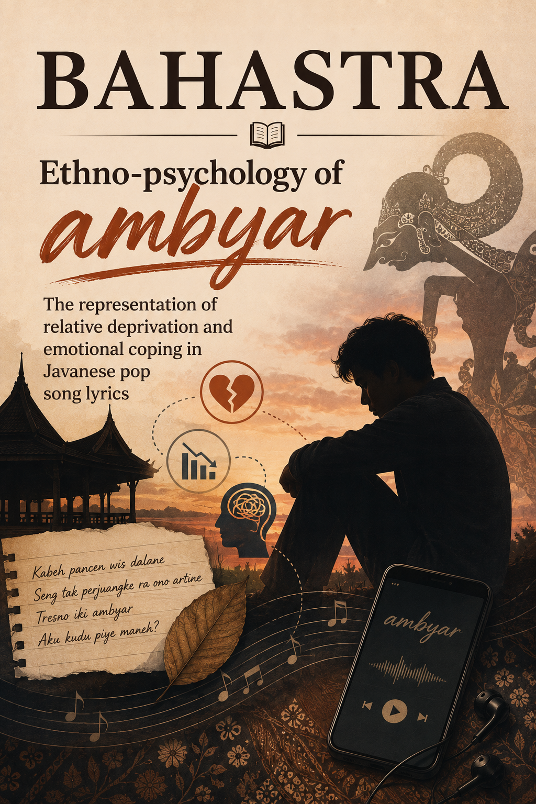
Ethno-psychology of ambyar: The representation of relative deprivation and emotional coping in Javanese pop song lyrics
DOI:
https://doi.org/10.26555/bs.v46i2.2169Keywords:
Emotional Coping , Indigenous Psychology , Javanese Pop, Mental Health , Relative DeprivationAbstract
This study examines how psychological experience is represented in contemporary Javanese pop song lyrics amid socio-economic inequality. The phenomenon of "ambyar" is read here not merely as an expression of romantic loss, but as reconstructed in these lyrics as an emotional response to social inequality. This study analyzes the representation of relative deprivation, self-esteem threat, and culturally embedded emotional coping in the Javanese pop songs Ropang, Yowis, Titenono, and Ginio. Qualitative content analysis based on indigenous psychology will be used in this paper to analyze the representation of relative deprivation, self-esteem threat, and culturally rooted emotion-coping. The findings show that the representation of emotional experience takes place using social comparison, internalized economic identity, and culturally rooted coping strategy such as sambat and nrimo coping strategy as well as assertive way of response. All findings are treated as textual representations rather than as evidence of the actual psychological states of songwriters, performers, or audiences. This study proposes the Ethno-Psychology of Ambyar as an interpretive framework, inductively developed from these four songs, for understanding the construction of psychological experience in Javanese pop music; its generalizability and empirical validity remain open to further testing.
References
Akmal, M., Argenti, G., & Marsingga, P. (2022). Dangdut music as a realization of Indonesian cultural diplomacy and social relations between countries. Jurnal Ilmiah Wahana Pendidikan, 10(24), 112–116. https://www.jurnal.peneliti.net/index.php/JIWP/article/view/9140
Andriani, D., Maritasari, D. B., Laela, I., & Husnadia, S. (2025). Pemilihan teknik sampling yang tepat dalam penelitian kualitatif: Literature review. Indo-MathEdu Intellectuals Journal, 6(4), 6238–6247. https://doi.org/10.54373/imeij.v6i4.3783
Ayyildiz, C., Geibel, O., Herff, S. A., Hashim, S., Eerola, T., & Küssner, M. B. (2025). Music as social surrogate? A qualitative analysis of older adults’ choices of music to alleviate loneliness. Musicae Scientiae, 29(4), 535–555. https://doi.org/10.1177/10298649251319403
Bachri, B. S. (2010). Meyakinkan validitas data melalui triangulasi pada penelitian kualitatif. Teknologi Pendidikan, 10(1), 46–62.
Berry, J. W., & Kim, U. (1993). Indigenous psychologies: Research and experience in cultural context. Sage Publications.
Brown, R. L., Chen, M. A., Paoletti, J., Dicker, E. E., Wu-chung, E. L., Leroy, A. S., Majd, M., Suchting, R., Thayer, J. F., & Fagundes, C. P. (2022). Emotion regulation, parasympathetic function, and psychological well-being. Frontiers in Psychology, 13, 879166. https://doi.org/10.3389/fpsyg.2022.879166
Burwell, R. A., & Bias, S. (2024). Mental health self-stigma: Links with social self-worth contingencies and ally support. Cogent Mental Health, 3(1), 2310039. https://doi.org/10.1080/28324765.2024.2310039
Cheung, J. O., & Feng, D. (2021). Attitudinal meaning and social struggle in heavy metal song lyrics: A corpus-based analysis. Social Semiotics, 31(2), 230–247. https://doi.org/10.1080/10350330.2019.1601337
Difadrana, T. R., & Mulyana, R. (2026). Medan makna dalam lirik lagu “Bahas Bahasa” karya Barasuara. Journal for the Study of Language, Literature, Culture and The Humanities, 1(1), 35–42. https://ejournal.uinsgd.ac.id/index.php/adabia/article/view/2360
Elbæk, C. T., Mitkidis, P., Aarøe, L., & Otterbring, T. (2023). Subjective socioeconomic status and income inequality are associated with self-reported morality across 67 countries. Nature Communications, 14, 5453. https://doi.org/10.1038/s41467-023-41007-0
Febrindasari, C., Musyafa, N., & Zakiyah, M. (2025). Maskulinitas yang terluka: Mengungkap narasi patah hati laki-laki pada lagu Jawa populer dalam perspektif budaya. KOLITA: Konferensi Linguistik Tahunan Atma Jaya, 23(23), 64–76. https://ejournal.atmajaya.ac.id/index.php/kolita/article/view/7146
Festinger, L. (1954). A theory of social comparison processes. Human Relations, 7(2), 117–140. https://doi.org/10.1177/001872675400700202
Freud, A. (2018). The ego and the mechanisms of defence. Taylor & Francis Group. https://doi.org/10.4324/9780429481550
Freud, S. (1936). Inhibitions, symptoms, and anxiety. The Psychoanalytic Quarterly, 5(1), 1–28. https://doi.org/10.1080/21674086.1936.11925270
Gerber, J., & Wheeler, L. (2009). On being rejected: A meta-analysis of experimental research on rejection. Perspectives on Psychological Science, 4(5), 468–488. https://doi.org/10.1111/j.1745-6924.2009.01158.x
Giuseppe, M. Di, Perry, J. C., Prout, T. A., & Conversano, C. (2021). Editorial: Recent empirical research and methodologies in defense mechanisms: Defenses as fundamental contributors to adaptation. Frontiers in Psychology, 12, 802602. https://doi.org/10.3389/fpsyg.2021.802602
Gobel, M. S., & Miyamoto, Y. (2024). Self- and other-orientation in high rank: A cultural psychological approach to social hierarchy. Personality and Social Psychology, 28(1), 54–80. https://doi.org/10.1177/10888683231172252
Gurr, T. R. (2016). Why men rebel. Taylor & Francis Group. https://doi.org/10.4324/9781315631073
Hadi, S., Sunarto, Cahyono, A., & Djatiprambudi, D. (2025). When songs provide artistic value: A historical functionalism study in 1970s Indonesian popular music. International Journal of Visual and Performing Arts, 7(1), 141–154. https://pubs2.ascee.org/index.php/viperarts/article/view/1955
Hartono, T. M., & Ulya, C. (2025). Representation of male roles and characters in Indonesian classic dangdut songs from the 1970s to the 1990s. Kembara: Jurnal Keilmuan Bahasa, Sastra, dan Pengajarannya, 11(2), 869–882. https://doi.org/10.22219/kembara.v11i2.42208
He, Z., Muhlert, N., & Elliott, R. (2021). Emotion regulation of social exclusion: A cross-cultural study. Humanities and Social Sciences Communications, 8, 173. https://doi.org/10.1057/s41599-021-00857-z
Hollenstein, T., & Faulkner, K. (2024). Adolescent digital emotion regulation. Research on Adolescence, 1341–1351. https://doi.org/10.1111/jora.13009
Khamida, K., Yusuf, A., Fitryasari, R., Rohmawati, R., & Hasina, S. N. (2021). The effectiveness of santri’s life style management on santri’s coping mechanisms. 9, 1586–1589. https://doi.org/10.3889/oamjms.2021.7868
Kresna, A. A. (2023). The epistemology of rasa as a basic foundation of the Javanese psychology. East Asian Journal of Multidisciplinary Research, 2(8), 3209–3222. https://doi.org/10.55927/eajmr.v2i8.5699
Kuo, C., Hsieh, S., Liao, P., & Kawachi, I. (2025). Social science & medicine relative deprivation and subsequent health, happiness, and human flourishing: A longitudinal outcome-wide analysis. Social Science & Medicine, 384, 118537. https://doi.org/10.1016/j.socscimed.2025.118537
Lahdji, R. F. (2013). Objektifikasi perempuan dan tubuh: Wacana tubuh perempuan dalam lirik lagu dangdut populer tahun 2000-2013. Lakon Jurnal Kajian Sastra dan Budaya, 4(1), 103–130. https://doi.org/10.20473/lakon.v4i1.1938
Lazarus, R. S., & Folkman, S. (1984). Stress, appraisal, and coping. Springer Publishing Company.
Leary, M. R. (2012). Sociometer theory. In Handbook of theories of social psychology (Vol. 2, pp. 141–159). https://doi.org/10.4135/9781446249222.n33
Liu, Z., & Xiao, L. (2024). Is it just about scrolling? The correlation of passive social media use with college students’ subjective well-being based on social comparison experiences and orientation assessed using a two-stage hybrid structural equation modeling. Behavioral Sciences, 14, 1162. https://doi.org/10.3390/bs14121162
Munawaroh, E., Sugiharto, D. Y. P., Sofyan, A., Arinata, F. S., Asti, Z. P. B., & Mashudi, E. A. (2024). Family resilience belief system: A phenomenological study on Javanese and Sundanese family. Jurnal Kajian Bimbingan dan Konseling, 6(2), 80–89. https://doi.org/10.17977/um001v6i22021p080-089
Nazarrina, A. P., Dzarna, D., & Mijianti, Y. (2025). Simbol lokal dalam lagu karya Didi Kempot: Analisis semiotika. Jentera: Jurnal Kajian Sastra, 14(2), 230–241. https://doi.org/10.26499/jentera.v14i2.8417
Nazri, S. N. A., & Kassim, A. (2023). Issues and functions of code-switching in studies on popular culture: A systematic literature review. International Journal of Language Education and Applied Linguistics, 13(2). https://doi.org/10.15282/ijleal.v13i2.9585
Pak, T. (2025). Relative deprivation: How subjective experiences of income inequality influence risk preferences. Behavioral Sciences, 15(4), 425. https://doi.org/10.3390/bs15040425
Pamarto, A. A., Tinggi, S., Rajawali, T., & Indonesia, A. (2025). Keteguhan iman dalam penderitaan: Integrasi. Rerum: Journal of Biblical Practice, 5(2), 138–156. https://doi.org/10.55076/rerum.v5i2.491
Pring, E. X., Olsen, K. N., Mobbs, A. E. D., & Thompson, W. F. (2024). Music communicates social emotions: Evidence from 750 music excerpts. Scientific Reports, 14, 27766. https://doi.org/10.1038/s41598-024-78156-1
Qorib, F., & Dewi, S. I. (2021). Sobat ambyar: The phenomenon of fans, social media, and modern campursari music in Indonesia. Jurnal Pekommas, 6(2), 67–76. https://doi.org/10.56873/jpkm.v6i2.3960
Ratnawati, D. I., & Hastangka. (2022). Perception and assertiveness practices in the Ewuh Pekewuh concept: An indigenous psychology approach in Yogyakarta society. Journal of Social Research, 4(11), 2866–2871. https://doi.org/10.55324/josr.v4i10.2804
Rochman, K. L., & Faishol, L. (2024). Kawruh and Rahsa: Epistemic relations of indigenous psychology with Javanese traditions. Jurnal Bimbingan dan Konseling Islam, 14(2), 104–126. https://jurnalfdk.uinsa.ac.id/index.php/jbki/article/view/1910
Rosenberg, M. (1965). Rosenberg self-esteem scale (RSE). Acceptance and Commitment Therapy. Measures Package, 61(52), 18. https://doi.org/10.1037/t01038-000
Safaria, T. (2026). Geopsychiatry from rasa to rukun: Toward a geopsychiatric perspective on Javanese well-being. Geopsychiatry, 3, 100038. https://doi.org/10.1016/j.geopsy.2025.100038
Samuel, J. C., Kamajaya, G., & Mahadewi, N. M. A. S. (2024). Musik dangdut sebagai pengartikulasi perasaan pribadi mahasiswa kedokteran Universitas Udayana. Socio-Political Communication, and Policy Review, 1(4), 194–210. https://doi.org/10.61292/shkr.153
Subandi, M. A. (2013). Psikologi agama dan kesehatan mental. Jurnal Psikologi Islam, 2.
Tian, J., Li, B., & Zhang, R. (2025). Behavioral sciences the impact of upward social comparison on social media on appearance anxiety: A moderated mediation model. Behavioral Science, 15(1), 8. https://doi.org/10.3390/bs15010008
Tobar, J. P. (2022). Social movements , relative deprivation and cellular automata social movements, relative deprivation, and cellular automata. Cogent Social Sciences, 8(1), 2053268. https://doi.org/10.1080/23311886.2022.2053268
Tunshorin, C. (2016). Analisis resepsi budaya populer Korea pada eternal jewel dance community Yogyakarta. Profetik: Jurnal Komunikasi, 9(1). https://doi.org/10.14421/pjk.v9i1.1191
Wahdiyati, D., & Dhaifina, G. (2022). Muatan pornografi, pornoaksi, dan eksploitasi perempuan dalam lagu dangdut. Calathu: Jurnal Ilmu Komunikasi, 4(1), 9–30. https://doi.org/10.37715/calathu.v4i1.2709
Walker, I., & Smith, H. J. (2002). Relative deprivation: Specification, development, and integration. Cambridge University Press. https://doi.org/10.1017/CBO9780511527753
Wesselmann, E. D., Bradley, E., Taggart, R. S., & Williams, K. D. (2023). Exploring social exclusion: Where we are and where we’re going. Social and Personality Psychology Compass, 17(1), e12714. https://doi.org/10.1111/spc3.12714
Winduwati, S. (2017). Representasi seks bebas pada lirik lagu dangdut (Analisis semiotika Saussure pada lirik lagu “Cinta Satu Malam”). Jurnal Muara Ilmu Sosial, Humaniora, dan Seni, 1(2), 346–349. https://doi.org/10.24912/jmishumsen.v1i2.1023
Wu, M., Yan, Y., & Kong, D. (2024). The impact of social environment perception on relative deprivation among residents in rural tourism destinations. Sustainability, 16, 8937. https://doi.org/10.3390/su16208937
Xu, L., & Li, L. (2024). Upward social comparison and social anxiety among Chinese college students: A chain-mediation model of relative deprivation and rumination. Frontiers in Psychology, 15, 1430539. https://doi.org/10.3389/fpsyg.2024.1430539
Yu, S., & Blader, S. L. (2020). Why does social class affect subjective well-being? The role of status and power. Personality and Social Psychology Bulletin, 46(3), 331–348. https://doi.org/10.1177/0146167219853841
Zafila, S. S., & Purnairawan, R. E. (2024). Budaya lokal sebagai sarana pemulihan trauma: Sebuah studi pada generasi Z di Indonesia. Saneskara: Journal of Social Studies, 1(2), 53–71. https://doi.org/10.62491/sjss.v1i2.2024.18
Zhao, S., & Peng, L. (2021). Feeling matters: Perceived social support moderates the relationship between personal relative deprivation and depressive symptoms. BMC Pscyhiartry, 21, 345. https://doi.org/10.1186/s12888-021-03334-8
Additional Files
Published
Issue
Section
License
Copyright (c) 2026 Chafit Ulya, Sarwiji Suwandi, Nugraheni Eko Wardani, Titi Setiyoningsih, Laila Fitri Nur Hidayah, Bertha Sylvester Maingu

This work is licensed under a Creative Commons Attribution-ShareAlike 4.0 International License.