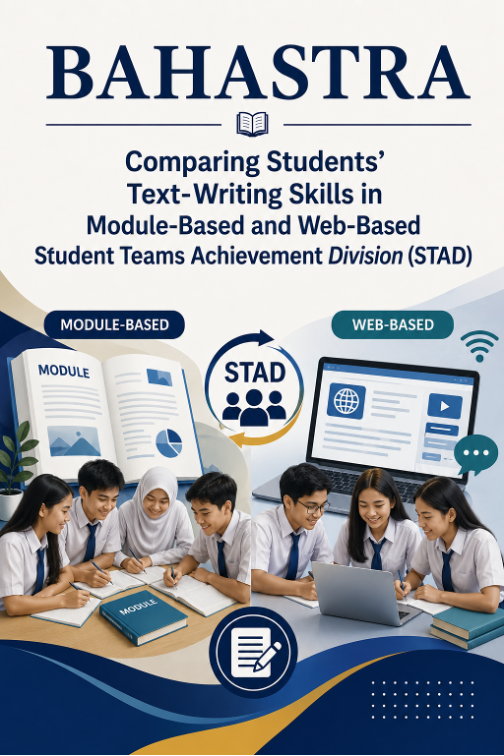
Comparing students’ text-writing skills in module-based and web-based Student Teams Achievement Division (STAD)
DOI:
https://doi.org/10.26555/bs.v46i2.2151Keywords:
Kurikulum Merdeka , Module-Based Learning, STAD , Text-Writing Skills , Web-Based LearningAbstract
Writing instruction in Indonesian language classrooms requires students to develop ideas, organize genre-specific structures, and use appropriate linguistic features across print and digital environments. Previous studies on Student Teams Achievement Division (STAD) have largely examined it as a cooperative-learning intervention, with limited attention to how different instructional media shape writing outcomes within the same STAD framework. This study compared module-based and web-based STAD for tenth-grade students’ writing of observation report, exposition, and anecdote texts. A quantitative quasi-experimental comparative design involved 70 students from two Grade X classes at SMA Negeri 3 Padang, with 35 students in each instructional condition. Students’ texts were assessed using an analytic rubric covering content development, generic structure, and linguistic features. Data were analyzed using descriptive statistics, Welch’s t test, the Mann–Whitney U test, and effect sizes. The module-based group obtained an overall mean of 76.06 (SD = 6.46), whereas the web-based group achieved 80.85 (SD = 5.61). The overall difference was significant, t(66.69) = 3.31, p = .001, d = .79. Web-based STAD also showed significant advantages in observation report and anecdote writing, whereas the difference in exposition writing was not significant. These findings indicate that instructional-media effects within STAD are genre-sensitive. The study demonstrates that cooperative writing outcomes may depend on the alignment between instructional media and genre-specific writing demands.
References
American Educational Research Association, American Psychological Association, & National Council on Measurement in Education. (2014). Standards for educational and psychological testing. American Educational Research Association.
Badan Standar, Kurikulum, dan Asesmen Pendidikan. (2024). Keputusan Kepala Badan Standar, Kurikulum, dan Asesmen Pendidikan Nomor 032/H/KR/2024 Tentang Capaian Pembelajaran pada Pendidikan Anak Usia Dini, Jenjang Pendidikan Dasar, dan Jenjang Pendidikan Menengah pada Kurikulum Merdeka. Kementerian Pendidikan, Kebudayaan, Riset, dan Teknologi.
Badger, R., & White, G. (2000). A process genre approach to teaching writing. ELT Journal, 54(2), 153-160. https://doi.org/10.1093/elt/54.2.153
Cohen, J. (1988). Statistical power analysis for the behavioral sciences (2nd ed.). Lawrence Erlbaum Associates.
Deci, E. L., & Ryan, R. M. (2000). The “what” and “why” of goal pursuits: Human needs and the self-determination of behavior. Psychological Inquiry, 11(4), 227-268. https://doi.org/10.1207/S15327965PLI1104_01
Elabdali, R. (2021). Are two heads really better than one? A meta-analysis of the L2 learning benefits of collaborative writing. Journal of Second Language Writing, 52, 100788. https://doi.org/10.1016/j.jslw.2020.100788
Elola, I., & Oskoz, A. (2010). Collaborative writing: Fostering foreign language and writing conventions development. Language Learning & Technology, 14(3), 51-71. https://doi.org/10.64152/10125/44226
Flower, L., & Hayes, J. R. (1981). A cognitive process theory of writing. College Composition and Communication, 32(4), 365-387. https://doi.org/10.2307/356600
Gintings, M. F. M. (2020). Promoting students’ writing skill: Genre-based approach in Indonesia EFL context. Lexeme: Journal of Linguistics and Applied Linguistics, 2(1), 31–38.
Graham, S. (2018). A revised writer(s)-within-community model of writing. Educational Psychologist, 53(4), 258-279. https://doi.org/10.1080/00461520.2018.1481406
Hakim, A. (2023). Genre-related episodes as a lens on students’ emerging genre knowledge: Implications for genre-based writing pedagogy, collaborative tasks, and learning materials. Journal of Second Language Writing, 60, 101001. https://doi.org/10.1016/j.jslw.2023.101001
Helaluddin, Nurhayati, Nadya, N. L., Ismail, G., Guntur, M., & Fransori, A. (2023). The use of collaborative strategies to improve students' writing ability and self-efficacy: A mixed method study. European Journal of Educational Research, 12(1), 265-280. https://doi.org/10.12973/eu-jer.12.1.265
Herman, Purba, R., Thao, N. V., & Purba, A. (2020). Using genre-based approach to overcome students’ difficulties in writing. Journal of Education and e-Learning Research, 7(4), 464–470. https://doi.org/10.20448/journal.509.2020.74.464.470
Hitimala, H., Damayanti, I. L., & Yusuf, F. N. (2024). Genre-based approach in writing explanation text: A systematic literature review. EduLite: Journal of English Education, Literature and Culture, 9(1), 32–49. https://doi.org/10.30659/e.9.1.32-49
Hyland, K. (2003). Second language writing. Cambridge University Press. https://doi.org/10.1017/CBO9780511667251
Karnedi, K. (2025). Effectiveness of developing a STAD model integrated into group work projects to enhance students' writing skills. Baileo: Jurnal Sosial Humaniora, 2(2), 225-241. https://doi.org/10.30598/baileofisipvol2iss2pp225-241
Kementerian Pendidikan, Kebudayaan, Riset, dan Teknologi. (2024). Peraturan Menteri Pendidikan, Kebudayaan, Riset, dan Teknologi Nomor 12 Tahun 2024 tentang Kurikulum pada Pendidikan Anak Usia Dini, Jenjang Pendidikan Dasar, dan Jenjang Pendidikan Menengah.
Kindenberg, B. (2021). Fixed and flexible, correct and wise: A case of genre-based content-area writing. Linguistics and Education, 64, 100938. https://doi.org/10.1016/j.linged.2021.100938
Landrieu, Y., De Smedt, F., Van Keer, H., & De Wever, B. (2023). Argumentation in collaboration: The impact of explicit instruction and collaborative writing on secondary school students’ argumentative writing. Reading and Writing. https://doi.org/10.1007/s11145-023-10439-x
Li, J., & Mak, L. (2022). The effects of using an online collaboration tool on college students’ learning of academic writing skills. System, 105, 102712. https://doi.org/10.1016/j.system.2021.102712
Li, W. (2022). Scoring rubric reliability and internal validity in rater-mediated EFL writing assessment: Insights from many-facet Rasch measurement. Reading and Writing, 35, 2409–2431. https://doi.org/10.1007/s11145-022-10279-1
Liu, Y., Thurston, A., & Ye, X. (2024). Technology-enhanced cooperative language learning: A systematic review. International Journal of Educational Research, 124, 102314. https://doi.org/10.1016/j.ijer.2024.102314
Lu, Q., Yao, Y., & Zhu, X. (2023). The relationship between peer feedback features and revision sources mediated by feedback acceptance: The effect on undergraduate students’ writing performance. Assessing Writing, 56, 100725. https://doi.org/10.1016/j.asw.2023.100725
Lu, X., & Kim, S. (2021). A systematic review of collaborative writing implementation in K-12 second language classrooms. TEFLIN Journal, 32(1), 50-71. https://doi.org/10.15639/teflinjournal.v32i1/50-71
Lukmawardani, N. I., & Badriyah, I. M. (2022). Genre based approach to improve students’ writing ability of tenth graders of senior high school. English Edu: Journal of English Teaching and Learning, 1(1), 9-17. https://doi.org/10.18860/jetl.v1i1.1622
Lv, X., Ren, W., & Xie, Y. (2021). The effects of online feedback on ESL/EFL writing: A meta-analysis. Frontiers in Psychology, 12, 643261. https://doi.org/10.3389/fpsyg.2021.643261
Mantra, I. B. N., Maba, W., & Widiastuti, I. A. M. S. (2025). Utilizing cooperative learning as an effective method to improve students' writing skills. International Journal of Multidisciplinary Approach Research and Science, 3(2), 458-471. https://doi.org/10.59653/ijmars.v3i02.1520
Martin, J. R., & Rose, D. (2008). Genre relations: Mapping culture. Equinox.
Nisja, I. (2018). Kesesuaian buku teks Bahasa Indonesia dengan Kurikulum 2013. Jurnal Penelitian Pendidikan Bahasa dan Sastra Indonesia, 1(1), 162-172.
OECD. (2023). PISA 2022 results (Volume I): The state of learning and equity in education. OECD Publishing. https://doi.org/10.1787/53f23881-en
Ouyang, F., Zhang, N., Chen, Y., & Shao, X. (2025). The use and effect of cognitive scaffoldings on facilitating collaborative discussion-supported writing. Technology, Pedagogy and Education, 34(3), 275–295. https://doi.org/10.1080/1475939X.2024.2437036
Öztürk, B. (2023). The effect of cooperative learning models on learning outcomes: A second-order meta-analysis. Educational Policy Analysis and Strategic Research, 18(3), 273–296. https://doi.org/10.29329/epasr.2023.600.13
Pardede, P. (2024). The strands and findings of recent research on technology-enhanced collaborative writing in EFL settings: A systematic review. Journal of English Teaching, 10(2), 170–182. https://doi.org/10.33541/jet.v10i2.6035
Resmi, T., Tansliova, L., & Maysaroh, E. (2020). Pengaruh model pembelajaran STAD terhadap kemampuan menulis teks laporan hasil observasi. JIPIS, 29(2), 107-111.
Rusman. (2011). Model-model pembelajaran: Mengembangkan profesionalisme guru. Raja Grafindo Persada.
Svenlin, M., & Sørhaug, J. O. (2022). Collaborative writing in L1 school contexts: A scoping review. Scandinavian Journal of Educational Research, 67(6), 980–996. https://doi.org/10.1080/00313831.2022.2115128
Tafonao, R. S. H., Halawa, N., Bu'ulolo, Y., & Ndruru, M. (2025). Penerapan model STAD dalam meningkatkan kemampuan menulis surat dinas. J-Simbol, 13(2), 739-747. https://doi.org/10.23960/simbol.v13i2.1005
Tardy, C. M., Sommer-Farias, B., & Gevers, J. (2020). Teaching and researching genre knowledge: Toward an enhanced theoretical framework. Written Communication, 37(3), 287–321. https://doi.org/10.1177/0741088320916554
Teng, M. F. (2021). Interactive-whiteboard-technology-supported collaborative writing: Writing achievement, metacognitive activities, and co-regulation patterns. System, 97, 102426. https://doi.org/10.1016/j.system.2020.102426
Vuogan, A., & Li, S. (2023). Examining the effectiveness of peer feedback in second language writing: A meta-analysis. TESOL Quarterly, 57(4), 1115–1138. https://doi.org/10.1002/tesq.3178
Wang, L. (2023). MALL-based collaborative writing in second language classroom: A systematic review. Future in Educational Research, 1(2), 147–162. https://doi.org/10.1002/fer3.18
What Works Clearinghouse. (2022). What Works Clearinghouse procedures and standards handbook, version 5.0. National Center for Education Evaluation and Regional Assistance, Institute of Education Sciences, U.S. Department of Education.
Yusuf, Q., Jusoh, Z., & Yusuf, Y. Q. (2019). Cooperative learning strategies to enhance writing skills among students. International Journal of Instruction, 12(1), 1399-1412. https://doi.org/10.29333/iji.2019.12189a
Zhang, M., & Chen, W. (2022). Assessing collaborative writing in the digital age: An exploratory study. Journal of Second Language Writing, 57, 100868. https://doi.org/10.1016/j.jslw.2022.100868
Zhang, M., Gibbons, J., & Li, M. (2021). Computer-mediated collaborative writing in L2 classrooms: A systematic review. Journal of Second Language Writing, 54, 100854. https://doi.org/10.1016/j.jslw.2021.100854
Additional Files
Published
Issue
Section
License
Copyright (c) 2026 Indriani Nisja, Lira Hayu Afdetis Mana

This work is licensed under a Creative Commons Attribution-ShareAlike 4.0 International License.