Reproducing or challenging gender stereotypes? Literary texts in Indonesian language textbooks under the merdeka curriculum
DOI:
https://doi.org/10.26555/bs.v46i2.2122Keywords:
gender representation, literary text, Literacy , Merdeka Curriculum, TextbooksAbstract
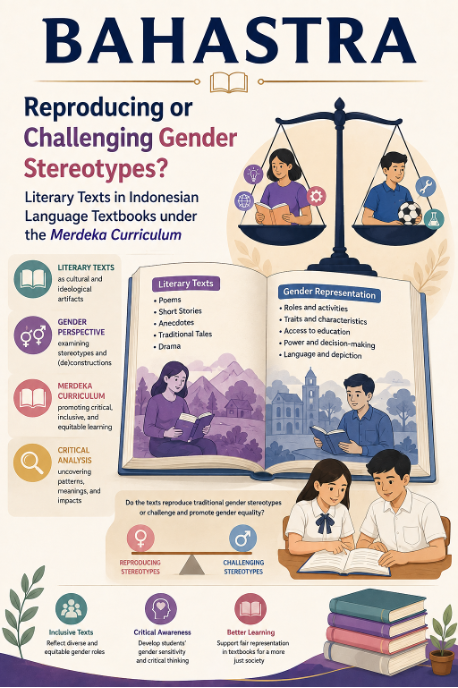
This study aims to: (1) analyze the gender values projected in literary texts in Indonesian language textbooks under the Merdeka Curriculum and (2) examine how gender projection operates in literary works and its manifestation as a source of literacy. Literary text in a textbook not only functions as the material of learning language but also as the medium representing the social value and construct of gender roles. This study uses a qualitative approach combined with content analysis of the literary texts contained in the Indonesian language textbook for Junior High School and Senior High School students in accordance with the Merdeka Curriculum (Emancipated Curriculum). The research data were collected through documentation by identifying and classifying literary texts containing gender representation. The findings mainly show two points: first, gender perspective has been integrated in some literary texts through character representation, critical description towards gender representation, and the discussion of gender issues in narrative texts; and second, some literary texts still reproduce dichotomous gender stereotypes which strengthen the patriarchal roles, representing women as weak and subordinated figures while men are represented as strong and dominant figures. However, some texts also show a more inclusive representation by presenting an empowered woman with a sense of agency. This study concludes that gender representation in literary texts potentially influences students’ understanding of gender roles in the community, so that textbook development needs to consider gender diversity and balance in the literary materials.
References
Adukia, A., Eble, A., Harrison, E., Runesha, H. B., & Szasz, T. (2023). What we teach about race and gender: Representation in images and text of children’s books. The Quarterly Journal of Economics, 138(4), 2225–2285. https://doi.org/10.1093/qje/qjad028
Alimuddin, J. (2023). Implementasi kurikulum merdeka di sekolah dasar. Jurnal Ilmiah Kontekstual, 4(2), 67. https://doi.org/10.46772/kontekstual.v4i02.995
Anggraeni, R. (2021). Dinamika gender dalam novel Perempuan di Titik Nol karya El Sadaawi prespektif Prof. Dr. Farida Hanum, M. Si. Metalanguage: Jurnal Ilmu Bahasa dan Sastra Indonesia, 2(2), 1–10.https://doi.org/10.56707/jmela.v2i02/2021/10.69
Aries, A. M. (2022). Peningkatan karakter gotong royong melalui market day di sekolah dasar. Dewantara Jurnal Pendidikan Sosial Humaniora, 1(4), 68–81. https://doi.org/10.30640/dewantara.v1i4.388
Astuti, Y. D. (2016). Media dan gender (Studi deskriptif representasi stereotipe perempuan dalam iklan di televisi swasta). Profetik: Jurnal Komunikasi, 9(2), 25–32. https://doi.org/10.14421/pjk.v9i2.1205
Aulia, F. T., Gumilar, S. I., & Kurniawan, A. (2021). Cerdas cergas berbahasa dan bersastra Indonesia untuk SMA/SMK kelas X. Pusat Kurikulum dan Perbukuan, Badan Penelitian dan Pengembangan dan Perbukuan, Kementerian Pendidikan, Kebudayaan, Riset, dan Teknologi.
Condron, C., Power, M., Mathew, M., Lucey, S. M., Henn, P., Dean, T., Kirrane-Scott, M., Eppich, W., & Lucey, S. M. (2025). Gender equality training for students in higher education: Scoping review. JMIR Medical Education, 11, e60061. https://doi.org/10.2196/60061
Cortés, R. J., & Aires, L. (2021). Feminist trends in distance and hybrid higher education: A scoping review. International Journal of Educational Technology in Higher Education, 18(1), 1–20. Springer Nature. https://doi.org/10.1186/s41239-021-00297-4
Darma, B. (2004). Pengantar teori sastra. Pusat Bahasa Depdiknas.
Darni, F. I. N. A. (2017). Gender bias in elementary school language textbooks. International Journal of Gender & Women S Studies, 5(1), 128–133. https://doi.org/10.15640/ijgws.v5n1a13
Febriani, M. (2018). Kesesuaian materi apresiasi sastra pada buku teks bahasa Indonesia SMP kurikulum 2013. Jurnal Pendidikan Bahasa Indonesia, 6(2), 123–137. https://doi.org/10.30659/j.6.2.123-137
Febriani, M., Setyaningsih, N. H., & Fernando, L. (2022). Konstruksi nilai perjuangan perempuan dalam novel Ibu Doa yang Hilang dan implikasinya sebagai konten pembelajaran sastra yang berperspektif gender. Jurnal Pendidikan Bahasa dan Sastra, 11(2), 96–104.
Gusfitri, M. L., & Delfia, E. (2021). Bahasa Indonesia untuk SMP/MTs kelas VIII. Pusat Kurikulum dan Perbukuan, Badan Penelitian dan Pengembangan dan Perbukuan, Kementerian Pendidikan, Kebudayaan, Riset, dan Teknologi.
Hunaepi, H., & Suharta, I. G. P. (2024). Transforming education in Indonesia: The impact and challenges of the merdeka belajar curriculum. Path of Science, 10(6), 5026. https://doi.org/10.22178/pos.105-31
Hussein, I., & Ali, M. (2021). Examining female characters in children picture books: An international teachers’ perspective. Journal of Applied Learning & Teaching, 4(1), 114–119. https://doi.org/10.37074/jalt.2021.4.1.14
Jewkes, R., Flood, M., & Lang, J. (2014). From work with men and boys to changes of social norms and reduction of inequities in gender relations: A conceptual shift in prevention of violence against women and girls. The Lancet, 385(9977), 1580. https://doi.org/10.1016/s0140-6736(14)61683-4
Kabeer, N. (1994). Reversed realities: Gender hierarchies in development thought. Verso.
Keller, L., Lüdtke, O., Preckel, F., & Brunner, M. (2023). Educational inequalities at the intersection of multiple social categories: An introduction and systematic review of the multilevel analysis of individual heterogeneity and discriminatory accuracy (MAIHDA) approach. Educational Psychology Review, 35(1), 1–37. https://doi.org/10.1007/s10648-023-09733-5
Kim, S. J. (2016). Possibilities and challenges of early critical literacy practices: Bilingual preschoolers' exploring multiple voices and gender roles. Journal of Early Childhood Research, 14(4), 370–388.
https://doi.org/10.1177/1476718X14552878
Kube, D., Weidlich, J., Kreijns, K., & Drachsler, H. (2024). Addressing gender in STEM classrooms: The impact of gender bias on women scientists’ experiences in higher education careers in Germany. Education and Information Technologies, 29(15), 20135. https://doi.org/10.1007/s10639-024-12669-0
Kuteesa, K. N., Akpuokwe, C. U., & Udeh, C. A. (2024). Gender equity in education: Addressing challenges and promoting opportunities for social empowerment. International Journal of Applied Research in Social Sciences, 6(4), 631–641. https://doi.org/10.51594/ijarss.v6i4.1034
Liu, S., Dai, Y., Ng, O. L., & Zhihui, C. (2025). Gender disparity in computational thinking pedagogy and assessment: A three-level meta-analysis. Educational Psychology Review, 37(4), 114. https://doi.org/10.1007/s10648-025-10095-3
Llorens, A., Tzovara, A., Bellier, L., Bhaya-Grossman, I., Bidet‐Caulet, A., Chang, W. K., Cross, Z. R., Dominguez-Faus, R., Flinker, A., Fonken, Y., Gorenstein, M. A., Holdgraf, C., Hoy, C. W., Ivanova, M. V., Jimenez, R., Jun, S., Kam, J. W. Y., Kidd, C., Marcelle, E. T., … Dronkers, N. F. (2021). Gender bias in academia: A lifetime problem that needs solutions. Neuron, 109(13), 2047–2074. https://doi.org/10.1016/j.neuron.2021.06.002
Mafrukhi, M., Rustono, R., Subiyantoro, S., & Doyin, M. (2019). Hegemoni sosial, budaya, dan kekuasaan wacana sastra buku teks bahasa Indonesia SMA. Prosiding Seminar Nasional Pascasarjana (PROSNAMPAS), 2(1), 1030–1038. https://proceedings.unnes.ac.id/snpasca/article/view/409
Marshall, C., & Roosman, G. B. (2006). Designing qualitative research. Sage Publication.
Miles, M. B., & Huberman, A. M. (2005). Qualitative data analysis (terjemahan). UI Press.
Nemani, P., Joel, Y. D., Vijay, P., & Liza, F. F. (2023). Gender bias in transformers: A comprehensive review of detection and mitigation strategies. Natural Language Processing Journal, 6, 100047. Elsevier BV. https://doi.org/10.1016/j.nlp.2023.100047
Nugroho, Y. E., Prabaningrum, D., & Sumartini, S. (2023). Otoritas dan kemandirian perempuan dalam karya sastra Indonesia modern. Jurnal Sastra Indonesia, 12(1), 48–55.
Nukman, E. Y., Kurniasari, A. F., & Nurhidayah, H. (2022). Bahasa Indonesia untuk SMP/MTs kelas IX. Pusat Perbukuan, Badan Standar, Kurikulum, dan Asesmen Pendidikan, Kementerian Pendidikan, Kebudayaan, Riset, dan Teknologi.
Nurgiyantoro, B. (2016). Sastra anak-anak. Gadjah Mada University Press.
Nursida, I. (2015). Isu gender dan sastra feminis dalam karya sastra Arab: Kajian atas novel Aulad Haratina karya Najib Mahfudz. Alfaz (Arabic Literatures for Academic Zealots), 3(1), 1–35. https://jurnal.uinbanten.ac.id/index.php/alfaz/article/view/670
Rahayu, M., Pasaribu, R. E., & Christomy, T. (2021). Stereotip gender dan resistensi perempuan dalam novel Gadis Kretek karya Ratih Kumala. Kelasa, 16(2), 259–274. https://doi.org/10.26499/kelasa.v16i2.226
Rohidi, T. R. 2012. Metodologi penelitian seni. Cipta Prima Nusantara.
Rokhmansyah, A., Hanum, I. S., & Dahlan, D. (2018). Calabai dan bissu suku Bugis: Representasi gender dalam novel Calabai karya Pepi Al-Bayqunie. CaLLs (Journal of Culture, Arts, Literature, and Linguistics), 4(2), 89–102. https://doi.org/10.30872/calls.v4i2.1645
Rule, N. E., & Estera, M. V. (2026). The insights of teachers on the impact of the revised K to 12 curriculum on literacy development. International Journal of Innovative Science and Research Technology (IJISRT), 11(1), 1169–1187. https://doi.org/10.38124/ijisrt/26jan512
Sari, W. D. (2025). The love curriculum approach in overcoming learning loss in primary and secondary schools: A review of the literature and implications of Islamic education. At-Tadzkir Islamic Education Journal, 4(1), 71–80. https://doi.org/10.59373/attadzkir.v4i1.94
Setyaningsih, N. H., Febriani, M., & Zuliyanti, Z. (2018). Persepsi dosen dan mahasiswa terhadap pembelajaran apresiasi sastra berperspektif gender. Jurnal Pendidikan Bahasa Indonesia, 6(2), 138–151. https://doi.org/10.30659/j.6.2.138-151
Shayne, J., Hattwig, D., Ellenwood, D., & Hiner, T. (2016). Creating counter archives: The university of Washington Bothell’s feminist community archive of Washington project. Feminist Teacher, 27(1), 47–65. https://doi.org/10.5406/femteacher.27.1.0047
Sibanda, L., & Herman, T. (2024). Do textbooks reflect learners’ diversity? A case study of grade 4 English and life skills textbooks. South African Journal of Education, 44(2), 1–10. https://doi.org/10.15700/saje.v44n2a2328
Sironić, M., & Dabić, M. (2025). Women in international business: a systematic review of trends, themes, and future directions. Review of Managerial Science, 20, 2121–2168. Springer Science+Business Media. https://doi.org/10.1007/s11846-025-00932-8
Solihati, N., & Hikmat, A. (2018). Critical thinking tasks manifested in Indonesian language textbooks for senior secondary students. SAGE Open. https://doi.org/10.1177/2158244018802164
Stuhler, O. (2024). The gender agency gap in fiction writing (1850 to 2010). Proceedings of the National Academy of Sciences, 121(29), 1–8. https://doi.org/10.1073/pnas.2319514121
Subarna, E. R., Dewayani, S., & Setyowati, C. E. (2021). Bahasa Indonesia untuk SMP/MTs kelas VII. Pusat Kurikulum dan Perbukuan, Badan Penelitian dan Pengembangan dan Perbukuan, Kementerian Pendidikan, Kebudayaan, Riset, dan Teknologi.
Sumarmi, S. (2023). Problematika penerapan kurikulum merdeka belajar. Social Science Academic, 1(1), 94–103. https://doi.org/10.37680/ssa.v1i1.3193
Trimansyah, B. (2022). Cerdas cergas berbahasa dan bersastra Indonesia untuk SMA/SMK/MA kelas XII. Pusat Perbukuan, Badan Standar, Kurikulum, dan Asesmen Pendidikan, Kementerian Pendidikan, Kebudayaan, Riset, dan Teknologi.
Verdugo-Castro, S., Gómez, M. C. S., & García‐Holgado, A. (2022). University students’ views regarding gender in STEM studies: Design and validation of an instrument. Education and Information Technologies, 27(9), 12301–12336. https://doi.org/10.1007/s10639-022-11110-8
Vu, M. T., & Pham, T. T. T. (2025). Gender, critical pedagogy, and textbooks: Understanding teachers' (Lack of) mediation of the hidden curriculum in the EFL classroom. Language Teaching Research, 29(7), 3143–3169. https://doi.org/10.1177/13621688221136937
Wang, N., Tan, A., Zhou, X., Liu, K., Zeng, F., & Jiong, X. (2023). Gender differences in high school students’ interest in STEM careers: A multi-group comparison based on structural equation model. International Journal of STEM Education, 10(1), 59. https://doi.org/10.1186/s40594-023-00443-6
Waskitaningtyas, K., & Marwati, H. (2021). Cerdas cergas berbahasa dan bersastra Indonesia untuk SMA/SMK/MA kelas XI. Pusat Kurikulum dan Perbukuan, Badan Standar, Kurikulum, dan Asesmen Pendidikan, Kementerian Pendidikan, Kebudayaan, Riset, dan Teknologi.
Widyaningsih, L. (2021). Analisis gaya bahasa dalam kumpulan puisi Kekasihku karya Joko Pinurbo: Kajian stilistika. Academica Journal of Multidisciplinary Studies, 5(1), 105–120. https://doi.org/10.22515/academica.v5i1.4135
Williams, O. A. (2022). Critical literacy in practice: How educators leverage supports and overcome challenges to enact critical literacy pedagogy. Literacy Research: Theory, Method, and Practice, 71(1), 323–340. https://doi.org/10.1177/23813377221115190
Wolf, N. (1991). The beauty myth: How images of beauty are used against women. Harper Collins.
___________. (1993). Fire with fire: The new female power and how to use it. Random House.
___________. (2002). Misconceptions: Truth, lies, and the unexpected on the journey to motherhood. Doubleday.
World Economic Forum. (2025). The global gender gap report 2025. https://www.weforum.org/publications/global-gender-gap-report-2025/
Additional Files
Published
Issue
Section
License
Copyright (c) 2026 Meina Febriani, Rahayu Pristiwati, Ayu Lestari, Ning Imas Ati Zuhrotul Afifah, Tetyana Ltyvynenko

This work is licensed under a Creative Commons Attribution-ShareAlike 4.0 International License.