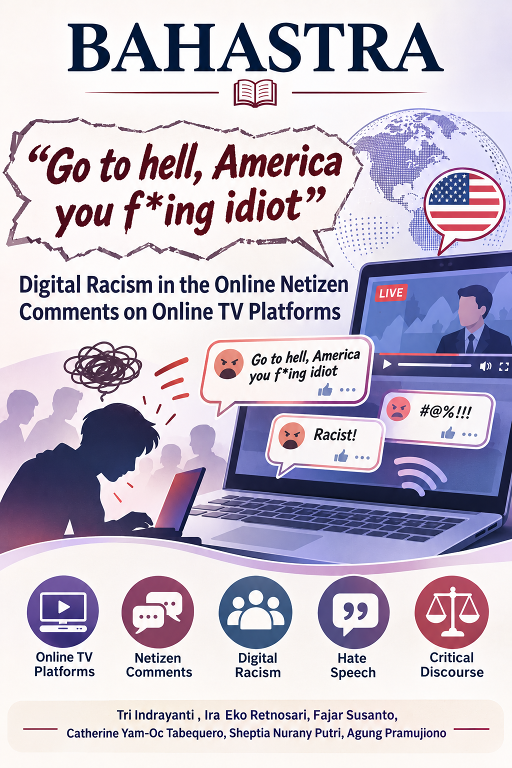
“Go to hell, America you f*ing idiot" digital racism in the online netizen comments on online TV platforms
DOI:
https://doi.org/10.26555/bs.v46i3.1964Keywords:
Critical Discourse Analysis, Digital Racism, Netizen Language, Online TVAbstract
This study aims to uncover the construction of digital racism in the comment sections of online TV platforms and explain the mechanisms of reproduction of discriminatory ideologies through language practices in the digital public sphere. The study uses a qualitative approach with van Dijk's Critical Discourse Analysis method, which integrates text structure analysis, social cognition, and social context. Data in the form of netizen comments that appeared in real time during international sports broadcasts were collected through non-participant observation, documented, and then analyzed through thematic coding, categorization of racist speech forms, and critical interpretation of linguistic aspects, ideology, and digital media characteristics. The results show that digital racism is present not only in the form of explicit hate speech, but also through more subtle discursive strategies, such as labeling racial and national identities, stereotypes based on physical characteristics, the use of pejorative diction, dehumanizing metaphors, irony, and humor that normalize discriminatory practices. The reproduction of racism is reinforced by the repetition of comments, affirmations between users, account anonymity, the speed of interaction, and weak content moderation so that racist speech is perceived as a normal part of match commentary culture. These findings confirm that language in digital spaces is not neutral, but rather serves to construct and legitimize racist ideologies through everyday communication practices. This research contributes to the development of critical linguistics and digital racism studies and emphasizes the importance of critical digital literacy, language ethics, and content moderation in creating an inclusive online public space.
References
Arneback, E., & Jämte, J. (2022). How to counteract racism in education–A typology of teachers’ anti-racist actions. Race Ethnicity and Education, 25(2), 192–211. https://doi.org/10.1080/13613324.2021.1890566
Arneback, E., & Quennerstedt, A. (2016). Locations of racism in education: A speech act analysis of a policy chain. Journal of Education Policy, 31(6), 773–788. https://doi.org/10.1080/02680939.2016.1185670
Balfour, V. H. (2020). Likes, comments, action! An examination of the facebook audience engagement strategies used by strategic impact documentary. Media International Australia, 176(1), 34–51. SAGE Publications. https://doi.org/10.1177/1329878X19897416
Banga, S. (2024). Theorising racist hate speech on UK university campuses through a CRT lens. Whiteness and Education, 9(1), 68–81. https://doi.org/10.1080/23793406.2023.2173638
Ben, J., & Elias, A. (2024). Pandemic racism in Australia: A systematic review. Journal of Intercultural Studies, 45(3), 392–413. https://doi.org/10.1080/07256868.2023.2298325
Ben, J., Elias, A., Sharples, R., Dunn, K., Truong, M., Mansouri, F., Denson, N., Walton, J., & Paradies, Y. (2024). Racism data in Australia: A review of quantitative studies and directions for future research. Journal of Intercultural Studies, 45(2), 228–257. https://doi.org/10.1080/07256868.2023.2254725
Billig, M. (2001). Humour and hatred: The racist jokes of the Ku Klux Klan. Discourse & Society, 12((3)), 267–289. https://doi.org/10.1177/0957926501012003001
Bonilla-Silva, E. (2014). Racism without racists: Color-blind racism and the persistence of racial inequality in America. Rowman & Littlefield Publishers.
Bourdieu, P. (1991). Language and symbolic power. Harvard University Press.
Burç, R., Yanaşmayan, Z., Rischke, R., Sinanoğlu, C., & Yula, E. (2025). Navigating simultaneous racisms: Intersecting experiences of in/visibility and antiracist strategies among Turkey-originated communities in Germany. Ethnic and Racial Studies, 9870, 1–19. https://doi.org/10.1080/01419870.2025.2544374
Celikates, R. (2025). From “Xenophobia” to structural racism, and back? Epistemic obstacles, conceptual struggles, and the role of critical theory. Ethnic and Racial Studies, 48(7), 1338–1356. https://doi.org/10.1080/01419870.2024.2446488
Clarkson, B. G., Parry, K. D., Sawiuk, R., Grubb, L., & Kavanagh, E. (2025). Transforming the English coaching landscape: Black women football coaches’ acts of resistance against racism and sexism. Managing Sport and Leisure, 30(2), 156–171. https://doi.org/10.1080/23750472.2022.2148720
Ellefsen, R., Banafsheh, A., & Sandberg, S. (2022). Resisting racism in everyday life: From ignoring to confrontation and protest. Ethnic and Racial Studies, 45(16), 435–457. https://doi.org/10.1080/01419870.2022.2094716
Essed, P. (1991). Understanding everyday racism: An interdisciplinary theory. SAGE Publications. https://doi.org/10.4135/9781483345239
Fairclough, N. (1995). Critical discourse analysis: The critical study of language. Longman.
Gavra, D. P., & Bykova, E. V. (2023). The рast as a reflection of the political present: M.S. Gorbachev in posthumous comments by the Russian online audience. In Memoirs of NovSU (Issue 6, pp. 550–562). Yaroslav-the-Wise Novgorod State University. https://doi.org/10.34680/2411-7951.2023.6(51).550-562
Gebhard, A., Novotna, G., Carter, H., & Oba, F. (2023). Racism plays a disappearing act: Discourses of denial in one anti-discrimination campaign in higher education. Whiteness and Education, 8(2), 229–247. https://doi.org/10.1080/23793406.2022.2072760
Habermas, J. (1984). The theory of communicative action. Beacon Press.
Hall, S. (1997). Representation: Cultural representations and signifying practices. Sage.
Jackson, A., Yerena, A., Lee, A., Garcia-Zambrana, I., Chrissinger, B., Harjo, L., & Harwood, S. (2023). Anti-racist futures: Disrupting racist planning practices in workplaces, institutions, and communities: Introduction to the special issue. Journal of the American Planning Association, 89(4), 411–422. https://doi.org/10.1080/01944363.2023.2244850
Kähäri, O. (2025). “Not by preaching” but storytelling: Anti-racist podcast production in Finland in the European context. Ethnic and Racial Studies, 9870, 1–18. https://doi.org/10.1080/01419870.2025.2531300
Kamp, A., Sharples, R., Vergani, M., & Denson, N. (2024). Asian Australian’s experiences and reporting of racism during the covid-19 pandemic. Journal of Intercultural Studies, 45(3), 452–472. https://doi.org/10.1080/07256868.2023.2290676
KhosraviNik, M. (2017). Social media critical discourse studies (SM-CDS). Critical Discourse Studies, 14((4)), 329–343. https://doi.org/10.4324/9781315739342-40
Kim, T. J., & Steinhilper, E. (2025). On the limits of antiracism: How antiracist opposition is connected to racism denial in Germany. Ethnic and Racial Studies, 9870, 1–19. https://doi.org/10.1080/01419870.2025.2508392
Nakamura, L. (2013). Cybertypes: Race, ethnicity, and identity on the Internet. Routledge. https://doi.org/10.4324/9780203699188
O’Neill, S. (2025). Racially minoritised students’ strategies for navigating and resisting racism in higher education. Ethnic and Racial Studies, 48(5), 997–1018. https://doi.org/10.1080/01419870.2024.2337047
Ortiz, S. M. (2020). Racists without racism? From colourblind to entitlement racism online. Ethnic and Racial Studies, 44(14), 2637–2657. Informa UK Limited. https://doi.org/10.1080/01419870.2020.1825758
Petrucelli, J. (2020). Introduction: Can we speak to the ism in racism? Changing the conversation1. Contemporary Psychoanalysis, 56(2–3), 191–200. https://doi.org/10.1080/00107530.2020.1778993
Peucker, M., Clark, T., & Claridge, H. (2024). Mapping the journey of (non-) reporting in response to racism: A change-oriented approach to reporting barriers, motives, and support needs. Journal of Intercultural Studies, 45(3), 473–493. https://doi.org/10.1080/07256868.2023.2296026
Piwoni, E. (2025). “Don’t complain. Adapt. Be successful”: How highly educated, middle-class Germans of Polish, Turkish, and sub-Saharan African background respond to racism. Ethnic and Racial Studies, 9870, 1–18. https://doi.org/10.1080/01419870.2025.2529413
Rattansi, A. (2020). 1. ‘Race’ and racism: Some conundrums. Racism: A Very Short Introduction (pp. 1–9). Oxford University Press. https://doi.org/10.1093/actrade/9780198834793.003.0001
Schols, H., & Maussen, M. (2025). Changing conceptions of racism in the Netherlands: From interpersonal bias to racism as institutional. Ethnic and Racial Studies, 9870, 1–19. https://doi.org/10.1080/01419870.2025.2549367
Suler, J. (2004). The online disinhibition effect. CyberPsychology & Behavior, 7((3)), 321–326. https://doi.org/10.1089/1094931041291295
Tajfel, H., & Turner, J. C. (1986). The social identity theory of intergroup behavior. Psychology of Intergroup Relations.
Temmerman, M., & Mast, J. (2020). Introduction: News values from an audience perspective. In News Values from an Audience Perspective (pp. 1–13). Springer International Publishing. https://doi.org/10.1007/978-3-030-45046-5_1
van Dijk, T. A. (1998). Ideology: A multidisciplinary approach. SAGE Publications.
van Dijk, T. A. (2008). Discourse and power. Palgrave Macmillan UK. https://doi.org/10.1007/978-1-137-07299-3
Virdee, S. (2025). The contemporary left, racialised capitalism, and ending racism. Ethnic and Racial Studies, 9870(May), 1–7. https://doi.org/10.1080/01419870.2025.2508943
Wang, M., & Li, D. (2020). What motivates audience comments on live streaming platforms? In PLOS ONE (Vol. 15, Issue 4). Public Library of Science (PLoS). https://doi.org/10.1371/journal.pone.0231255
Wong, B., Elmorally, R., Copsey-Blake, M., Highwood, E., & Singarayer, J. (2021). Is race still relevant? Student perceptions and experiences of racism in higher education. Cambridge Journal of Education, 51(3), 359–375. https://doi.org/10.1080/0305764X.2020.1831441
Young, J. (2022). The taxonomy of online racism for critical race media literacy: Applications for social studies education research and practice. Proceedings of the 2022 AERA Annual Meeting. AERA. https://doi.org/10.3102/1893494
Additional Files
Published
Issue
Section
License
Copyright (c) 2026 Tri Indrayanti

This work is licensed under a Creative Commons Attribution-ShareAlike 4.0 International License.