Identification of metacognition skills of physics education students in magnetic electricity courses
DOI:
https://doi.org/10.12928/jrkpf.v13i1.1831Keywords:
Evaluation, Magnetic electricity, Metacognition, Planning, MonitoringAbstract
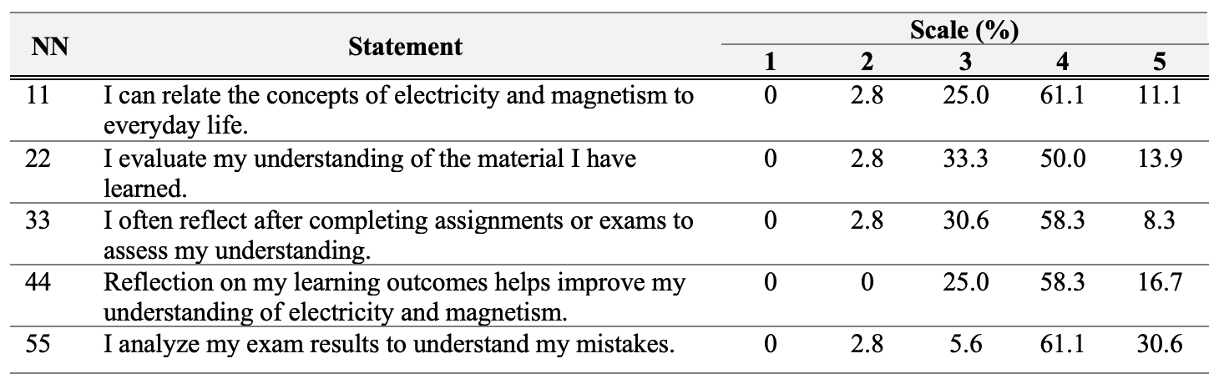
Metacognition is the ability to plan, monitor, and evaluate. Metacognition has a significant role in obtaining information, understanding, reading, solving problems, and controlling oneself. In physics learning, metacognitive skills are important because they help students understand complex concepts, including those in electricity and magnetism. These topics are essential in physics but often difficult for students since they involve abstract ideas. This study aims to identify the metacognition ability of physics education students in the electricity and magnetism course. The survey method was used in this research. The data collection technique used a questionnaire through Google Forms. In this study, the instrument used was a closed-ended questionnaire. The sampling technique used was simple random sampling. The percentage of planning ability: 58.30%, mostly answered 'doubtful'; monitoring ability: 58.30%, mostly answered 'agree'; and evaluation ability: 61.10%, mostly answered 'agree'. This percentage was obtained from the data of 36 respondents. In conclusion, students demonstrate varying levels of metacognitive abilities, with stronger monitoring and evaluation skills but weaker planning skills. Practically, these findings imply the need for instructional strategies that explicitly support the development of students' planning abilities in physics learning.
References
[1] M. F. Teng, C. Qin, and C. Wang, "Validation of metacognitive academic writing strategies and the predictive effects on academic writing performance in a foreign language context," Metacognition and Learning, vol. 17, no. 1, pp. 167-190, 2022. doi: https://doi.org/10.1007/s11409-021-09278-4
[2] M. Ishak, I. Oderinde, and S. Ahmad, "The role of metacognitive strategies in enhancing learning outcomes and educational efficiency: A systematic review of quantitative, qualitative and mixed-method studies," International Journal of Academic Research in Business and Social Sciences, vol. 15, no. 4, pp. 81-101, 2025. doi: https://doi.org/10.6007/IJARBSS/v15-i4/24964
[3] G. Taasoobshirazi and J. Farley, "A multivariate model of physics problem solving," Learning and Individual Differences, vol. 24, pp. 53-62, 2013. doi: https://doi.org/10.1016/j.lindif.2012.05.001
[4] C. D. Zepeda, J. E. Richey, P. Ronevich, and T. J. Nokes-Malach, "Direct instruction of metacognition benefits adolescent science learning, transfer, and motivation: An in vivo study," Journal of Educational Psychology, vol. 107, no. 4, pp. 954-970, 2015. doi: https://doi.org/10.1037/edu0000022
[5] J. L. Docktor and J. P. Mestre, "Synthesis of discipline-based education research in physics," Physical Review Special Topics-Physics Education Research, vol. 10, no. 2, pp. 201-212, 2014. doi: https://doi.org/10.1103/PhysRevSTPER.10.020119
[6] I. Galili, "Physics and mathematics as interwoven disciplines in science education," Science & Education, vol. 27, no. 1, pp. 7-37, 2018. doi: https://doi.org/10.1007/s11191-018-9958-y
[7] Á. Suárez, A. C. Martí, K. Zuza, and J. Guisasola, "Electromagnetic field presented in introductory physics textbooks and consequences for its teaching," Physical Review Physics Education Research, vol. 19, no. 2, pp. 201-210, 2023. doi: https://doi.org/10.1103/PhysRevPhysEducRes.19.020113
[8] M. Frodyma and S. Rosas, "Using symmetry and invariance to solve problems in elementary physics," The Physics Teacher, vol. 57, no. 7, pp. 475-477, 2019. doi: https://doi.org/10.1119/1.5126828
[9] E. Purwaningsih, "The role of metacognition in character education: A case study on students' moral and ethical formation strategies," Society, vol. 12, no. 1, pp. 1-13, 2024. doi: https://doi.org/10.33019/society.v12i1.617
[10] U. Azizah and H. Nasrudin, "Metacognitive skills and self-regulated learning in prospective chemistry teachers: Role of metacognitive skill-based teaching materials," Journal of Turkish Science Education, vol. 18, no. 3, pp. 461-476, 2021. doi: https://doi.org/10.36681/tused.2021.84
[11] Y. J. Dori, Z. R. Mevarech, and D. R. Baker, D. R. (Eds.), "Cognition, metacognition, and culture in STEM education," Springer, 2018. doi: https://doi.org/10.1007/978-3-319-66659-4
[12] E. Dessie, D. Gebeyehu, and F. Eshetu, "Enhancing critical thinking, metacognition, and conceptual understanding in introductory physics: The impact of direct and experiential instructional models," Eurasia Journal of Mathematics, Science and Technology Education, vol. 19, no. 7, pp. 2287-2298, 2023. doi: https://doi.org/10.29333/ejmste/13273
[13] E. Dessie, D. Gebeyehu, and F. Eshetu, "Motivation, conceptual understanding, and critical thinking as correlates and predictors of metacognition in introductory physics," Cogent Education, vol. 11, no. 1, pp. 229-237, 2024. doi: https://doi.org/10.1080/2331186X.2023.2290114
[14] G. Falloon, "Using simulations to teach young students science concepts: An experiential learning theoretical analysis," Computers & Education, vol. 135, pp. 138-159, 2019. doi: https://doi.org/10.1016/j.compedu.2019.03.001
[15] M. U. Badolo, M. A. Malik, R. A. Nur, and A. Latifa, "The impact of metacognitive strategy training on higher-order thinking skills (HOTS) in high school mathematics: A quasi-experimental study," International Journal of Environment, Engineering and Education, vol. 7, no. 2, pp. 146-157, 2025. doi: https://doi.org/10.55151/ijeedu.v7i2.302
[16] N. Osman, S. N. D. Mahmud, and N. M. Arsad, "A systematic review of metacognitive dynamics in secondary physics education," International Journal of Evaluation and Research in Education, vol. 14, no. 5, pp. 3859-3871, 2025. doi: https://doi.org/10.11591/ijere.v14i5.32722
[17] A. Zohar and S. Barzilai, "A review of research on metacognition in science education: Current and future directions," Studies in Science Education, vol. 49, no. 2, pp. 121-169, 2013. doi: https://doi.org/10.1080/03057267.2013.847261
[18] N. S. Wilson and H. Bai, "The relationships and impact of teachers' metacognitive knowledge and pedagogical understandings of metacognition," Metacognition and Learning, vol. 5, no. 3, pp. 269-288, 2010. doi: https://doi.org/10.1007/s11409-010-9062-4
[19] S. Yerdelen-Damar and A. Eryılmaz, "Promoting conceptual understanding with explicit epistemic intervention in metacognitive instruction: Interaction between the treatment and epistemic cognition," Research in Science Education, vol. 51, no. 2, pp. 547-575, 2021. doi: https://doi.org/10.1007/s11165-018-9807-7
[20] M. Modi, "Meta-cognition-driven problem solving in physics education," Graduate Journal of Interdisciplinary Research, Reports and Reviews, vol. 2, no. 2, pp. 110-118, 2024. doi: https://doi.org/10.34256/gjir3.v2i02.32
[21] L. D. McDowell, "The roles of motivation and metacognition in producing self-regulated learners of college physical science: a review of empirical studies," International Journal of Science Education, vol. 41, no. 17, pp. 2524-2541, 2019. doi: https://doi.org/10.1080/09500693.2019.1689584
[22] K. T. Kotsis, "Physics education in EU high schools: Knowledge, curriculum, and student understanding," European Journal of Contemporary Education and E-Learning, vol. 2, no. 4, pp. 28-38, 2024. doi: https://doi.org/10.59324/ejceel.2024.2(4).03
[23] A. Madsen, S. B. McKagan, and E. C. Sayre, "Best practices for administering attitudes and beliefs surveys in physics," The Physics Teacher, vol. 58, no. 2, pp. 90-93, 2020. doi: https://doi.org/10.1119/1.5144786
[24] H. K. Mohajan, "Quantitative research: A successful investigation in natural and social sciences," Journal of Economic Development, Environment and People, vol. 9, no. 4, pp. 50-79, 2020. doi: https://doi.org/10.26458/jedep.v9i4.679
[25] M. Briggs, "Comparing academically homogeneous and heterogeneous groups in an active learning physics class," Journal of College Science Teaching, vol. 49, no. 6, pp. 76-82, 2020. doi: https://doi.org/10.1080/0047231X.2020.12290667
[26] S. P. Chand, "Methods of data collection in qualitative research: Interviews, focus groups, observations, and document analysis," Advances in Educational Research and Evaluation, vol. 6, no. 1, pp. 303-317, 2025. doi: https://doi.org/10.25082/AERE.2025.01.001
[27] C. F. J. Pols, P. J. J. M. Dekkers, and M. J. De Vries, "What do they know? Investigating students' ability to analyse experimental data in secondary physics education," International Journal of Science Education, vol. 43, no. 2, pp. 274-297, 2021. doi: https://doi.org/10.1080/09500693.2020.1865588
[28] D. Sapitri and S. Indriyati, "Analysis of the use of discussion and question and answer methods as an effort to improve student physics learning outcomes," International Journal of Education and Teaching Zone, vol. 2, no. 2, pp. 188-199, 2023. doi: https://doi.org/10.57092/ijetz.v2i2.63
[29] Suryadi, I. K. Mahardika, Supeno, and Sudarti, "Data literacy of high school students on physics learning," Journal of Physics: Conference Series, vol. 1839, no. 1, pp. 1-10, 2021. doi: https://doi.org/10.1088/1742-6596/1839/1/012025
[30] A. H. Subarjo, N. D. Retnowati, and H. Putranta, "Development of QR Code based archipelago insight media to improve students' conceptual understanding," Jurnal Lemhannas RI, vol. 13, no. 4, pp. 577-591, 2025. doi: https://doi.org/10.55960/jlri.v13i4.1185
[31] S. Kavousi, P. A. Miller, and P. A. Alexander, "Modeling metacognition in design thinking and design making," International Journal of Technology and Design Education, vol. 30, no. 4, pp. 709-735, 2020. doi: https://doi.org/10.1007/s10798-019-09521-9
[32] J. E. R. Marantika, "Metacognitive ability and autonomous learning strategy in improving learning outcomes," Journal of Education and Learning (EduLearn), vol. 15, no. 1, pp. 88-96, 2021. doi: https://doi.org/10.11591/edulearn.v15i1.17392
[33] H. Kallio, K. Virta, and M. Kallio, "Modelling the components of metacognitive awareness," International Journal of Educational Psychology, vol. 7, no. 2, pp. 94-122, 2018. doi: https://doi.org/10.17583/ijep.2018.2789
[34] M. Asy'ari, and M. Ikhsan, "The effectiveness of inquiry learning model in improving prospective teachers' metacognition knowledge and metacognition awareness," International Journal of Instruction, vol. 12, no. 2, pp. 455-470, 2019. doi: https://doi.org/10.29333/iji.2019.12229a
[35] H. Bae and K. Kwon, "Developing metacognitive skills through class activities: What makes students use metacognitive skills?," Educational Studies, vol. 47, no. 4, pp. 456-471, 2021. doi: https://doi.org/10.1080/03055698.2019.1707068
[36] D. R. Diya and H. Putranta, "Identifying the conceptual understanding of undergraduate physics students in solving basic physics problems: A descriptive quantitative study," Journal of Mathematics Science and Computer Education, vol. 5, no. 2, pp. 98-114, 2025. doi: https://doi.org/10.20527/jmscedu.v5i2.14585
[37] N. Ropi'i, S. E. Nugroho, and E. Ellianawati, "Analysis of physics problem solving skills of junior high school students through PBL-HOTS on magnetism material," Physics Communication, vol. 9, no. 1, pp. 27-39, 2025. doi: https://doi.org/10.15294/pc.v9i1.1821
[38] E. Ince, "An overview of problem solving studies in physics education," Journal of Education and Learning, vol. 7, no. 4, pp. 191-200, 2018. doi: https://doi.org/10.5539/jel.v7n4p191
[39] A. Kızılaslan and M. Tunagür, "Dyslexia and working memory: understanding reading comprehension and high level language skills in students with dyslexia," Kastamonu Education Journal, vol. 29, no. 5, pp. 941-952, 2021. doi: https://doi.org/10.24106/kefdergi.741028
[40] H. Putranta, "Enhancing critical thinking through Kahoot-based digital learning: A meta-analytical study in physics education," SAR Journal-Science and Research, vol. 8, no. 4, pp. 382-394, 2025. doi: https://doi.org/10.18421/SAR84-10
[41] M. Jamil, F. A. Hafeez, and N. Muhammad, "Critical thinking development for 21st century: Analysis of physics curriculum," Journal of Social & Organizational Matters, vol. 3, no. 1, pp. 1-10, 2024. doi: https://doi.org/10.56976/jsom.v3i1.45
[42] N. Gumisirizah, C. M. Muwonge, and J. Nzabahimana, "Effect of problem-based learning on students' problem-solving ability to learn physics," Physics Education, vol. 59, no. 1, pp. 150-159, 2024. doi: https://doi.org/10.1088/1361-6552/ad0577
[43] M. Salam, L. Misu, U. Rahim, N. Hindaryatiningsih, and A. R. A. Ghani, "Strategies of metacognition based on behavioural learning to improve metacognition awareness and mathematics ability of students," International Journal of Instruction, vol. 13, no. 2, pp. 61-72, 2020. doi: https://doi.org/10.29333/iji.2020.1325a
[44] H. Putranta and F. Afifah, "Development of the four-tier diagnostic test to identify student misconceptions in the static fluids chapter," Journal on Efficiency and Responsibility in Education and Science, vol. 18, no. 4, pp. 268-281, 2025. doi: https://doi.org/10.7160/eriesj.2025.180403
[45] P. Güner and H. N. Erbay, "Metacognitive skills and problem-solving," International Journal of Research in Education and Science, vol. 7, no. 3, pp. 715-734, 2021. doi: https://doi.org/10.46328/ijres.1594
[46] Ö. Akman and B. Alagöz, "Relation between metacognitive awareness and participation to class discussion of university students," Universal Journal of Educational Research, vol. 6, no. 1, pp. 11-24, 2018. doi: https://doi.org/10.13189/ujer.2018.060102
[47] C. H. Padmanabha, "Metacognition: conceptual framework," Journal on Educational Psychology, vol. 14, no. 1, pp. 1-11, 2020. doi: https://doi.org/10.26634/jpsy.14.1.16710
[48] A. Mbonyiryivuze, L. L. Yadav, and M. M. Amadalo, "Physics students' conceptual understanding of electricity and magnetism in nine years basic education in Rwanda," European Journal of Educational Research, vol. 11, no. 1, pp. 83-101, 2020. doi: https://doi.org/10.12973/eu-jer.11.1.83
[49] A. Maries, M. J. Brundage, and C. Singh, "Using the conceptual survey of electricity and magnetism to investigate progression in student understanding from introductory to advanced levels," Physical Review Physics Education Research, vol. 18, no. 2, pp. 201-211, 2022. doi: https://doi.org/10.1103/PhysRevPhysEducRes.18.020114
[50] M. Furqon, P. Sinaga, and L. S. Riza, "Analyzing critical thinking skills of physics preservice teachers on electricity and magnetism," Jurnal Penelitian Pendidikan IPA, vol. 9, no. 6, pp. 4477-4483, 2023. doi: https://doi.org/10.29303/jppipa.v9i6.3581
Downloads
Published
Issue
Section
License
Copyright (c) 2026 Rahmadhanti, Himawan Putranta

This work is licensed under a Creative Commons Attribution-NonCommercial 4.0 International License.