Trends in islamic astronomy research: Bibliometric analysis of scopus publications
DOI:
https://doi.org/10.12928/jrkpf.v13i1.1800Keywords:
Islamic astronomy, Bibliometrics, Publication trends, VOSviewerAbstract
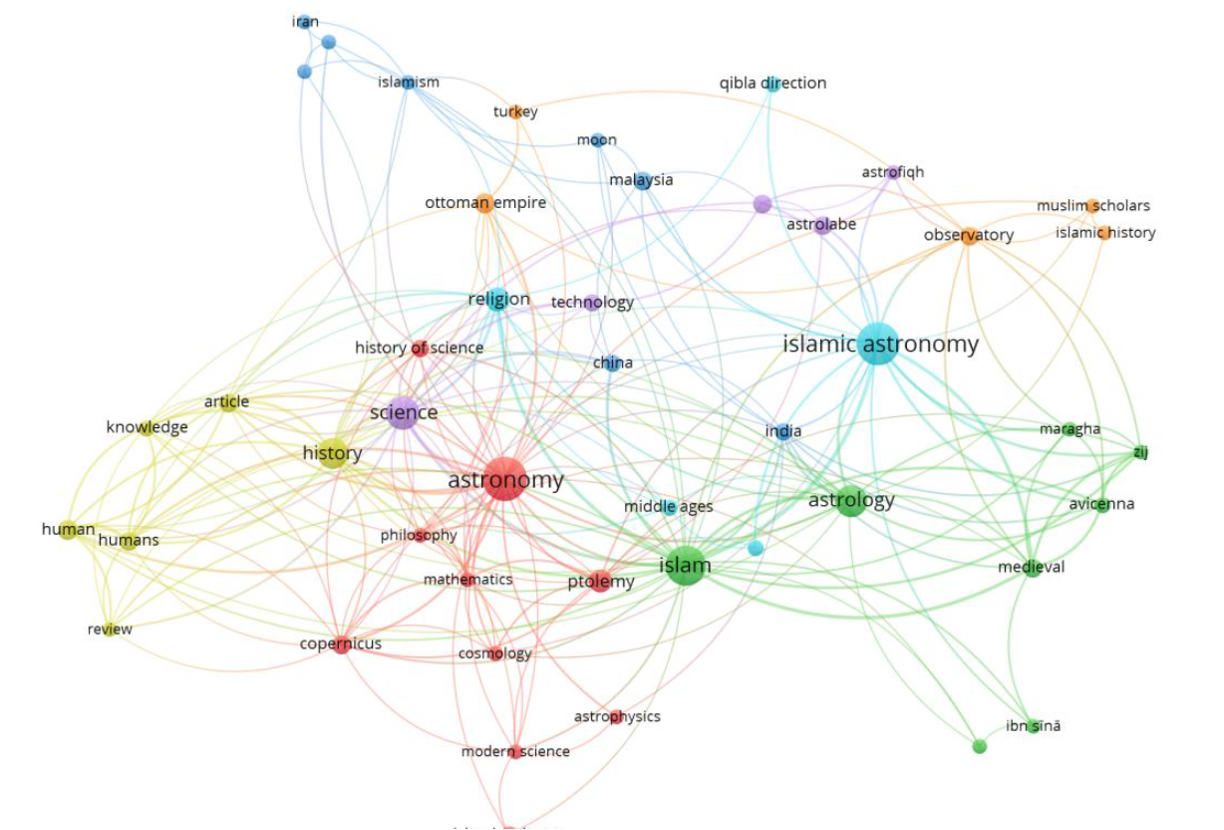
This study aims to provide a comprehensive overview of scientific research trends in the field of Islamic astronomy over the past two decades, namely from 2006 to 2025. To achieve this goal, the approach used is bibliometric analysis by utilizing publication data from the Scopus database. This study maps the extent to which the topic of Islamic astronomy has been studied, who the most active authors are, what journals contain the most related articles, and what keywords are often used in publications. Data were collected using keywords relevant to Islamic astronomy and filtered based on document type, language, and content relevance. Analysis was conducted using VOSviewer software to visualize the relationships between data, such as authors, institutions, keywords, and emerging themes. The results show that the trend of Islamic astronomy publications has increased significantly, especially in the last five years. Some journals and authors appear to be the most productive, such as the Archive for History of Exact Sciences and author Mozaffari. In terms of themes, Islamic astronomy research is divided into several clusters, ranging from philosophy of science, history of figures and manuscripts, to religious practices. In addition, there are also new trends such as the digitization of manuscripts and Islamic astronomy education that emerged after 2020. This study is expected to be an initial reference for novice researchers who want to explore Islamic astronomy and understand the direction and opportunities for future development of this topic.
References
[1] L. Jaeger and M. Dacorogna, "Astronomical Research," in Where Is Science Leading Us?, Cham: Springer Nature Switzerland, 2023, pp. 259-278. doi: https://doi.org/10.1007/978-3-031-47138-4_12
[2] L. Taub, "Astronomy in Its Contexts," in The Cambridge Companion to Ancient Greek and Roman Science, Cambridge University Press, 2020, pp. 208-228. doi: https://doi.org/10.1017/9781316136096.011
[3] M. I. Aziz and A. Musta'id, "Islamic Astronomy of Abbasid Era (750-1258 AD)," J. Islam. Hist. Manuscr., vol. 1, no. 1, pp. 35-52, Jun. 2022, doi: https://doi.org/10.24090/jihm.v1i1.5944
[4] A. Anwar, B. Bukhari, and A. Mardika, "Bridging Law and Astronomy: The Influence of Astronomy on Islamic Law," Astroislamica J. Islam. Astron., vol. 3, no. 2, pp. 156-170, Dec. 2024, doi: https://doi.org/10.47766/astroislamica.v3i2.3646
[5] E. Sururi and A. Laili, "Penentuan Awal Waktu Sholat Sebagai Syarat Sah Sholat," Fakta Forum Aktual Ahwal Al-Syakhsiyah, vol. 1, no. 2, pp. 37-40, Aug. 2023, doi: https://doi.org/10.28926/fakta.v1i2.1344
[6] Z. Zainuddin, M. Misbah, M. Mastuang, Q. Qamariah, M. Z. Bin Amiruddin, and N. F. A. Rahman, "Mapping a Decade of Research on Artificial Intelligence and Augmented Reality in Physics Education: A Bibliometric Analysis (2016-2025)," Online Learn. Educ. Res., vol. 5, no. 2, pp. 537-557, Dec. 2025, doi: https://doi.org/10.58524/oler.v5i2.901
[7] M. Z. Abidin, S. I. Ahmad, and N. D. A. Majid, "Bibliometric analysis of global research trends on the risks of hydrogen in Scopus database," 2025, p. 020037. doi: https://doi.org/10.1063/5.0212508
[8] C. M. Darie, "The Link between Business Benefits and ERP Systems: A Bibliometric Analysis," Proc. Int. Conf. Bus. Excell., vol. 17, no. 1, pp. 1957-1966, Jul. 2023, doi: https://doi.org/10.2478/picbe-2023-0172
[9] A. Kumari, R. Nagina, M. Paruthi, and H. Das Gupta, "A Bibliometric Analysis of Sustainability Literature: Benefits, Implications and Future Trends," in Securing the Future through Sustainability, Health, Education, and Technology, London: Routledge, 2024, pp. 1-22. doi: https://doi.org/10.1201/9781003587200-1
[10] W. Q. de F. Cavalcante, A. Coelho, and C. M. Bairrada, "Sustainability and Tourism Marketing: A Bibliometric Analysis of Publications between 1997 and 2020 Using VOSviewer Software," Sustainability, vol. 13, no. 9, p. 4987, Apr. 2021, doi: https://doi.org/10.3390/su13094987
[11] I. A. Ibrahim, M. R. Ahmad, M. H. Safiai, and W. K. Mujani, "Islamic astronomy and the establishment of Al-Khawarizmi complex in Malaysia," Adv. Nat. Appl. Sci., vol. 6, no. 3, pp. 316-320, 2012, [Online]. Available: https://www.scopus.com/inward/record.uri?eid=2-s2.0-84860861221&partnerID=40&md5=cbb9bdd5999e715b153d2bac9189e92d
[12] I. A. Ibrahim et al., "Observatories in Malaysia: Descendants of islamic civilization superiority," Int. J. Civ. Eng. Technol., vol. 8, no. 12, pp. 782-795, 2017, [Online]. Available: https://www.scopus.com/inward/record.uri?eid=2-s2.0-85040708494&partnerID=40&md5=4772bac5021cbd86f64d17b3b0022595
[13] M. Fleer, The Role of Imagination in STEM Concept Formation. BRILL, 2022. doi: https://doi.org/10.1163/9789004520066
[14] M. Americo, "Theory as an Inclusive Pedagogical Tool: Postcolonial Theory and the Greco-Arabic Translation Movement in Today's Ancient History Classrooms," Class. World, vol. 115, no. 3, pp. 291-318, Mar. 2022, doi: https://doi.org/10.1353/clw.2022.0011
[15] N. F. Ngadiman, N. N. M. Shariff, and Z. S. Hamidi, "Zenithal Sky Brightness Measurement at Selangor Observatory," J. Phys. Conf. Ser., vol. 1768, no. 1, p. 012015, Jan. 2021, doi: https://doi.org/10.1088/1742-6596/1768/1/012015
[16] M. Maskufa, S. Sopa, S. Hidayati, and A. Damanhuri, "Implementation of the New MABIMS Crescent Visibility Criteria: Efforts to Unite the Hijriyah Calendar in the Southeast Asian Region," AHKAM J. Ilmu Syariah, vol. 22, no. 1, Jun. 2022, doi: https://doi.org/10.15408/ajis.v22i1.22275
[17] M. Marwadi, "Renewing the Thoughts of the Hijri Calendar of Muhammadiyah, Nahdlatul Ulama and Persatuan Islam and Its Implications for Realization of National Hijri Calendar," Al-Manahij J. Kaji. Huk. Islam, vol. 15, no. 1, pp. 19-36, Jun. 2021, doi: https://doi.org/10.24090/mnh.v15i1.4870
[18] M. S. Faid, M. S. A. M. N., M. H. Mohd Saadon, N. Ahmad, and A. Ali @ Mat Zin, "Islamic Historical Review on Middle Age Lunar Crescent Visibility Criterion," J. Al-Tamaddun, vol. 17, no. 1, pp. 109-125, Jun. 2022, doi: https://doi.org/10.22452/JAT.vol17no1.9
[19] G. Van Brummelen, The Doctrine of Triangles: A History of Modern Trigonometry. Canada: Princeton University Press, 2021, [Online]. Available: https://www.scopus.com/inward/record.uri?eid=2-s2.0-85133028090&partnerID=40&md5=0f293d1aee059853edf6c42ef0bb71a2
[20] J. M. Determann, Islam, Science Fiction and Extraterrestrial Life. I.B. Tauris, 2021. doi: https://doi.org/10.5040/9780755601288
[21] M. Mehfooz and A. S. Syed, "The Development of Science and Technology in the Muslim World: Past and Present Issues with Possible Resolutions," Islam. Stud., vol. 59, no. 2, pp. 225-238, 2020, [Online]. Available: https://www.scopus.com/inward/record.uri?eid=2-s2.0-85150384600&partnerID=40&md5=4808e39a672f1bdc24d9b6af10e603f6
[22] F. Ozcep, "Physical earth and its sciences in Istanbul: a journey from pre-modern (Islamic) to modern times," Hist. Geo. Space Sci., vol. 11, no. 2, pp. 173-198, Aug. 2020, doi: https://doi.org/10.5194/hgss-11-173-2020
[23] G. Zotti and S. M. Mozaffari, "New Light on the Main Instrument of the Samarqand Observatory," J. Hist. Astron., vol. 51, no. 3, pp. 255-271, Aug. 2020, doi: https://doi.org/10.1177/0021828620943986
[24] A. M. Mulyadi, "Taklif of Lunar and Solar Eclipse Prayers According to Fiqh and Scientific Perspective," AL-IHKAM J. Huk. Pranata Sos., vol. 14, no. 1, pp. 27-49, Jun. 2019, doi: https://doi.org/10.19105/al-lhkam.v14i1.1862
[25] S. M. Mozaffari, "The Orbital Elements of Venus in Medieval Islamic Astronomy: Interaction Between Traditions and the Accuracy of Observations," J. Hist. Astron., vol. 50, no. 1, pp. 46-81, Feb. 2019, doi: https://doi.org/10.1177/0021828618808877
[26] S. M. Mozaffari, "Ibn al-Zarqālluh's discovery of the annual equation of the Moon," Arch. Hist. Exact Sci., vol. 78, no. 3, pp. 271-304, May 2024, doi: https://doi.org/10.1007/s00407-023-00323-z
[27] S. Brentjes, "Teaching Mathematical and Astronomical Knowledge in Classical and Post-Classical Islamicate Societies," in Knowledge and Education in Classical Islam: Religious Learning between Continuity and Change (2 vols), BRILL, 2020, pp. 610-634. doi: https://doi.org/10.1163/9789004413214_028
[28] Y. Isahaya, "Islamicate Astral Sciences in Eastern Eurasia During the Mongol-Yuan Dynasty (1271-1368)1," in Routledge Handbook on the Sciences in Islamicate Societies, London: Routledge, 2023, pp. 688-695. doi: https://doi.org/10.4324/9781315170718-61
[29] C. P. E. Nothaft, "Criticism of trepidation models and advocacy of uniform precession in medieval Latin astronomy," Arch. Hist. Exact Sci., vol. 71, no. 3, pp. 211-244, May 2017, doi: https://doi.org/10.1007/s00407-016-0184-1
[30] P. Kamrani, I. Dorsch, and W. G. Stock, "Do researchers know what the h-index is? And how do they estimate its importance?," Scientometrics, vol. 126, no. 7, pp. 5489-5508, Jul. 2021, doi: https://doi.org/10.1007/s11192-021-03968-1
[31] H. P. Singh, "Alternative research bibliometrics: It's about quality and not quantity," Shoulder Elb., vol. 14, no. 2, pp. 121-122, Apr. 2022, doi: https://doi.org/10.1177/17585732211058453
[32] H. H. Bi, "Four problems of the h-index for assessing the research productivity and impact of individual authors," Scientometrics, vol. 128, no. 5, pp. 2677-2691, May 2023, doi: https://doi.org/10.1007/s11192-022-04323-8
[33] S. R. Mirnezami and C. Beaudry, "Does Experiencing International Research Collaboration Permanently Affect the Impact of Scientific Production? Evidence from Africa," J. Afr. Econ., vol. 31, no. 3, pp. 251-271, May 2022, doi: https://doi.org/10.1093/jae/ejab008
[34] J. Dua, V. K. Singh, and H. H. Lathabai, "Measuring and characterizing international collaboration patterns in Indian scientific research," Scientometrics, vol. 128, no. 9, pp. 5081-5116, Sep. 2023, doi: https://doi.org/10.1007/s11192-023-04794-3
[35] Z. Zhong, G. Zheng, and Y. Wang, "Impact of Transnational Research Collaboration on Universities' Innovation Performance: Panel Data Research of 64 Chinese Universities from 2009 to 2019," Sustainability, vol. 15, no. 1, p. 83, Dec. 2022, doi: https://doi.org/10.3390/su15010083
[36] X. Fu, X. (Maggie) Fu, P. Ghauri, and J. Hou, "International collaboration and innovation: Evidence from a leading Chinese multinational enterprise," J. World Bus., vol. 57, no. 4, p. 101329, Jun. 2022, doi: https://doi.org/10.1016/j.jwb.2022.101329
[37] A. Bardi, "Islamic Astronomy in Fifteenth-Century Christian Environments: Cardinal Bessarion and His Library," J. Islam. Stud., vol. 30, no. 3, pp. 338-366, Sep. 2019, doi: https://doi.org/10.1093/jis/etz013
[38] K. Kusdiyana, S. Samsudin, M. Buchori, and R. M. Syam, "A Comparative Study of Islamic Astronomy and Jurisprudence on the Qibla Direction of Historical Mosques in Cirebon Indonesia," J. Ilm. Mizani Wacana Hukum, Ekon. Dan Keagamaan, vol. 11, no. 2, p. 450, Oct. 2024, doi: https://doi.org/10.29300/mzn.v11i2.4902
[39] E. A. Rojak and R. Fawzi, "The Normative Basis of Islamic Astronomy For The Transformation of Prayer Schedules To Digital And Its Accuracy," El-Usrah J. Huk. Kel., vol. 7, no. 2, p. 602, Dec. 2024, doi: https://doi.org/10.22373/ujhk.v7i2.22097
[40] D. A. King, Islamic Astronomy and Geography. Taylor and Francis, 2022. [Online]. Available: https://www.scopus.com/pages/publications/85143921950. https://doi.org/10.4324/9781003278924-1
[41] F. Jamil Ragep, "Mathematics, the mathematical sciences, and historical contingency: Some thoughts on reading Netz," Interdiscip. Sci. Rev., vol. 47, no. 3-4, pp. 464-477, Oct. 2022, doi: https://doi.org/10.1080/03080188.2022.2108963
[42] Y. Mahdavi, "Abū Saʿīd Al-Siǧzī And The 'Structure Of The Orbs,' The Earliest Known Work On Hayʾa," Arab. Sci. Philos., vol. 31, no. 1, pp. 45-94, Mar. 2021, doi: https://doi.org/10.1017/S0957423920000089
[43] W. Hidayat and T. Ibrahim, "Implementing of Science-Social Integration in Islamic Education Learning," J. Pendidik. Islam, vol. 7, no. 1, pp. 1-16, Jun. 2021, doi: https://doi.org/10.15575/jpi.v7i1.12515
[44] M. A. Ma'arif, M. H. Rofiq, and A. Sirojuddin, "Implementing Learning Strategies for Moderate Islamic Religious Education in Islamic Higher Education," J. Pendidik. Islam, vol. 8, no. 1, pp. 75-86, Jun. 2022, doi: https://doi.org/10.15575/jpi.v8i1.19037
[45] U. A. Bukar, M. S. Sayeed, O. A. Amodu, S. F. A. Razak, S. Yogarayan, and M. Othman, "Leveraging VOSviewer approach for mapping, visualisation, and interpretation of crisis data for disaster management and decision-making," Int. J. Inf. Manag. Data Insights, vol. 5, no. 1, p. 100314, Jun. 2025, doi: https://doi.org/10.1016/j.jjimei.2024.100314
[46] Y. Gao, S. L. Wong, M. N. M. Khambari, N. bt Noordin, and J. Geng, "Sustaining E-Learning Studies in Higher Education: An Examination of Scientific Productions in Scopus between 2019 and 2021," Sustainability, vol. 14, no. 21, p. 14005, Oct. 2022, doi: https://doi.org/10.3390/su142114005
[47] Z. Allam, A. Sharifi, D. Giurco, and S. A. Sharpe, "On the Theoretical Conceptualisations, Knowledge Structures and Trends of Green New Deals," Sustainability, vol. 13, no. 22, p. 12529, Nov. 2021, doi: https://doi.org/10.3390/su132212529
[48] H. Omrany, R. Chang, V. Soebarto, Y. Zhang, A. Ghaffarianhoseini, and J. Zuo, "A bibliometric review of net zero energy building research 1995-2022," Energy Build., vol. 262, p. 111996, May 2022, doi: https://doi.org/10.1016/j.enbuild.2022.111996
[49] Syed M. Afraz Hassan Gillani, Aslan Bin Amat Senin, Jürgen Bode, Muniba, and Syed M. Ahmad Hassan Gillani, "Bibliometric Analysis of Digital Entrepreneurial Education and Student Intention; Reviewed and Analyzed by VOSViewer from Google Scholar," Int. J. Interact. Mob. Technol., vol. 16, no. 13, pp. 48-65, Jul. 2022, doi: https://doi.org/10.3991/ijim.v16i13.30619
[50] M. N. Amin, W. Ahmad, K. Khan, and M. M. Sayed, "Mapping Research Knowledge on Rice Husk Ash Application in Concrete: A Scientometric Review," Materials (Basel)., vol. 15, no. 10, p. 3431, May 2022, doi: https://doi.org/10.3390/ma15103431
Downloads
Published
Issue
Section
License
Copyright (c) 2026 Fitri Nur Hikmah, Moh. Irma Sukarelawan

This work is licensed under a Creative Commons Attribution-NonCommercial 4.0 International License.