Comparison of Proximate Composition of Coconut Dregs Flour Produced by Dry and Wet Processes as an Alternative to Wheat Flour
DOI:
https://doi.org/10.26555/ijce.v3i2.2046Keywords:
Coconut dreg flour, Drying, Gluten-free, RoastingAbstract
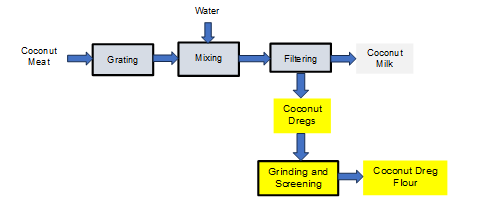
Currently, Indonesia relies on wheat imports to meet its domestic flour demand. In contrast, the country is rich in local agricultural resources, particularly coconuts. Substantial amounts of coconut dregs are discarded during the production of coconut milk and coconut oil, contributing to environmental pollution. This study explored the conversion of coconut dregs into flour using two processing methods: dry and wet. The dry method involved grating fresh coconut meat, roasting it at 80-100 °C, and pressing to extract the oil, producing coconut dregs as a byproduct. The wet method involved grating fresh coconut meat, mixing it with water, and filtering to make coconut milk, with the coconut dregs as a byproduct. Subsequently, the coconut dregs were dried by roasting (80-100 °C), then grinding and screening. Coconut dregs flour was subjected to proximate analysis to determine its water, ash, protein, fat, and carbohydrate content. In this study, a proximate analysis was conducted on wheat flour for comparison. Coconut dregs flour from the dry process contained 53.40% fat, 9.45% protein, and 32.62% carbohydrate. The wet process produced flour with a fat content of 36.47%, protein 0.36%, and carbohydrate 55.08%. The wheat flour contained 1.11-2.10% fat, 0.6-1.1% protein, and 84.28%-86.05% carbohydrate. Coconut dreg flour could be combined with other flours to create nutritious food options, thereby reducing reliance on wheat flour.
References
[1] I. Fadhlurrahman, Indonesia Impor 1 Juta Ton Gandum dan Meslin pada Juni 2025, https: databoks. katadata.co.id, 21 Agustus 2025.
[2] Ministry of Agriculture, The National Plantation Leading Statistics 2020-2022. Directorate General of Plantation, Jakarta, 2021.
[3] I. Purnamasari, M. Zamhari, and S. Putri, “Production of High Fiber Flour from Coconut Dregs by Vacuum Freeze Drying”, J. Kinetika, Vol. 12, No. 01, pp. 45-50, 2021.
[4] J.B. Adeloye, H. Osho, and L.O. Idris, “Defatted Coconut Flour Improved the Bioactive Components, Dietary Fiber, Antioxidant and Sensory Properties of Nixtamalized Maize Flour”. J. Agriculture and Food Research Vol 2, 100042, 2020.
[5] N. Kumolontang, “Coconut Flour as Partial Substituents in Making of White Bread”, J. Penelitian Teknologi Industri, Vol. 6 No. 2, pp. 63-79, 2014.
[6] L. Diasultra, and A. Thamrin, “Effect of Coconut Dreg (Cocos nucifera L) Substitution on Fiber Content and Nutritional Value of Cookies”, J. Riset Pangan, Vol. 3, No. 3, pp. 327-335, 2025.
[7] I.D. Kumalasari, I. Santosa, and E. Sulistiawati, “Coconut Oil Production with Various Roasting Temperatures and Dried Grated Coconut as A By-Product, IOP Conf. Ser: Earth Environ. Sci. 515, 012026
[8] I. Santosa, E. Sulistiawati, and A. Aktawan,” Mathematical modeling of drying behavior of coconut grate in a modified screw mixed dryer”, IOP Publishing: Materials Science and engineering 674.
[9] M. Yulvianti, W. Ernayati, Tarsono, and M. Alfian R, “Pemanfaatan Ampas Kelapa Sebagai Bahan Baku Tepung Kelapa Tinggi Serat dengan Metode Freeze Drying”, Jurnal Integrasi Proses, Vol. 5 No (2) 101-107, 2015.
[10] D. Widiastuti, A. Mulyati, and M. Septiani, “Karakteristik Tepung Limbah Ampas Kelapa Pasar Tradisional Dan Industri Virgin Coconut Oil (VCO)”, Ekologia, Vol. 15 No (1) 29-34, 2015.
[11] S. Mutiar, M. Anggia, Khofifah, “Characteristics of Coconut Palm Flour at Various Drying Temperatures”, Jurnal Penelitian dan Kajian Ilmiah, Vol.18, No. 1, pp.1-8, 2024.
[12] A. Callista, and M. Afriani, “Nutritional content and organoleptic test of coconut flour substitution in making of putu bamboo cake”, J. Food Technology and Nutrition, Vol. 24, No.2, pp. 130-138, 2025.
[13] R.I. Fitransyah, D.S. Saragih, Y. Cucikodana, M.D. Syafrullah, M.A. Mazdalifah, D. Swari, and D.S.Y. Aurora, “Determination of the Optimal Coconut Dregs Flour Substitution on the Sensory and Chemical Quality of Steamed Brownies”, J. Sains dan Teknologi Pangan, Vol. 10, No.6, pp. 8982-8991, 2025.
[14] E. Sulistiawati, I. Santosa, and A. Aktawan, “Substitusi Tepung Cococaf pada Pembuatan Brownies Kukus Sebagai Alternatif Pengganti Terigu”, Prosiding SNTT 4, UM Purwokerto, 2016.
[15] N. Kumolontang, and M. Edam, “The Level of Acceptance and Fiber Content of Rice Analogue Made from Taro and Coconut Flour Mixture”, J. Penelitian Teknologi Industri, Vol. 12 No. 1, pp. 11-18, 2020.
[16] H.K. Muchtar, T. Koapaha, and Y. Oessoe, “Effect of Mixing Purple Sweet Potato Flour (Ipomoea batatas) and Coconut Dregs Flour on Physicochemical and Organoleptic Characteristics of Biscuit”, J. teknologi Pertanian, Vol. 13, No.2, pp. 95-104, 2022.
[17] S.O. Pusungulena, E.J.N. and J.R. Assa, “The Effect of Substitution Coconut Dregs Flour (Cocos nucifera L) on Food Fiber, Level Development, Chemical Characteristics, and Level of Sponge Preference”, J. Teknologi Pertanian, Vol. 14, No. 1, pp. 43-56, 2023.
[18] E.J. Seilatuw, Y.Y.E. Oessoe, J.C.E. Lamaega, “The Effect of Mixing of Coconut Dregs Flour and Wheat Flour on the Physical Properties, Organoleptic, and Fiber Content of Coconut Dregs Pancakes”, J. Teknologi Pertanian Vol. 14, No.2, pp. 119-126, 2023.
[19] A.H.A. Manaf, H. Rahmah, and M.N. Hidayatullah, “The Effect of Coconut Drain Flour and Black Potato Flour Substitution on Fiber Content and Organoleptic of Beef Sausage”, J. Teknologi Pangan dan Ilmu Pertanian, Vol. 7, No. 2, pp. 9-16, 2025.
[20] Rahmayuni, E. Rossi, and E. Sumantri, “The Use of Composite Flour from Kepok Banana, Soybean Dregs Flour, and Coconut Dregs in Snack Bar Production”, J. Teknologi Pertanian, Vol. 12, No. 1, pp. 1-12, 2025.
Downloads
Published
Issue
Section
License
Copyright (c) 2026 Endah Sulistiawati, Imam Santosa

This work is licensed under a Creative Commons Attribution-ShareAlike 4.0 International License.