Kajian Praktik Pedagogik dalam Pengembangan Aspek Keterampilan Kewarganegaraan Abad 21
DOI:
https://doi.org/10.12928/citizenship.v9i1.1985Keywords:
Kompetensi Kewarganegaan, Keterampilan Kewargaan , Praktik PedagogikAbstract
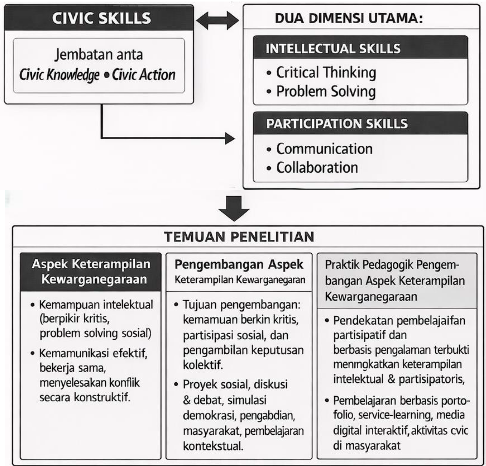
Praktik pedagogik pendidikan kewarganegaraan selama ini belum mengembangkan aspek keterampilan. Penelitian ini menganalisis hasil-hasil penelitian yang membahas praktik pedagogik dalam pengembangan aspek keterampilan kewarganegaraan. Metode yang digunakan adalah Systematic Literature Review melalui pendekatan content analysis dan thematic synthesis. Hasil temuan: (1) Aspek kewargaan yang meliputi intellectual skills, participation skill, critical thinking skills, communication skills, cooperation skills, conflict resolution skills; (2) Pengembangan pembelajaran melalui proyek kewargaan, diskusi, debat, simulasi, studi kasus, kegaiatn kemanusiaan dan kegiatan lingkungan; (3) Kajian praktik pedagogik pengembangan aspek keterampilan kewarganegaraan menunjukkan bahwa pendekatan pembelajaran berbasis pengalaman, seperti service-learning, pembelajaran berbasis isu publik, proyek kewarganegaraan, dan aksi sosial, secara konsisten memberikan dampak positif terhadap peningkatan keterampilan komunikasi, kolaborasi, berpikir kritis, kepemimpinan, efikasi diri, serta tanggung jawab sosial. Hal in menjadi kebutuhan strategis dalam pengembangan pendidikan kewarganegaraan menghadapi kompleksitas persoalan sosial, politik, digital, dan ekologis pada tingkat lokal, nasional, maupun global sesuai dengan kecakapan Abad 21.
References
Adha, M. M., Yanzi, H., & Nurmalisa, Y. (2018). The Improvement of Student Intelectual and Participatory Skill Through Project Citizen Model in Civic Education Classroom. INTERNATIONAL JOURNAL PEDAGOGY OF SOCIAL STUDIES, 3(1), 39–49.
Amadeo, J.-A., Torney-Purta, J., Lehmann, R., Husfeldt, V., & Nikolova, R. (2002). Civic knowledge and engagement. An IEA Study of Upper Secondary Students in Sixteen Countries. Amsterdam: IEA.
Ashtari, D., & de Lange, M. (2019). Playful civic skills: A transdisciplinary approach to analyse participatory civic games. Cities, 89(June), 70–79. https://doi.org/10.1016/j.cities.2019.01.022
Ata, A. (2016). Fostering Students’ Civic Skills: Teachers’ Perspectives About School And External Level Factors [Dissertation]. Dean of the Graduate School, University of Georgia.
Branson, M. S. (1998). The Role of Civic Education: Center for Civic Education. Available.
Branson, M. S. (2001). Making the Case for Civic Education: Educating Young People for Responsible Citizenship. ERIC Processing and Reference Facility: Lanham, Maryland.
Brunell, L. A. (2013). Building global citizenship: Engaging global issues, practicing civic skills. Journal of Political Science Education, 9(1), 16–33. https://doi.org/10.1080/15512169.2013.747833
Center for Civic Education. (1994). National standards for civics and government. Center for Civic Education.
Comber, M. K. (2005). Civic Skills and Civic Education: An Empirical Assessment [Dissertation, Faculty of the Graduate School of the University of Maryland]. https://api.drum.lib.umd.edu/server/api/core/bitstreams/2e0d6f7d-21f7-43dd-a572-a3a246007dec/content
Deutsch, M., Coleman, P. T., & Marcus, E. C. (2011). The handbook of conflict resolution: Theory and practice. John Wiley & Sons.
Dharma, S. (2020). Model Pembelajaran Pendidikan Kewarganegaraan Global Berbasis Multikultural (Studi Pengembangan Untuk Meningkatkan Kompetensi Kewarganegaraan Global Pada Mahasiswa di Perguruan Tinggi di Kota Medan) [Disertasi, Universitas Pendidikan Indonesia]. https://repository.upi.edu/53328/?utm_source=chatgpt.com
Dobozy, E. (2007). Effective learning of civic skills: Democratic schools succeed in nurturing the critical capacities of students. Educational Studies, 33(2), 115–128. https://doi.org/10.1080/03055690601068279
Eko Digdoyo, E. (2021). Peranan Community Civic dalam Membangun Kesadaran Ekologi Kewarganegaraan (Studi Kasus Peran Ruang Publik Terpadu Rumah Anak (Rptra) di DKI Jakarta) [Disertasi, Universitas Pendidikan Indonesia]. http://perpustakaan.upi.edu
Ennis, R. (2011). Critical thinking: Reflection and perspective Part II. Inquiry: Critical Thinking across the Disciplines, 26(2), 5–19.
Ennis, R. H. (2011). The nature of critical thinking: An outline of critical thinking dispositions and abilities. University of Illinois, 2(4), 1–8.
Galston, W. A. (2001). Political knowledge, political engagement, and civic education. Annual Review of Political Science, 4(1), 217–234. https://doi.org/10.1146/annurev.polisci.4.1.217
Gates, R. G. (2012). The Impact of Service-Learning on College Students’ Civic Development and Sense of Self-Efficacy [Dissertation]. Department of Psychology College of Science and Health DePaul University.
Hoskins, B., & Crick, R. D. (2010). Competences for Learning to Learn and Active Citizenship: Different currencies or two sides of the same coin? European Journal of Education, 45(1), 121–137.
Johnson, D. W., & Johnson, R. T. (1987). Learning together and alone: Cooperative, competitive, and individualistic learning. Prentice-Hall, Inc.
Johnson, D. W., & Johnson, R. T. (2006). Peace education for consensual peace: The essential role of conflict resolution. Journal of Peace Education, 3(2), 147–174. https://doi.org/10.1080/17400200600874792
Kerr, D. (1999a). Citizenship education: An international comparison. Qualifications and Curriculum Authority London.
Kerr, D. (1999b). Citizenship education in the curriculum: An international review. School Field, 10(3/4), 5–32.
Kerr, D. (2003). Citizenship: Local, national and international. In Learning to teach citizenship in the secondary school (pp. 21–43). Routledge.
Kerr, D. (2011). Comparative and international perspectives on citizenship education. In Debates in citizenship education (pp. 29–43). Routledge.
Kirlin, M. (2005). Understanding the Relationship between Civic Skills and Civic Participation: Educating Future Public Managers. Journal of Public Affairs Education, 11(4), 305–314. https://doi.org/10.1080/15236803.2005.12001404
Kirschenbaum, H. (1995). 100 Ways To Enhance Values and Morality in Schools and Youth Settings. ERIC.
Kolb, D. A. (2014). Experiential learning: Experience as the source of learning and development. FT press.
Komalasari, K. (2012). The effect of contextual learning in civic education on students’ civic skills. Educare, 4(2), 179–190. https://doi.org/10.2121/edu-ijes.v4i2.255.g254
Liu, C.-Y. A. (2025). Empowering communities through service-learning: A model for nonprofit volunteerism and civic responsibility. Social Responsibility Journal, 21(8), 1–17. https://doi.org/10.1108/SRJ-03-2025-0198
Lundberg, E. (2024). Can Participation in Mock Elections Boost Civic Competence among Students? Journal of Political Science Education, 20(2), 274–291. https://doi.org/10.1080/15512169.2023.2300425
Maravé-Vivas, M., Gil-Gómez, J., García, O. M., & Capella-Peris, C. (2022). Service-Learning and Physical Education in Preservice Teacher Training: Toward the Development of Civic Skills and Attitudes. Journal of Teaching in Physical Education, 42(4), 631–639. https://doi.org/10.1123/jtpe.2022-0094
McCrillis, R. R. (2013). Civic responsibility development in African-American and Latino students: A mixed methods study to understand the effects of service [Dissertation, University of Nebraska]. https://digitalcommons.unl.edu/dissertations/AAI3590322
Moely, B. E., & Ilustre, V. (2013). Stability and Change in the Development of College Students’ Civic Attitudes, Knowledge, and Skills. Michigan Journal of Community Service Learning, 19(2), 21–35.
Muhamad Saleh, -. (2023). Pengembangan Model Pembelajaran Pendidikan Kewarganegaraan Berbasis Kecakapan Abad -21 Untuk Mewujudkan Civic Engagement Mahasiswa [Disertasi, Universitas Pendidikan Indonesia]. http://repository.upi.edu
Murdiono, M. (2007). Peningkatan keterampilan kewarganegaraan (civic skills) melalui penerapan pembelajaran kewarganegaraan berbasis portofolio. Humanika: Kajian Ilmiah Mata Kuliah Umum, 7(1), 1–20. https://doi.org/10.21831/hum.v7i1.21016
Nicotera, N., Brewer, S., & DesMarais, E. (2013). Developing the Civic Skills of Public School Youth: A Mixed Methods Assessment. International Journal of Research on Service-Learning and Community Engagement, 1(1), 61–79.
Niemi, R. G., & Junn, J. (2005). Civic education: What makes students learn. Yale University Press.
Patterson, K. (2019). Civic Identity, Civic Skills, and Civic Knowledge: The Role of Adolescent School Experiences in Facilitating Civic Engagement in Adulthood [Disertasi]. University of North Carolina at Chapel Hill Graduate School.
Perangin-angin, R. B. B. (2017). Pengembangan Pembelajaran PPKn Berbasis Kearifan Lokal dalam Meningkatkan Kompetensi Civic Skill Mahasiswa Jurusan PPKn UNIMED. JUPIIS: JURNAL PENDIDIKAN ILMU-ILMU SOSIAL, 9(2), 151. https://doi.org/10.24114/jupiis.v9i2.8243
Puspitasari, R. (2024). Membangun Karakter Peduli Lingkungan Berbasis Teknologi: Penggunaan Aplikasi Diary Android Dalam Pembelajaran Civic Intelligence Untuk Siswa Sekolah Dasar [Disertasi, Universitas Pendidikan Indonesia]. https://repository.upi.edu
Rondli, W. S. (2021). Gusjigang Sebagai Pengembangan Entrepreneurship: Perspektif Pendidikan Kewarganegaraan [Disertasi]. Universitas Pendidikan Indonesia.
Schulz, W., Ainley, J., Fraillon, J., Kerr, D., & Losito, B. (2010). ICCS 2009 International Report: Civic knowledge, attitudes, and engagement among lower-secondary school students in 38 countries. ERIC.
Suryanto, -. (2011). Pembelajaran PKn Berlatar Isu-Isu Kontroversial Kebijakan Publik Untuk Meningkatkan Kompetensi Kewarganegaraan (Studi Pada Siswa SMA di Kediri) [Disertasi, Universitas Pendidikan Indonesia]. http://repository.upi.edu
Suyato, Hidayah, Y., Septiningrum, L., & Arpannudin, I. (2024). Application of the Collaborative Learning Model to Improve 21st-Century Civic Skills. Journal of Education and E-Learning Research, 11(3), 456–463. https://doi.org/10.20448/jeelr.v11i3.5753
Torney-Purta, J., Lehmann, R., Oswald, H., & Schulz, W. (2001). Citizenship and education in twenty-eight countries: Civic knowledge and engagement at age fourteen. ERIC.
Westheimer, J., & Kahne, J. (2004). What kind of citizen? The politics of educating for democracy. American Educational Research Journal, 41(2), 237–269. https://doi.org/10.3102/0002831204100223
Downloads
Published
Issue
Section
License
Copyright (c) 2026 Danang Prasetyo, Mukhamad Murdiono

This work is licensed under a Creative Commons Attribution-ShareAlike 4.0 International License.