Interpreting the principles of Pancasila through the lens of deontological ethics philosophy and its implications for moral education in Indonesia
DOI:
https://doi.org/10.12928/citizenship.v9i1.1913Keywords:
Pancasila Values , Deontological Ethics , Philosophy Moral EducationAbstract
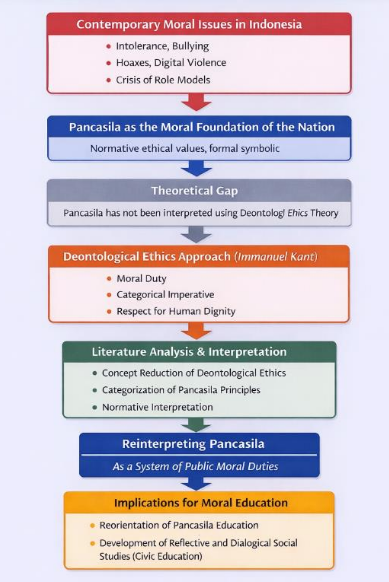
The understanding of Pancasila is often still normative and narrow, or does not function as a practical guide in moral decision-making, especially when society is faced with contemporary ethical issues. Therefore, an approach is needed that can bridge the gap between Pancasila as a normative moral foundation and concrete moral practices in everyday life. This study uses a literature review with an interpretive qualitative analysis approach to sources of Pancasila, moral philosophy, and moral education. The results of the discussion show that there is normative coherence between the principles of deontological ethics and the values of Pancasila. These findings confirm that Pancasila can be understood as a system of collective moral obligations rather than merely symbolic. The implications of this study emphasize the need to reorient Pancasila moral education towards the formation of a rational and reflective moral obligation consciousness.
References
Aini, N. Q., & Dewi, D. A. (2022). Sistem Etika Pancasila dalam Kehidupan Berbangsa dan Bernegara. Jurnal Pendidikan Tambusai, 6(2), 11120-11125.
Barman, S. (2025). Kant on the universality of moral principles: An analysis. Asian Journal of Philosophy and Religion, 3(1), 45–58. Doi: https://doi.org/10.55927/ajpr.v4i1.13855
Basuki, S. K. (2025). Relevansi semboyan bhinneka tunggal ika dalam sejarah perumusan Pancasila. Maliki Interdisciplinary Journal, 3(11), 386-394.
Blanco, M., & Altieri, L. (2025). Deliberative democracy in Habermas. Sociology an Social Work Review, 9(1), 154-169. Doi: https://doi.org/10.58179/SSWR9111
Creswell, J. W., & Poth, C. N. (2018). Qualitative inquiry and research design: Choosing among five approaches (4th ed.). Sage.
Darmawan, R. D., & Rihmi, S. R. (2025). Hak asasi manusia dalam konteks pancasila. Jurnal Multidisiplin Ilmu Akademik, 2(6), 336-344. Doi: https://doi.org/10.61722/jmia.v2i6.7013
Dendodi, D., Radiana, U., & Simarona, N. (2023). Hubungan filsafat dan agama menurut pandangan immanuel kant di era modern. Reflektika, 18(2), 266-281.
Dolmans, D. H. J. M., Loyens, S. M. M., Marcq, H., & Gijbels, D. (2016). Deep and surface learning in problem-based learning: A review of the literature. Advances in Health Sciences Education, 21, 1087–1112. https://doi.org/10.1007/s10459-015-9645-6
Habermas, J. (2015). The Lure of Technocracy. Polity Press.
Hajarmaryam, S., Srinarwati, D. R., Pramesti, C. (2025). Implementasi Nilai Sila Pancasila “Kerakyatan yang Dipimpin oleh Hikmat Kebijaksanaan dalam Permusyawaratan/Perwakilan” dalam Kegiatan Kepramukaan di SMK Islam Anharul Ulum Kecamatan Kademangan. Bhinneka: Jurnal Bintang Pendidikan dan Bahasa, 3(3), 18-29. Doi: https://doi.org/10.59024/bhinneka.v3i3.1453
Hill, T. E. (2020). Respect, pluralism, and justice: Kantian perspectives. Oxford University Press.
Iriany, I. S., & Paciana, R. (2019). The improvement of high education quality in Indonesia through the character education. Journal Of Educational Experts (JEE), 2(1), 15-26. Doi: https://doi.org/10.30740/jee.v2i1p15-26
Johnson, R., & Cureton, A. (2022). Kant’s Moral Philosophy. Stanford Encyclopedia of Philosophy.
Kaelan. (2013). Negara kebangsaan Pancasila: Kultural, historis, filosofis, yuridis, dan aktualisasinya. Paradigma.
Kant, I. (1997). Groundwork of the metaphysics of morals (M. Gregor, Trans.). Cambridge University Press.
Kemendikbud. (2021). Projek Penguatan Profil Pelajar Pancasila. Badan Penelitian dan Pengembangan dan Perbukuan.
Korsgaard, C. M. (2012). Creating the kingdom of ends. Cambridge University Press.
Kriswinarti, A., Christiani, Y. H., Aunurrahman., & Halida (2025). Memudarnya Moral Dan Etika Remaja Indonesia. Jurnal Dunia Pendidikan, 6(2), 420-438. Doi: https://doi.org/10.55081/jurdip.v6i2.2425
Landau, R. S. (2015). The ethical life: fundamental readings in ethics and moral problems 3rd Edition. Oxford University Press.
Manuela, N., & Tarigan, J. R. (2025). Pemahaman dan Penerapan Nilai-Nilai Pancasila oleh Siswa SMA dalam Kehidupan Sehari-hari. Jurnal Kewarganegaraan, 9(1), 1-4. https://doi.org/10.31316/jk.v9i1.7729
Maswati, M. (2024). Values of Pancasila Ideology as a Multicultural Adhesive in Indonesia. International Journal of Islamic Educational Research, 1(4), 70-89. Doi: https://doi.org/10.61132/ijier.v1i4.144
Meyer, K. (2023). Moral education through the fostering of reasoning skills. Ethical Theory and Moral Practice, 27, 41-55. https://doi.org/10.1007/s10677-023-10367-3
Misselbrook D. (2013). Duty, Kant, and deontology. The British journal of general practice: the journal of the Royal College of General Practitioners, 63(609), 211. https://doi.org/10.3399/bjgp13X665422
Nabila, A. A., Yusuf, M. F., Rafi, M., Rahmawan, W. F., & Antoni, H. (2024). Pendidikan Karakter Berbasis Pancasila: Peran Sila Pertama dalam Pembentukan Karakter Siswa di Sekolah. Jurnal Kajian dan Penelitian Umum, 2(6), 236-246. Doi: https://doi.org/10.47861/jkpu-nalanda.v2i6.1470
Notonagoro. (1983). Pancasila: Dasar falsafah negara. Bina Aksara.
Nucci, L. (2016). Recovering the role of reasoning in moral education to addres inequity and social justice. Journal of Moral Education,45(3), 291-307. Doi: http://dx.doi.org/10.1080/03057240.2016.1167027
Praditya, F. P. (2017). The Role of Pancasila as the Legal Basis in Indonesia. Jurnal Scientia Indonesia, 3(2), 105-120. Doi: https://doi.org/10.15294/jsi.v3i2.36018
Priwardani, A. N., Monica, A. A. D., & Yaasiin, M. N. F. (2020). Pancasila sebagai sistem Etika. Indigenous Knowledge, 2(3), 226-232.
Rahmadifa, A. F., Yuliana, D., Sarah, A., Ananda, A. D., Sahrani, S., & Wulandari. (2025). Pancasila sebagai kunci menjaga keberagaman dalam persatuan Indonesia. Antropocene: Jurnal Penelitian Ilmu Humaniora, 5(1), 7-11. Doi: https://doi.org/10.56393/antropocene.v5i1.2788
Ray, G., McDermott, C, D., Nicho, M. 2024. Cyberbullying on social media: definitions, prevalence, and impact challenges. Journal of Cybersecurity, 10(1), 1-18. Doi: https://doi.org/10.1093/cybsec/tyae026
Shahramnia, A. M. (2011). Explanation of deliberative democracy in philosophical thoughts of Jurgen Habermas. African Journal of Political Science and International Relations, 5(5), 254-261.
Siburian, P. R. (2024). Prinsip kesatuan pancasila dalam membentuk masyarakat yang harmonis. Jurnal Penelitian Pendidikan Indonesia (JPPI), 1(4), 42-46. Doi: https://doi.org/10.62017/jppi.v1i4.1363
Snyder, H. (2019). Literature review as a research methodology: An overview and guidelines. Journal of Business Research, 104, 333–339. Doi: https://doi.org/10.1016/j.jbusres.2019.07.039
Soleha, S., & Nurmayanti, P. (2025). Dimensi Filosofis Ketuhanan dalam Sila Pertama Pancasila: Analisis Teoretis atas Tafsir Al-Maraghi. Al-Qolam: Jurnal Ilmu Al-Quran dan Tafsir, 2(1), 60-72.
Wardani, A. P. P., & Parida, R. (2025). Implementing the Value of Indonesian Unity in Preventing Social Conflict in the Digital Era. CIVICS: Jurnal Pendidikan Pancasila dan Kewarganegaraan, 10(2), 886-891. Doi: https://doi.org/10.36805/civics.v10i02.11300
Winarno. (2019). Paradigma baru pendidikan kewarganegaraan: pandangan kuliah di perguruan tinggi. Jakarta: Bumi Aksara.
Wood, A. W. (2008). Kanthian ethics. Cambridge University Press
Downloads
Published
Issue
Section
License
Copyright (c) 2026 Nanda Maharani Sukma, Muhammad Akbar Hajuan

This work is licensed under a Creative Commons Attribution-ShareAlike 4.0 International License.